
A B2B founder opens analytics on a Monday morning. Rankings look steady, impressions are fine, but clicks are sliding week after week. The sales pipeline isn’t empty—yet inquiries feel different: shorter messages, fewer “I found you on Google,” and more “an AI tool recommended you.”
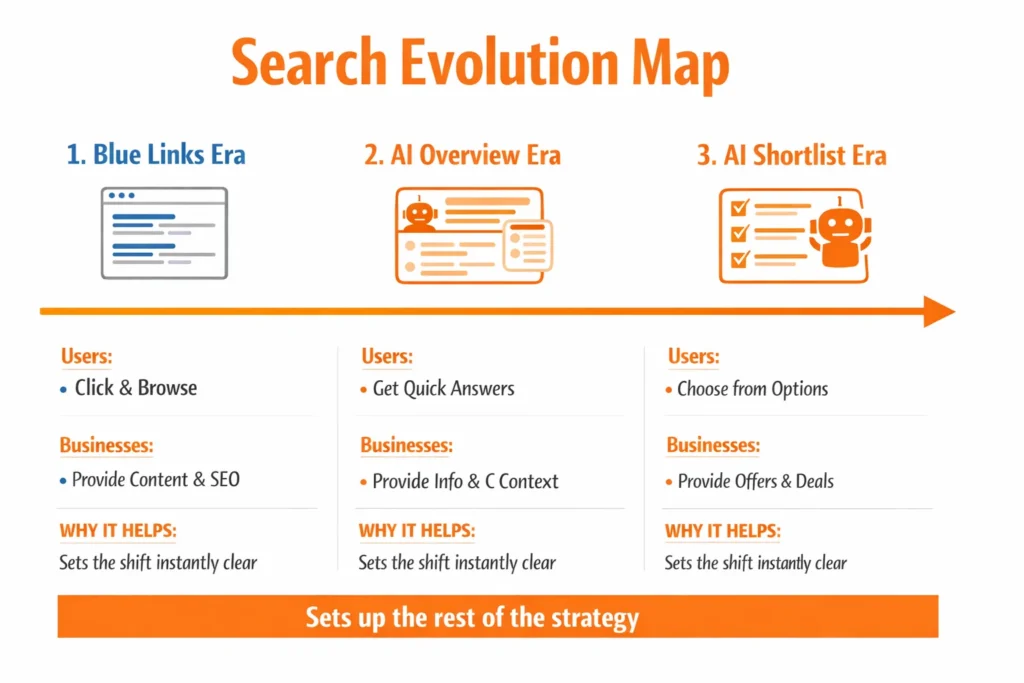
That’s the real change. Search is shifting from lists of links to direct answers and shortlists. Traditional SEO isn’t “dead” because search engines disappeared; it’s fading because many old tactics assumed clicks were the main reward. In the AI search era, visibility is earned through clarity, credibility, and usefulness—so systems can understand your value and people can trust it fast.
Why this shift feels sudden
The click is no longer guaranteed
When an AI summary satisfies the intent, users may not visit any website. Your goal becomes being the referenced source and the obvious next step.
Topic context / What changed
AI-powered search experiences increasingly summarize, compare, and recommend information without always sending users to websites. Even when classic search results appear, many users read an AI overview first, then decide if they need to click. This changes the role of SEO: your content must be easy to interpret, easy to summarize, and strong enough to earn trust without a long browsing session.
From keyword matching to meaning matching
Systems interpret intent, entities, and relationships
Modern search connects concepts such as brands, services, industries, locations, and outcomes. Clear definitions and consistent terminology matter more than repeating the same keyword in multiple places.
From one query to micro-journeys
Users ask follow-ups and refine constraints faster
People don’t stop after one search. They continue with questions like “best for my budget,” “for my industry,” “pros and cons,” and “how to choose.” Your pages must support fast comparison and decision-making.
Why it matters to businesses
If your growth relies on informational traffic, AI summaries can reduce top-of-funnel clicks. But the bigger issue is trust: fewer visits can mean fewer chances to educate, handle objections, and show why you’re different. When the journey becomes shorter, your brand needs to communicate value quickly and prove it clearly—otherwise you become interchangeable.
Visibility shifts from “page 1” to “being referenced”
Your content must be quotable and reliable
AI systems prefer content that is structured, specific, and consistent. Humans prefer content that reduces risk. Both reward clarity, evidence, and relevance over volume.
Demand capture becomes more competitive
Service pages must do more work per visit
With fewer clicks available, each visit matters more. If your service pages are vague, slow, or confusing, users will bounce and rely on another shortlist.
Brand recall becomes a growth lever
People remember clear positioning, not generic claims
When users don’t browse ten tabs, they tend to remember the one brand that explained the problem clearly and offered a practical next step without exaggeration.
Common mistakes / what not to do
Many brands react to AI search by scaling the same old tactics: more posts, more keyword variants, more “SEO content.” That often creates noise instead of advantage. In an AI-first journey, repetitive or vague pages are easier to summarize and ignore.
Scaling thin keyword pages
More pages can dilute authority
Near-duplicate posts split internal links, confuse topical focus, and become hard to maintain. They rarely add unique value worth referencing, and they can weaken your strongest pages.
Writing for algorithms instead of decisions
If it doesn’t help someone choose, it won’t win
Content that only defines basics is easy for AI to answer. What wins is decision support: trade-offs, constraints, steps, and clear “who this is for” guidance.
Ignoring credibility and proof
Trust signals are now non-negotiable
Statements like “best,” “top,” and “guaranteed” don’t help. Better signals include transparent process, realistic ranges, examples, policies, and clear ownership (who wrote it and why they’re qualified).
Treating SEO as separate from UX
Bad experience kills the value of visibility
If your page loads slowly, looks messy on mobile, or hides the next step, you waste limited attention. In the AI era, you may not get a second chance.
New approach / replacement strategy
What replaces traditional SEO is Search Experience Optimization: earning visibility by being the clearest answer, then converting by being the easiest next step. The goal is not to “beat the algorithm.” The goal is to help users reach a decision with less effort and less risk.
Replace “keywords-first” with “intent-first”
Map pages to jobs: learn → compare → choose → implement
Instead of chasing every keyword variation, build pages that match real decision points: explanations for learning, comparison pages for evaluation, and strong service pages for action.
Replace “rankings” with “visibility + outcomes”
Measure business impact, not just positions
Rankings can stay stable while clicks decline. Track qualified leads, assisted conversions, engagement on key pages, and branded search growth to understand real performance.
Replace “content volume” with “content utility”
Depth beats breadth when clicks are scarce
A smaller library of complete pages can outperform a large blog of thin posts because it earns trust, mentions, links, and repeat visits.
Framework
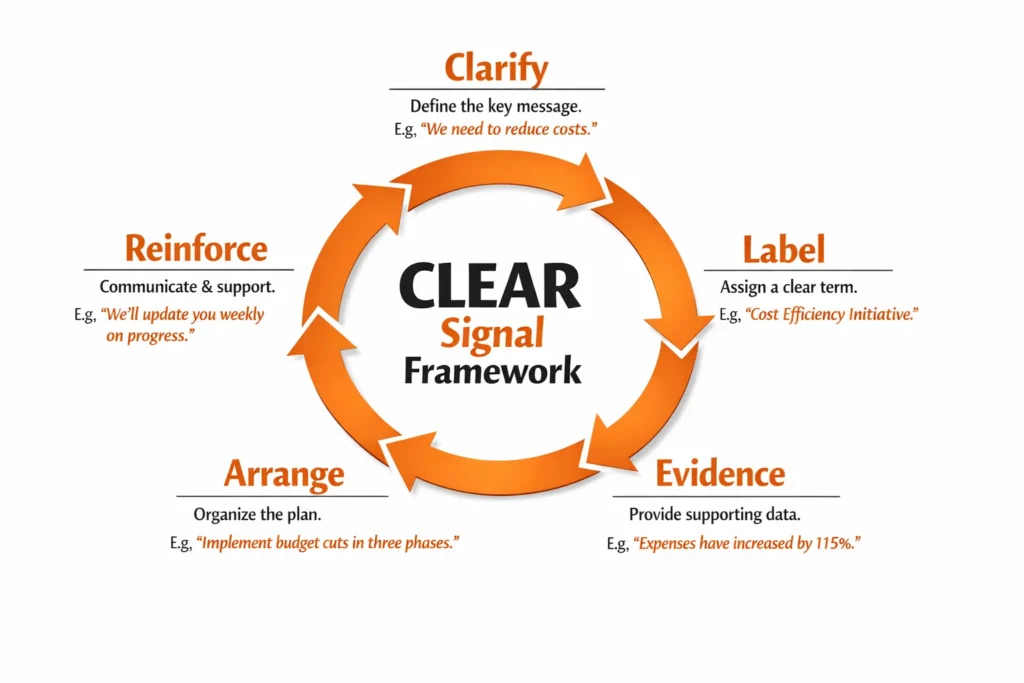
Use The CLEAR Signal Framework (5 steps) to rebuild SEO for AI search. It’s designed to make your content easy to interpret, easy to summarize, and strong enough to convert when users land on your site later in the journey.
Framework overview
Step 1 — Clarify the audience and job-to-be-done
Define who the page is for, what problem they’re solving, and what “success” looks like. Write for that situation, not for a broad keyword.
Step 2 — Label the entities and terminology
Make your service, industry, location (if relevant), and outcomes explicit. Use consistent phrasing across your site so both systems and humans follow your meaning.
Step 3 — Evidence the claims
Add proof: process steps, realistic ranges, constraints, examples, and what “good” looks like. Remove statements you can’t support or explain.
Step 4 — Arrange content for extraction and scanning
Use clean headings, short paragraphs, definitions, checklists, and comparison-friendly sections. If a section is hard to summarize, simplify it.
Step 5 — Reinforce with experience
Improve speed, mobile readability, internal linking, and CTAs. Strong content still needs a smooth path from interest to action.
Action playbook
Use this playbook to shift from old SEO to AI-era visibility in 2–6 weeks, without chasing volume. The focus is simple: tighten intent, add proof, improve structure, and make next steps obvious.
Quick wins
Changes you can ship this week
- Rewrite your top pages to state who it’s for, what problem it solves, and what the next step is.
- Add a short “Key takeaways” block near the top so users can scan and AI systems can summarize accurately.
- Replace vague claims with practical specifics (scope, timelines, constraints, and realistic ranges).
- Strengthen internal linking from high-traffic blogs to core service pages using descriptive anchors (not “click here”).
- Create one buyer-focused comparison page (service vs service vs in-house) that answers real objections.
Longer-term wins
Changes that compound over time
- Build a tight topic cluster around one revenue-driving service (a few deep pages, not dozens of thin posts).
- Add credibility signals site-wide (clear team info, process, reviews, policies, and contact details).
- Refresh priority pages quarterly with updated examples, clearer differentiation, and expanded FAQs.
- Improve conversion basics: simplify forms, reduce friction, and make CTAs match the user stage.
Mini case study (hypothetical but realistic)
A B2B service business sees a 20–30% drop in blog traffic over 90 days. Inquiries remain steady, but lead quality becomes inconsistent. They decide to rebuild around intent, proof, and a clearer path to action.
Baseline
Starting point metrics and issues
They ranked on many informational topics, but users often stopped at AI summaries. Service pages were generic, and internal links from blogs didn’t guide visitors toward decisions.
Actions taken
What changed in 30 days
They rewrote a small set of priority pages using the CLEAR framework, added one comparison page and one “how we work” page, and improved structure with clearer headings, takeaways, and short FAQs. They also simplified forms, improved page speed, and strengthened internal links from high-traffic posts to service pages.
Outcome (use ranges)
Realistic ranges over 60–90 days
Blog clicks stabilized rather than fully recovering (about -5% to +10%). Service page engagement improved by roughly +15% to +35%. Lead quality improved by about +10% to +25%, with fewer low-fit inquiries. Conversion rate on service pages increased by around +0.3 to +0.8 percentage points.
Quick checklist
Use this before publishing or updating any page
A fast quality gate
- Clear audience and problem stated in the first 120 words
- One primary intent per page (learn, compare, buy, or support)
- Definitions included for key terms and services
- Proof added: ranges, examples, process, or constraints
- Headings structured for scanning and easy summarization
- Internal links connect to next-step pages logically
- Page loads fast and reads well on mobile
- CTA matches the user stage (not too early, not too late)
- Language avoids exaggerated claims and vague promises
- Ownership and update plan are clear (who updates and when)
Conclusion
Traditional SEO isn’t disappearing; it’s changing jobs. In the AI search era, you win by being the clearest, most credible source—and by making the next step easy when a user is ready to act. Replace content volume with real utility, keywords with intent, and vague claims with evidence. Focus on pages that help users decide, not just pages that “rank.” If you want a practical direction, MOXSEO can review your priority pages, identify intent gaps, and help you build a lean content system designed for AI visibility and better-quality leads.
FAQs :-
Is traditional SEO really dead?
Not fully. Rankings still matter, but clicks are less predictable. SEO now includes being referenced in AI answers and converting users who arrive later in the journey.
What should I track if organic clicks drop?
Track qualified leads, assisted conversions, branded search trends, and engagement on service pages. These show whether visibility is still producing business outcomes.
Do keywords still matter in AI search?
Yes, but as context rather than a checklist. Focus on intent and clear explanations. Use keywords naturally where they help users understand options and choose.
How do I make content easier for AI to use?
Use clean headings, short sections, definitions, and specific statements. Add proof and constraints so summaries stay accurate and users still trust what they read.
Will AI summaries eliminate website traffic?
No. Comparisons, tools, and high-intent queries still drive clicks. The mix changes, so prioritize pages that support decisions and next steps.
What content formats perform best in the new era?
Comparison pages, decision guides, “how it works” explainers, pricing factors, and implementation checklists. These formats help users choose and reduce uncertainty.
Should I publish more blogs to compete?
Only if they add unique value. Consolidate overlapping posts, then upgrade fewer pages with depth, proof, and better structure instead of scaling thin content.
Does technical SEO still matter?
Yes. Speed, crawlability, internal linking, and mobile usability affect both visibility and conversions. Technical problems can block strong content from performing well.
How important is trust in AI search?
Very important. Clear authorship, evidence, consistent messaging, and transparent limitations help AI systems interpret you and help humans feel confident taking action.
What is the fastest first step for a small business?
Pick one core service and rebuild key pages around intent, proof, and a clear CTA. Add one comparison page and strengthen internal links to capture demand.