Post types, taxonomies, fields, relationships, and editorial permissions designed around actual publishing needs.

WORDPRESS DEVELOPMENT
WordPress development focused on editorial clarity, reusable components, performance, security, accessibility, and dependable ownership after launch.
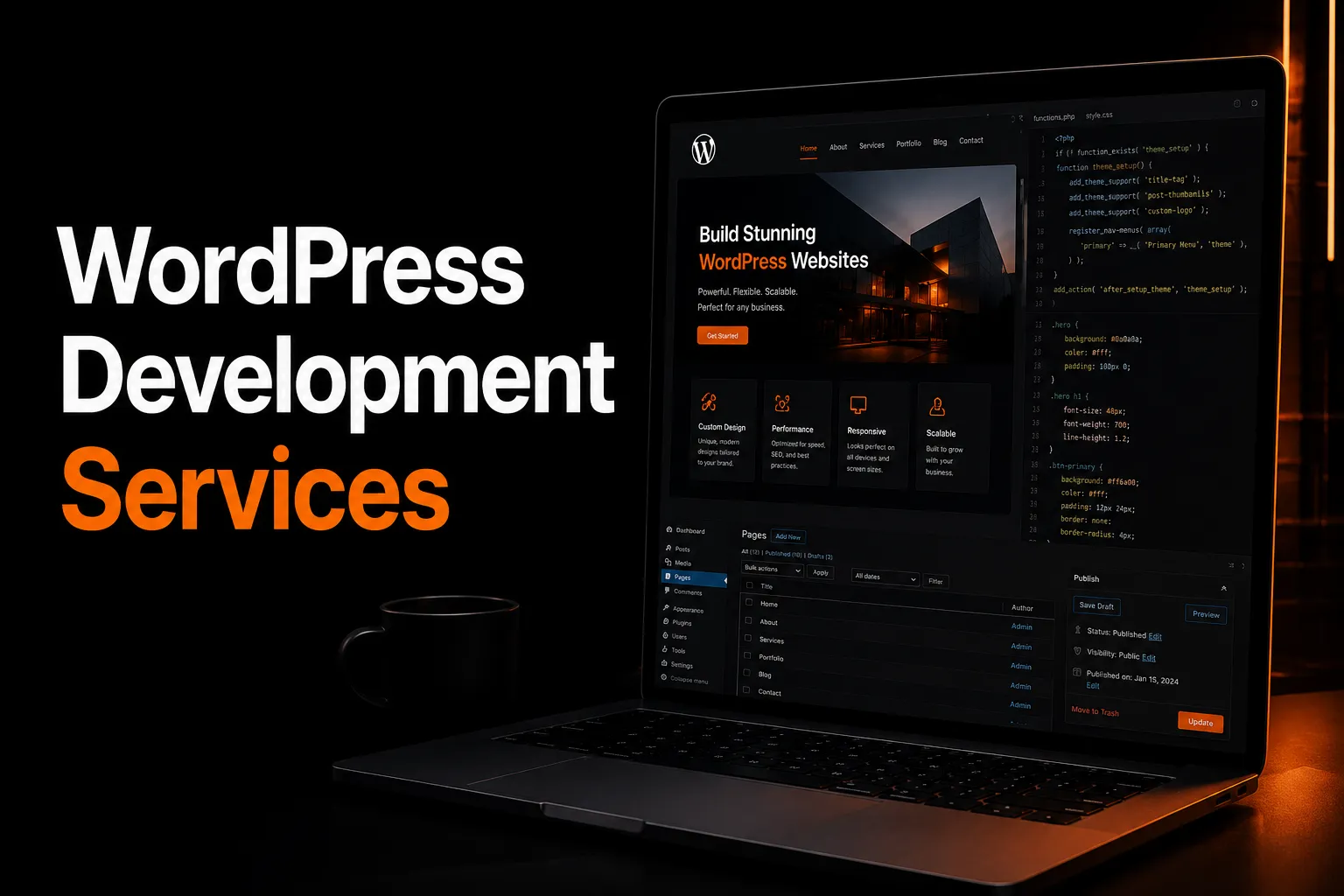
WordPress becomes difficult when pages rely on one-off builder settings, plugins overlap, and content has no reusable model. We give editors the right controls while protecting design, performance, and semantic quality at template level.
Content owners define what must change; designers and developers define safe components and fields. Release, plugin, backup, security, and support responsibilities are documented before the site becomes business-critical.
Post types, taxonomies, fields, relationships, and editorial permissions designed around actual publishing needs.
Reusable blocks and templates built with semantic markup, responsive behavior, and controlled design options.
Clear field labels, previews, patterns, validation, and documentation that reduce accidental page breakage.
Dependencies selected for clear ownership, update health, compatibility, security, and performance.
Rendering, media, fonts, caching, schema, metadata, sitemaps, and redirects handled at system level.
Environments, backups, monitoring, updates, testing, access, and incident procedures prepared for operation.
The content model, editor controls, theme system, plugins, and release process determine whether WordPress remains flexible or becomes fragile after launch.
Content types, fields, relationships, taxonomies, roles, and reusable patterns reflect editorial work.
Templates, blocks, tokens, responsive behavior, semantics, and accessibility constrain presentation safely.
Plugins, integrations, media, search, metadata, caching, security, and analytics support the website.
Training, preview, validation, releases, updates, monitoring, and support keep the system healthy.
Review page types, editorial roles, integrations, plugins, hosting, migrations, and quality requirements.
Define fields, blocks, templates, navigation, states, permissions, and design constraints.
Develop the theme, integrate systems, move content, and validate output across representative pages.
Test production, train editors, document maintenance, and establish monitoring and support.
We test authoring tasks, template output, responsive behavior, accessibility, performance, metadata, security controls, and update paths. A good front end with a confusing editor is not considered complete.
The specification defines what editors can change, what remains protected, and how the front end responds.
Only when their editing value outweighs performance, consistency, and maintenance costs. The decision follows requirements.
Yes. We inventory content and URLs, define transformations, rehearse migration, and validate redirects and rendered output.
We provide reusable patterns and controlled options appropriate to the team, rather than unlimited settings that fragment the system.
Ownership can remain internal or be covered through maintenance. In either case, the update and validation process is documented.
WordPress development is not a single tactic. It connects content modeling, custom themes, block systems, plugin boundaries, performance, and editorial governance. The work is valuable only when editors gain flexibility without turning the site into an unstable collection of plugins. That requires a model of the current system, the evidence behind each priority, and a clear definition of what will change in production.
We structure the engagement so editorial, design, development, hosting, SEO, and security teams can see why each decision exists, what depends on it, who owns the next action, and how it will be validated. The result is a program that can survive handoffs and release cycles instead of a checklist that becomes obsolete after delivery.
We establish the current state of content model and block architecture across content modeling, custom themes, block systems, plugin boundaries, performance, and editorial governance. The review separates visible symptoms from the underlying constraint, then records the evidence, owner, and dependency attached to the correction.
We trace theme and component system from strategic input to customer-facing output. That exposes handoffs where context is lost, rules conflict, or execution depends on undocumented knowledge.
We connect plugin and integration boundaries directly to the requirement that editors gain flexibility without turning the site into an unstable collection of plugins. This keeps the roadmap tied to customer and commercial consequences instead of treating activity as progress.
We define the operating rule for performance and release controls, including acceptance criteria, exceptions, and the team responsible for keeping the improvement intact.
Used to determine whether the primary constraint is coverage, quality, accessibility, workflow, or measurement before work is prioritized.
Compared with the intended customer journey and operating model to locate disconnects between strategy and the experience delivered in production.
Reviewed before assigning effort so priority follows likely business impact, implementation cost, and dependency risk rather than opinion.
Rechecked after implementation to distinguish durable improvement from temporary movement and to decide whether the roadmap should continue, change, or stop.
Defines the current state, material risks, and the order in which corrections should be handled.
Turns the recommended approach into owned work with dependencies, acceptance criteria, and release notes.
Gives internal teams a reusable specification instead of a presentation that expires after the meeting.
Connects implementation dates to observable evidence so results can be interpreted responsibly.
Records exceptions, unresolved questions, and decisions that require leadership or specialist review.
Creates a handoff that editorial, design, development, hosting, SEO, and security teams can maintain without relying on undocumented agency knowledge.
Editor publishing efficiency is reviewed against baselines, implementation dates, and known confounders. It is a decision signal, not an isolated vanity number.
Core Web Vitals health is reviewed against baselines, implementation dates, and known confounders. It is a decision signal, not an isolated vanity number.
Release and security stability is reviewed against baselines, implementation dates, and known confounders. It is a decision signal, not an isolated vanity number.
The sequence below protects WordPress development work from becoming an unowned recommendation. Each phase produces evidence for the next one, and each release carries acceptance criteria, a named owner, and a record of what changed. The pace can vary, but the control points remain consistent.
We inventory the relevant WordPress development surface, capture current performance, confirm access, and document unresolved assumptions. No recommendation becomes a commitment until the evidence and operating constraint are visible.
Evidence becomes a prioritized decision record. Each item includes the intended outcome, affected systems, required owner, effort, dependency risk, and acceptance criteria. Low-confidence ideas remain hypotheses rather than disguised requirements.
Changes are made at the template, workflow, platform, campaign, or governance layer that created the problem. Representative outputs are validated before the pattern is released across a wider operating surface.
Post-release behavior is compared with the baseline, exceptions are recorded, and the next decision is updated. Documentation, monitoring, and ownership move with the work so the improvement can be maintained.
The strongest engagement starts with a material constraint, an accountable owner, and enough access to inspect the real system. We use the signals opposite to determine whether the work should be a focused diagnostic, an implementation program, or a longer operating partnership.
Page builders create inconsistent output. This usually signals a constraint broad enough to justify coordinated work across content modeling, custom themes, block systems, plugin boundaries, performance, and editorial governance.
Editors need developer help for routine publishing. This usually signals a constraint broad enough to justify coordinated work across content modeling, custom themes, block systems, plugin boundaries, performance, and editorial governance.
Plugins overlap or conflict. This usually signals a constraint broad enough to justify coordinated work across content modeling, custom themes, block systems, plugin boundaries, performance, and editorial governance.
Theme changes repeatedly damage performance. This usually signals a constraint broad enough to justify coordinated work across content modeling, custom themes, block systems, plugin boundaries, performance, and editorial governance.
Service decision standard
Use this service when themes, blocks, builders, roles, integrations, migrations, performance, and security must support a sustainable publishing operation.
Indiscriminate plugins, unsupported licenses, copied themes, hidden maintenance costs, and a launch without update ownership are excluded.
A service page should not end at a capability description. Use these connected pages to understand commercial scope, delivery responsibilities, related disciplines, and the evidence available before deciding what the engagement needs.
Review published starting scopes, assumptions, and the variables that shape a responsible proposal.
See diagnosis, prioritization, ownership, implementation, validation, and measurement as one operating path.
Inspect selected constraints, interventions, outcomes, and measurement boundaries before comparing them with your own situation.
Use this capability when the adjacent system or channel is part of the same customer journey.
Use this capability when the adjacent system or channel is part of the same customer journey.
Start with the current baseline, business objective, platform, team ownership, and the change the system must support.
Share the content model, editor needs, and current stack. We will identify the first structural decision to make.