

If you’ve ever published an SEO blog post that was “optimized” but still didn’t rank (or didn’t bring leads), the missing piece is usually authority. Today, it’s not enough to include keywords and write 1,000 words. Search engines and users reward content that proves expertise, answers the full intent, and genuinely helps.
This guide walks you through a practical, repeatable process to write authoritative SEO content that ranks, earns trust, and converts. At MoxSEO, we follow this same framework to build content that doesn’t just attract traffic—it brings the right audience, improves topical authority, and supports real business growth.
What Is Authoritative SEO Content?
Authoritative SEO content is content that fully satisfies search intent and demonstrates credible expertise. It’s the piece readers bookmark, share, and return to—because it answers the question better than anything else on the page.
Authoritative vs “optimized” content
Many posts are optimized for search engines but not built for humans. They:
- repeat the same definitions
- add fluff to increase word count
- avoid taking clear positions
- lack proof, examples, or actionable steps
Authoritative content does the opposite:
- it’s complete, clear, and specific
- it shows real experience and reasoning
- it includes supporting evidence or references where needed
- it makes the reader’s next step obvious
The 4 signals search engines and users look for
Authority usually shows up through these signals:
- Topical depth
The content covers the main topic and the important subtopics people expect. - Credibility
The article is transparent, accurate, and backed with reliable sources or real experience. - Experience
The writing includes practical workflows, real-world examples, or lessons learned—not just theory. - Satisfaction
The content is easy to scan, answers quickly, and leaves fewer follow-up questions.
Choose the Right Topic
Authority doesn’t start when you write. It starts when you choose what to write about.
Pick topics where you can win
Before selecting a topic, check two things:
- Is there real demand? (people actively searching)
- Is the current ranking content weak? (thin posts, generic advice, outdated info)
High-opportunity topics often look like:
- “how to” queries with incomplete answers
- complex topics explained poorly
- new trends where most posts are shallow
Build topical clusters, not random posts
One post can rank. A cluster can dominate.
A smart structure:
- Pillar page: the main “ultimate guide” topic (broad, comprehensive)
- Cluster posts: supporting pages experiences that go deeper into subtopics
Example cluster around “authoritative SEO content”:
- How to do SERP intent research
- How to write SEO briefs that scale
- How to update old content for ranking gains
- E-E-A-T checklist for blog pages
This approach builds topical authority over time and makes internal linking natural.
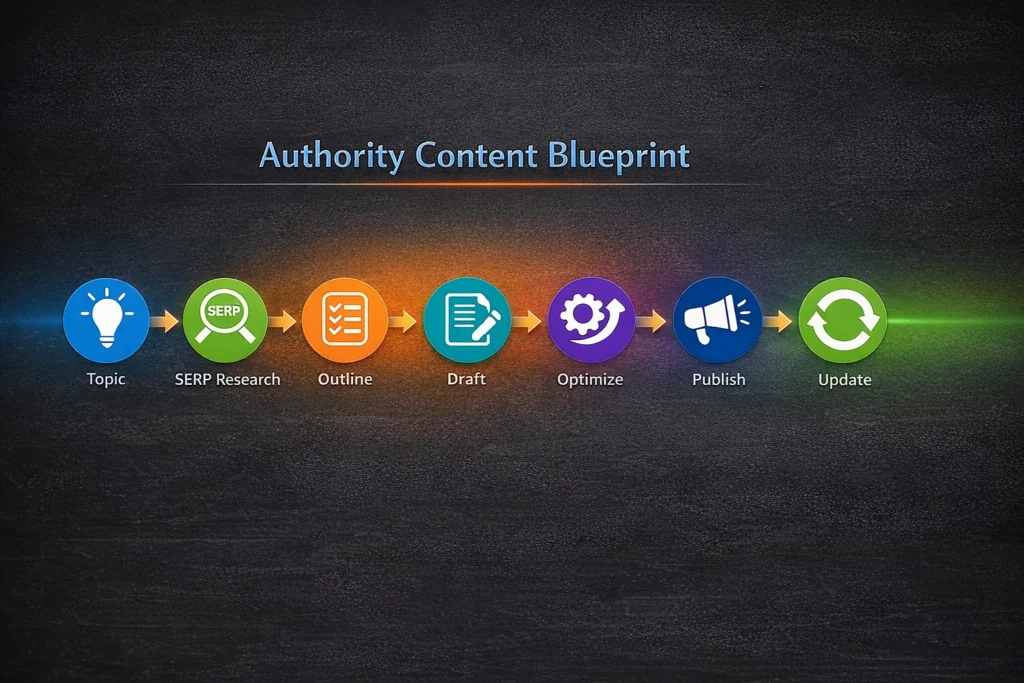
Research Like a Pro (Without Wasting Hours)
Research is where most writers either win or lose. The trick is to research with a system—so you cover what matters without drowning in tabs.
SERP research checklist
When you search your target keyword, analyze the top results and identify patterns:
1) Intent
Ask: what does Google think users want?
- a step-by-step guide?
- a list of tools?
- a definition and examples?
- comparisons or pricing?
2) Repeated subtopics
Note what competitors mention repeatedly. Those are usually “must-cover” sections.
3) Missing value
This is your advantage:
- What’s unclear?
- What’s outdated?
- What’s missing completely?
- Where are examples absent?
4) People Also Ask insights
Collect common questions and turn them into sections or FAQs.
Research sources that increase trust
Authoritative content typically includes at least one of these:
- First-party experience: your process, results, case learnings, screenshots
- Primary sources: official docs, research papers, original studies
- Reliable secondary sources: well-known industry publications
Even when you don’t quote directly, using solid sources improves accuracy and depth.
Build an Outline That Guarantees Coverage
A strong outline prevents fluff and forces completeness.
Use the “question-first” outline method
Instead of writing headings first, list:
- what the reader wants to know
- what they need to do next
- what mistakes they’re trying to avoid
- what decision they’re trying to make
Then turn those into H2/H3 sections.
Suggested structure for authority posts
This format works for most informational SEO topics:
- Definition (what it is)
- Why it matters
- How to do it (process)
- Examples/templates
- Tools
- Mistakes
- Checklist + FAQs
Write With E-E-A-T Signals (Without Sounding Fake)
E-E-A-T (Experience, Expertise, Authoritativeness, Trust) isn’t something you “add” at the end. It’s built through how you explain, structure, and support your claims.
Show expertise naturally
Expert writing feels like:
- clear decision-making (“do X when Y happens”)
- specific steps and frameworks
- concrete examples and templates
- explanations that teach why something works
A simple framework to write like an expert
Use this for key sections:
- What to do
- Why it matters
- How to do it
- Common mistake
- Quick fix
This instantly upgrades the quality without adding fluff.
Add experience-driven sections
Even if you don’t have big case studies, you can add real-world value through:
- “What usually goes wrong”
- “How we approach this in real projects”
- “What to prioritize if you have limited time”
Experience reduces guesswork for the reader—one of the strongest authority signals.
Improve trust elements on-page
These elements help both SEO and conversions:
- Clear author identity (who wrote it and why they’re qualified)
- Update dates (freshness matters in many topics)
- Transparent claims (avoid exaggerated promises)
- Citations when you reference stats, research, or sensitive claims
On-Page SEO That Supports Authority (Not Just Rankings)
On-page SEO should make the content easier to understand—not force keywords into awkward places.
Heading structure that keeps readers moving
A strong heading flow:
- H2 = main steps/chapters
- H3 = sub-steps, criteria, methods
- H4 = micro-actions, tips, examples
Avoid vague headings like “Introduction” or “Conclusion” as primary H2s. Use descriptive headings that signal value.
Keyword usage: natural but strategic
Use your primary keyword in:
- the title (H1)
- the first 100 words (naturally)
- one early H2 (if it fits)
- the conclusion (lightly)
Then support with:
- related terms (semantic keywords)
- common question phrases
- synonyms and natural language variations
The goal is coverage, not repetition.
Internal linking for authority
Internal links do two things:
- help users explore deeper
- help search engines understand your topic cluster
Best practices:
- link to relevant supporting blogs (cluster pages)
- link to service pages only when truly relevant
- use descriptive anchor text
Example (edit as needed for your site):
- If you have a content writing or SEO service page, add one contextual link like:
Format for Readability and Helpful Content Signals
Authority isn’t just what you say—it’s how easy it is to consume.
Make it skimmable
Most readers scan first. Help them:
- short paragraphs (2–4 lines)
- bullet lists and numbered steps
- bold key takeaways (sparingly)
Add “answer blocks”
Under major headings, include 2–3 lines that summarize the section before the details. This improves:
- user satisfaction
- time on page
- featured snippet potential
Use visuals with purpose
Only add visuals that clarify:
- a process
- a checklist
- a comparison
- a framework
Random stock images don’t build authority.
Add Proof: Examples, Data, and Real-World Support
The fastest way to make content feel authoritative is to support it.
What kinds of proof to include
Pick what’s realistic:
- mini examples (“here’s a strong meta description format…”)
- simple templates (brief outline templates, checklists)
- screenshots (SERP intent patterns, analytics trends)
- quotes from official documentation (short and relevant)
If you don’t have data, do this
You can still build credibility by:
- stating assumptions clearly (“this varies by industry”)
- avoiding absolute claims
- using logic + reliable references for best practices
Authority drops fast when content guidance sounds confident but unsupported.
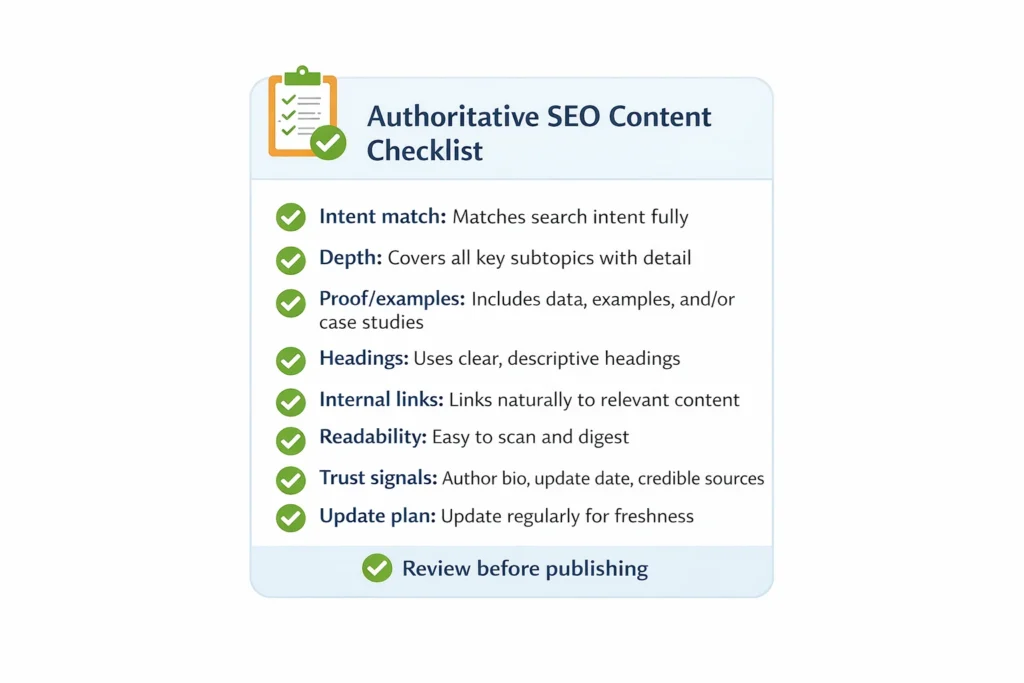
Quality Review Checklist Before Publishing
Before hitting publish, run a tight quality check.
Content quality checks
- Does the post answer the query completely?
- Does it include steps, examples, and takeaways?
- Would a beginner understand it?
- Would an expert respect it?
SEO checks
- Is the title clear and benefit-driven?
- Are headings clean and specific?
- Is the URL short and readable?
- Did you add internal links?
- Are images compressed and labeled with descriptive alt text?
Keep Authority Fresh With Updates
Authority isn’t a one-time achievement. It’s maintained.
How often to update
A simple rule:
- review important posts every 3–6 months
- update earlier if rankings drop or SERP intent shifts
What to update
- outdated recommendations
- statistics and references
- missing subtopics appearing in newer results
- new FAQs from “People Also Ask”
Conclusion
Authoritative SEO content isn’t about writing longer—it’s about writing better. When you choose a winnable topic, research intent properly, outline for full coverage, and add proof + experience, you create content that earns rankings and trust over time.
At MoxSEO, we use this same process to help brands publish content that doesn’t just rank—but also builds trust, attracts qualified leads, and supports long-term growth. If you want a content plan built around topical authority (pillar pages, clusters, internal linking, and a clear publishing roadmap), MoxSEO can help you execute it end-to-end.
FAQs
1. What makes content “authoritative” for SEO?
It fully answers the intent, demonstrates expertise/experience, and builds trust with clarity and proof.
2. How long should authoritative SEO content be?
As long as needed to satisfy intent—often 1000–2000 words for competitive topics.
3. Do I need expert authors to rank?
Not always, but clear credibility signals (experience, accuracy, transparency) help a lot.
4. How many keywords should I use in one article?
Focus on one main topic + related terms naturally. Avoid forcing keyword counts.
5. What is topical authority?
It’s when your site consistently covers a topic deeply through clusters and internal linking.
6. How do internal links improve authority?
They connect related content, improve crawling, and help search engines understand your expertise.
7. Should I add citations to every claim?
Not every line—cite stats, research claims, and anything that requires verification.
8. How do I optimize for AI search results?
Use clear structure, direct answers, strong headings, and concise summaries—plus real proof.
9. How often should I update SEO blog posts?
Every 3–6 months for important pages, or sooner if rankings change.
10. What tools help create authoritative content faster?
SERP analysis tools, keyword research tools, content briefs/templates, and editorial checklists.