






Amazon is a major product search engine. Many shoppers who want to buy something start their search on Amazon rather than Google. If your products are not ranking well on Amazon, they are hard for those shoppers to find. That is where Amazon SEO services come in.
Looking for the service rather than the explainer? See our Amazon SEO services.
Amazon SEO is the process of optimizing your product listings so they appear higher in Amazon search results. Unlike Google SEO, which evaluates content quality and backlinks, Amazon SEO is driven by sales velocity, conversion rate, and keyword relevance. This guide explains what Amazon SEO services include, how much they cost, and how to choose the right provider. For individual consulting, see our guide to Amazon SEO consulting. For official guidance on optimizing product listings, refer to Amazon Seller Central.
TL;DR: Amazon SEO services optimize your product titles, bullet points, descriptions, backend keywords, and listing images to rank higher in Amazon search results. Amazon’s algorithm (A9) prioritizes sales velocity and conversion rate alongside keyword relevance. Expect to pay $500 to $3,000 per month (₹15,000 to ₹90,000 in India). These are typical ranges quoted by agencies; check current quotes. MoxSEO offers Amazon SEO services for sellers looking to increase their product visibility and sales.
What Are Amazon SEO Services?
Amazon SEO services are optimization services designed to improve your product rankings within Amazon’s search engine. The core components include:
- Keyword research: Finding the search terms shoppers use on Amazon to find products like yours, including long-tail and niche terms.
- Title optimization: Writing product titles that include primary keywords while staying within Amazon’s character limits and readability guidelines.
- Bullet point optimization: Writing 5 benefit-driven bullet points that include relevant keywords and address common customer questions and objections.
- Product description optimization: Writing detailed descriptions that include secondary keywords, product specifications, and use cases.
- Backend keyword optimization: Adding relevant search terms to Amazon’s backend keyword fields that are not visible to shoppers but are indexed by Amazon’s algorithm.
- Image optimization: Ensuring main images meet Amazon’s search and browse experience guidelines and additional images show the product from multiple angles and in use.
- Review strategy: Implementing strategies to generate more positive reviews, which directly impact rankings and conversion rates.
How Amazon’s A9 Algorithm Works
Amazon’s search algorithm, called A9, works differently from Google’s. While Google prioritizes content quality and backlinks, Amazon prioritizes one thing above all: the likelihood that a search will result in a sale. The two most important ranking factors are:
- Sales velocity: Products that sell more rank higher. Amazon wants to show products that are likely to convert, and past sales are the strongest signal.
- Conversion rate: Products with higher conversion rates (more sales per click) rank higher. This means your images, price, reviews, and listing quality directly affect your rankings.
Keyword relevance is also important. Amazon matches the shopper’s search query to your title, bullet points, description, and backend keywords. But relevance alone is not enough. A perfectly optimized listing with no sales history will not rank. Sales velocity and conversion rate are the tiebreakers.
One caveat: Amazon does not publish how its ranking system works, so “A9” is the name the industry uses for it, and the factors above come from seller experience rather than an official specification. Treat them as working assumptions and judge any provider by measured results on your own listings.
How Much Do Amazon SEO Services Cost?
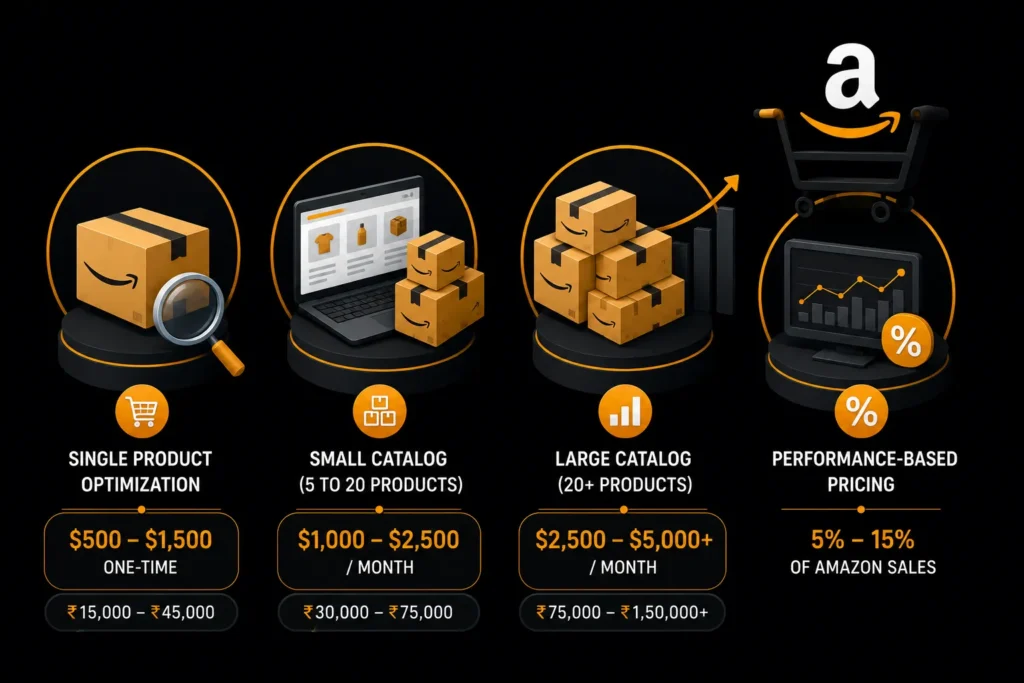
- Single product optimization: $500 to $1,500 one-time (₹15,000 to ₹45,000)
- Small catalog (5 to 20 products): $1,000 to $2,500/month (₹30,000 to ₹75,000/month)
- Large catalog (20+ products): $2,500 to $5,000+/month (₹75,000 to ₹1,50,000+/month)
Some providers charge a percentage of Amazon sales (typically 5% to 15%) instead of or in addition to a monthly fee.
What Makes One Amazon SEO Quote Higher Than Another?
Two quotes for the “same” service can differ widely because the scope underneath is different. When you compare proposals, check these cost drivers before you compare totals:
- Catalog size and variations: Every parent and child listing needs its own keyword mapping, so a catalog with many variations costs more than the product count suggests.
- Category competition: A crowded category needs more research, more creative testing and more review work than a niche one.
- Creative included or not: Main images, infographics, video and A+ Content are often priced separately. Ask whether they are in the quote.
- Advertising management: Amazon Ads support is a different job from organic listing SEO. A quote that bundles both should say how much time goes to each.
- Reporting and cadence: Monthly keyword-rank tracking, competitor reviews and listing tests take ongoing hours; a one-off audit does not.
What Does a Good Amazon SEO Process Look Like?
A competent provider should be able to walk you through their process before you sign. In practice it runs in this order:
- Listing audit: Review each listing for title structure, bullet content, image set, A+ Content, price position, review rating and stock reliability.
- Keyword research on Amazon data: Build a keyword list from Amazon’s own search suggestions, competitor listings and, if you have Brand Registry, the search query data in Brand Analytics. Our keyword research tool can help you start a seed list.
- Keyword mapping: Put the primary keyword in the title, secondary terms in bullets and the description, and remaining relevant terms in the backend search-terms field, without repeating or stuffing.
- Conversion fixes: Improve the main image, the image sequence, the first two bullets and the answers to common questions, because these affect the conversion rate that the ranking depends on.
- Measure and iterate: Track keyword position, sessions and unit session percentage (the conversion measure in Seller Central Business Reports) for each listing, then change one thing at a time.
How Do You Choose an Amazon SEO Services Provider?
Choose a provider that shows its method, reports the metrics above for your own listings, and never needs more access than necessary. The comparison below helps you decide which kind of provider fits your catalog.
| Option | Best for | Watch out for |
|---|---|---|
| Do it yourself | One to a few products, time to learn | Slow iteration; easy to miss backend and conversion issues |
| Freelancer | Listing rewrites for a small catalog | Single point of failure; limited creative and reporting capacity |
| Specialist agency | Larger catalogs, ongoing optimisation, several skills needed | Vague scope; junior staff doing the work after the pitch |
| In-house hire | Large, long-running Amazon business | Salary and tooling cost; one person’s skills only |
Ask every provider these questions:
- Which categories and marketplaces have you worked in, and can you show before-and-after listings with the metrics you tracked?
- Who actually writes and reviews my listings?
- What access do you need to my Seller Central account, and at what permission level?
- How do you handle reviews within Amazon’s rules?
- What is in the monthly report, and what happens if rankings do not move?
What Are the Red Flags When Hiring an Amazon SEO Provider?
- Guaranteed page-one rankings. Nobody controls Amazon’s ranking, and a sales history cannot be promised in advance.
- Buying or incentivising reviews. Amazon’s policies prohibit it and it can put your account at risk. Ask for compliant review strategies only.
- Keyword stuffing. Listings that read like a list of search terms may rank briefly but convert poorly, which hurts the rankings later.
- Asking for full account ownership or your login. Use Seller Central’s user permissions instead of sharing credentials.
- No tracked baseline. If nobody records your starting rank, sessions and conversion rate, results cannot be judged.
A Worked Example: One Listing, Step by Step
This example is hypothetical and uses no real data. Imagine a seller of stainless steel water bottles whose listing ranks on page three for “insulated water bottle”. The audit finds a title that opens with the brand name, bullets full of generic claims, and a main image with a cluttered background.
The provider moves the primary keyword and key attributes (capacity, material, insulation) into the title, rewrites bullets around real buyer questions, replaces the main image, and adds missing search terms to the backend field. After two to four weeks, the seller compares sessions, unit session percentage and keyword position against the baseline. If conversion improved but rank did not, the next step is more sales volume for that keyword, usually through carefully targeted advertising. If neither moved, the team looks at price, stock availability and review rating before changing text again.
What Is the Most Important Amazon SEO Factor?
There is no single factor, but conversion rate is the foundation. Keyword optimization may improve visibility, but products will struggle to maintain rankings if shoppers do not purchase. Start with relevant keywords, then improve your images, pricing, reviews, and listing content.
What Should You Do Next?
If you want hands-on help, MoxSEO’s Amazon SEO service covers audits, keyword mapping and listing optimisation, and our packages page shows what is published. If your products also sell on your own store, our ecommerce SEO work covers the Google side, which is a different system from Amazon search. You can also contact us to talk through your catalog.
Looking for Amazon SEO services that increase visibility and sales? Get a free consultation from MoxSEO and start improving your product rankings.
Frequently Asked Questions
What is Amazon SEO?
Amazon SEO is the process of optimizing your product listings to rank higher in Amazon search results. It involves keyword research, title optimization, bullet point writing, description optimization, backend keyword setup, and image optimization. For a deeper dive into finding the right terms, see our Keyword Research Guide. Amazon’s A9 algorithm prioritizes sales velocity and conversion rate alongside keyword relevance, so a well-optimized listing that converts well will rank higher.
How much do Amazon SEO services cost?
Amazon SEO services typically cost between $500 and $3,000 per month, or ₹15,000 to ₹90,000 per month in India. Single product optimizations may cost $500 to $1,500 as a one-time fee. Some providers charge a percentage of Amazon sales (5% to 15%) instead of a fixed fee. The cost depends on catalog size, competition level, and scope of work
How is Amazon SEO different from Google SEO?
Amazon SEO focuses on product listings within Amazon’s search engine, where the A9 algorithm prioritizes sales velocity and conversion rate alongside keyword relevance. Google SEO focuses on web pages in Google’s search results, where the algorithm prioritizes content quality, backlinks, and user experience. For Google focused ecommerce SEO, see our ecommerce SEO services. For a broader overview of Google ranking factors, see our SEO checklist for 2026.
How long does Amazon SEO take to work?
Amazon SEO can show results faster than Google SEO. Listing optimizations can improve rankings within 1 to 2 weeks if the product already has some sales history. New products with no sales history take longer, typically 1 to 3 months, because Amazon needs to gather conversion data before ranking the product higher.
Can I do Amazon SEO myself?
Yes, you can optimize your own Amazon listings. The basics (keyword research, title writing, bullet points, backend keywords) are learnable. However, competitive niches require ongoing optimization, competitor analysis, and review generation strategies that are time-consuming. Many sellers handle basic optimization themselves and hire a specialist for ongoing management of larger catalogs. See our guide to Amazon SEO consulting for more on professional help.
Is Amazon SEO the same as Amazon PPC?
No. Amazon SEO improves your organic ranking through listing content, images, price and reviews. Amazon PPC (Amazon Ads) pays for placement. They work together because ad-driven sales can feed the sales history that supports organic rank, but they are budgeted and managed separately.
How do I know if an Amazon SEO service is working?
Record a baseline before work starts: keyword positions, sessions and unit session percentage for each listing. Compare the same measures every month. Improvements in conversion and rank for your target keywords, rather than a report of activities, show that the service is working.
Should I choose a freelancer or an agency for Amazon SEO?
A freelancer suits a small catalog with a clear scope, such as rewriting a handful of listings. An agency suits a larger catalog that also needs images, A+ Content, reporting and ongoing testing. Whichever you pick, ask who does the work and what access they need.
Do Amazon SEO services include product photography?
Not always. Many providers price main images, infographics and A+ Content separately from keyword and copy work. Ask for the scope in writing so you can compare quotes properly.