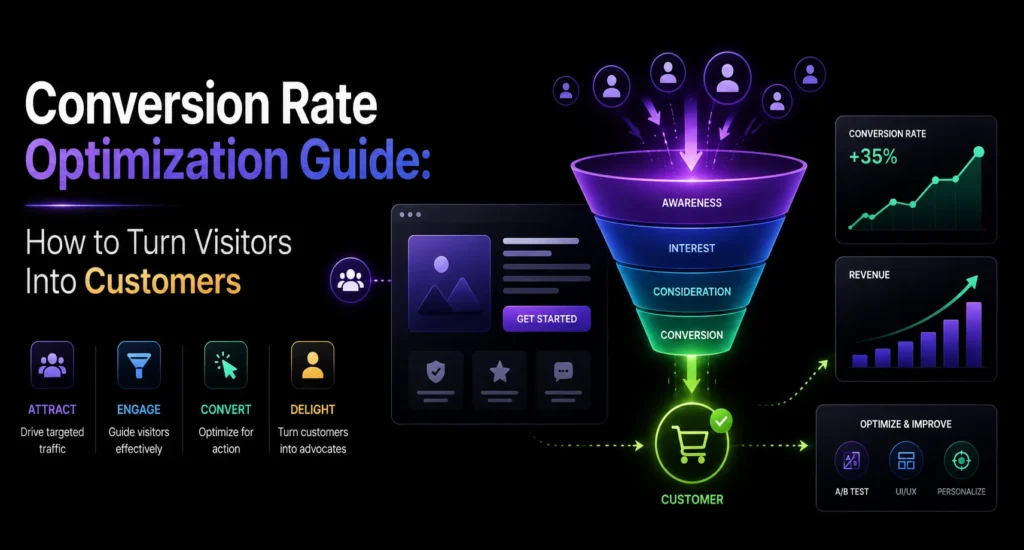
Conversion rate optimization (CRO) is the process of increasing the percentage of your website visitors who take a desired action, whether that is filling out a form, making a purchase, booking a call, or signing up for a newsletter. Most businesses focus on driving more traffic but ignore what happens after visitors arrive. If your conversion rate is low, more traffic just means more wasted visitors. CRO ensures your traffic actually turns into revenue.
TL;DR: Conversion rate optimization (CRO) is the process of improving your website to increase the percentage of visitors who convert. Key tactics include A/B testing, improving page speed, simplifying forms, writing clearer CTAs, reducing friction, and using social proof. Even small CRO improvements compound with traffic growth. MoxSEO offers digital marketing services that include CRO.
What Is Conversion Rate Optimization?
CRO is the systematic process of improving your website or landing page to increase the percentage of visitors who complete a desired action. A conversion can be anything: a purchase, a lead form submission, a phone call, a signup, or a download. The conversion rate is the number of conversions divided by the number of visitors, expressed as a percentage.
For example, if your landing page gets 1,000 visitors per month and 20 of them fill out your contact form, your conversion rate is 2%. If CRO improvements increase that to 4%, you double your leads without spending any more on traffic.
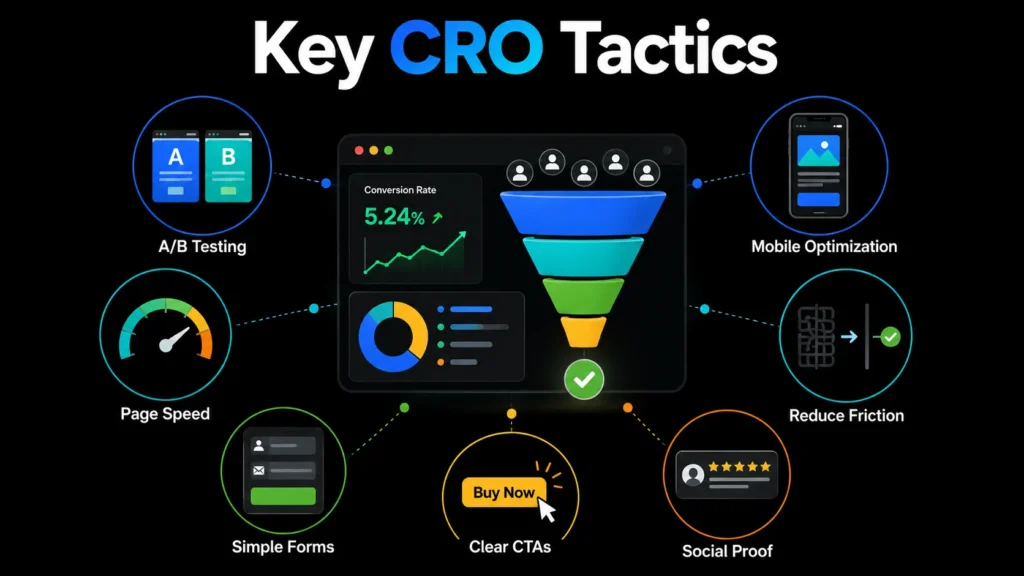
Key CRO Tactics
1. A/B Testing
A/B testing compares two versions of a page to see which performs better. Test one element at a time: headline, CTA button color, form length, image, or page layout. Use a tool like Google Optimize, VWO, or Optimizely. Run tests for at least 2 weeks to get statistically significant results.
2. Improve Page Speed
Every second of delay reduces conversions. A page that loads in 1 second converts 3 times better than a page that loads in 5 seconds. Optimize images, use caching, minimize JavaScript, and use a CDN. See our Core Web Vitals guide for detailed speed optimization tips.
3. Simplify Forms
Long forms kill conversions. Reduce your form to the minimum number of fields needed. Every additional field reduces submission rates. If you only need a name and email, do not ask for a phone number, company name, and job title. Use multi-step forms for longer processes, as they feel less overwhelming than one long form.
4. Write Clearer CTAs
Your call to action should tell visitors exactly what to do and what they will get. “Get Your Free Quote” is better than “Submit.” “Download the Free Guide” is better than “Click Here.” Use action verbs, create urgency where appropriate, and make the CTA button visually prominent.
5. Use Social Proof
People trust what other people trust. Add customer testimonials, case studies, review counts, client logos, and trust badges to your landing pages. Social proof reduces perceived risk and increases conversion rates. Show real names and companies, not generic “John D.” testimonials.
6. Reduce Friction
Friction is anything that makes it harder for a visitor to convert. Common sources of friction include too many form fields, required account creation, slow page load, confusing navigation, unclear value proposition, and too many steps in the checkout process. Identify and remove friction points at every stage of your funnel.
7. Optimize for Mobile
More than half of all web traffic comes from mobile devices. If your mobile experience is poor, you are losing the majority of your potential conversions. Ensure your mobile site has large tap targets, fast load times, simplified forms, and a clear CTA above the fold. For ecommerce-specific CRO, see our guide to ecommerce conversion rate optimization. For Shopify stores, see our Shopify CRO guide.
Turn More Website Visitors Into Customers
Driving more traffic is valuable, but traffic alone does not guarantee more leads or sales. Conversion rate optimization helps you get better results from the visitors already reaching your website. By improving page speed, simplifying forms, strengthening CTAs, adding credible social proof, and removing unnecessary friction, you can create a smoother path from interest to action.
The best CRO strategy is not based on assumptions. It starts with accurate tracking, user behaviour analysis, clear hypotheses, and continuous testing. Even small improvements can increase enquiries, purchases, bookings, and overall marketing ROI without requiring a larger advertising budget.
MoxSEO helps businesses identify conversion barriers and improve landing pages, website journeys, forms, messaging, and mobile experiences. Whether your goal is more qualified leads or higher online sales, our team can build a practical CRO strategy around your audience and business objectives.
Request a free CRO consultation and start turning more of your website traffic into measurable growth.
Frequently Asked Questions
What is a good conversion rate?
A good conversion rate depends on your industry and the type of conversion. For lead generation, 2 to 5% is average. For ecommerce, 1.5 to 3% is average. Top-performing sites convert at 5 to 10% or higher. The key is to measure your current rate and improve it incrementally through testing.
How long does CRO take?
Simple changes (simplifying forms, changing CTA text, adding social proof) can improve conversion rates within days. A/B tests need at least 2 weeks to reach statistical significance. A full CRO program with continuous testing and optimization is an ongoing process, not a one-time project.
What is the difference between CRO and SEO?
SEO brings visitors to your site. CRO turns those visitors into customers. Both are necessary. Driving 10,000 visitors to a page that converts at 1% gives you 100 conversions. Improving the conversion rate to 3% with the same traffic gives you 300 conversions. CRO multiplies the value of your SEO traffic. For professional help, see our guide to conversion rate optimization services.
What tools do I need for CRO?
Essential CRO tools include Google Analytics (to track conversions), an A/B testing tool (VWO, Optimizely, or Google Optimize), a heat mapping tool (Hotjar or Crazy Egg), and a form analytics tool. Google’s conversion tracking setup guide covers how to define and measure conversions in Google Analytics.
Should I focus on traffic or conversions first?
Start with conversions. If your site converts at 1%, doubling your traffic gives you 2x conversions. But doubling your conversion rate to 2% also gives you 2x conversions, without spending more on traffic. Ideally, do both: improve conversion rate first, then scale traffic. This way, every additional visitor is more likely to convert.
Related guides in CRO
- Conversion Rate Optimization Services: What They Include and How They Work
- Ecommerce Conversion Rate Optimization: A Complete Guide for Online Stores
- Shopify Conversion Rate Optimization: How to Increase Your Store’s Sales
Need this handled for you? Explore our Services service.

Sakshi Kumari is an SEO Specialist at MoxSEO with expertise in keyword research, on-page SEO, content optimization, technical SEO, and link-building strategies. She focuses on improving organic visibility, strengthening website performance, and creating search-focused content that attracts relevant traffic. Through data-driven analysis and practical SEO execution, Sakshi helps businesses build stronger search presence and achieve sustainable digital growth.