





People searching for legal help usually want a lawyer who understands the laws, courts, and procedures in their location. They may search for terms such as “divorce lawyer near me,” “criminal lawyer in Mumbai,” or “personal injury attorney in my city.”
Law firms that appear prominently in Google Maps, the local pack, and organic search results are more likely to receive these enquiries. Firms that are difficult to find online may lose potential clients to competitors, even when they have more experience or provide better legal services.
Local SEO for lawyers is the process of improving a law firm’s online visibility for location-based legal searches. It includes optimizing the Google Business Profile, creating detailed practice-area pages, collecting client reviews, maintaining accurate directory listings, and strengthening the website’s local authority.
This guide explains how lawyers and law firms can use local SEO to improve visibility, build trust, and attract more enquiries from potential clients in their city. For a broader understanding of local search strategies, read our local SEO consulting guide.
TL;DR: Local SEO for lawyers depends on a complete Google Business Profile, dedicated pages for each legal practice area, genuine client reviews, accurate legal directory listings, and a trustworthy website. Law firms that consistently maintain these elements are more likely to rank for competitive legal searches in their target locations.
Why Local SEO Matters for Lawyers
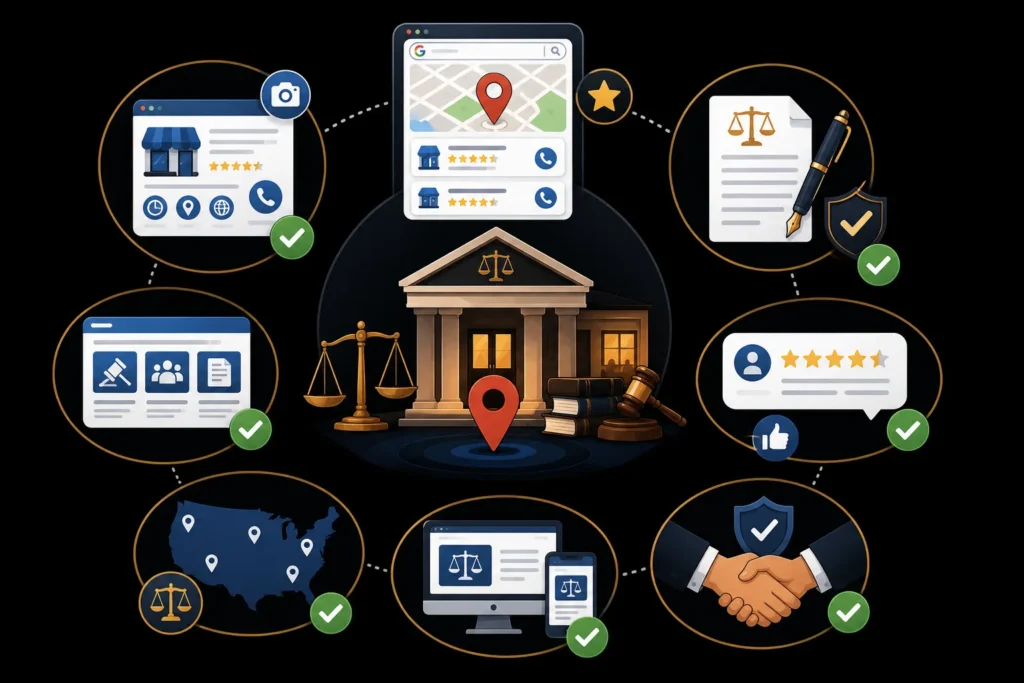
Legal services are highly location-dependent. Clients usually want a lawyer who can represent them in the relevant court, understand local legal procedures, and communicate with them easily.
When someone faces a divorce, criminal charge, property dispute, business issue, or personal injury claim, Google is often one of the first places they look for help. The user may compare several firms, read client reviews, visit websites, and call one or two lawyers before making a decision.
Google commonly displays a local pack for location-based searches. This section usually contains several Google Business Profile listings, along with ratings, contact information, opening hours, directions, and website links.
Appearing in this section can help a law firm gain:
- More phone calls
- More consultation requests
- More website visits
- Greater trust and visibility
- More enquiries from nearby clients
Legal search results are highly competitive because many firms target the same city and practice-area keywords. A general website with limited local information may struggle to compete against firms with optimized profiles, detailed service pages, strong reviews, and established local authority.
Local SEO helps search engines understand what legal services your firm provides, where it operates, and why it may be relevant to people searching in that area.
1. Optimize Your Google Business Profile
A Google Business Profile is one of the most important parts of local SEO for lawyers. It can help your firm appear in Google Maps, local search results, and branded searches.
Start by claiming and verifying the profile for your genuine office location. The information displayed should accurately represent the law firm and match the details on your website.
Choose the Most Relevant Category
The primary business category helps Google understand the main legal service your firm provides.
Depending on your practice, you may choose a broad category such as “Lawyer” or a more specific category such as:
- Family law attorney
- Criminal justice attorney
- Personal injury attorney
- Employment attorney
- Immigration attorney
- Bankruptcy attorney
Choose the category that best represents your primary source of legal work. You can add relevant secondary categories for additional services, but avoid selecting unrelated categories simply to appear for more searches.
Complete the Profile Information
Provide your correct business name, office address, phone number, website, opening hours, and appointment details.
Your profile should also contain a clear description of your firm. Explain your main practice areas, location, and the type of clients you serve. Keywords can be used naturally, but the description should remain readable and professional.
For example, a family law firm might mention divorce, child custody, maintenance, domestic disputes, and family settlements without repeating the same city or keyword unnaturally.
Add your legal services individually where the profile allows it. This gives potential clients a clearer understanding of your expertise.
Add Professional Photos
Images can influence how trustworthy and established a law firm appears.
Upload genuine photographs of your office, reception area, meeting rooms, lawyers, and professional team. You may also include appropriate branding images and exterior photographs that help visitors locate your office.
Avoid relying only on stock photography. Real images provide a better representation of the firm and can make clients feel more comfortable before scheduling a consultation.
Keep the Profile Active and Accurate
Update your opening hours during holidays and temporary closures. Incorrect hours can frustrate potential clients and may lead to negative experiences.
Google Business Profile posts can also be used to share firm updates, legal awareness content, new services, seminars, and useful information.
Avoid making misleading statements, sharing confidential case details, or publishing claims that cannot be supported.
2. Create Detailed Practice-Area and Location Pages
One of the most common law firm SEO mistakes is placing every legal service on one general practice-area page.
A single page may mention divorce law, corporate law, criminal defence, intellectual property, property disputes, and taxation. However, it may not provide enough depth to rank strongly for any individual service.
Create a dedicated page for each major practice area your firm handles.
Examples may include:
- Family law services
- Criminal defence
- Divorce and separation
- Corporate legal services
- Property dispute representation
- Employment law
- Immigration law
- Personal injury claims
Each page should explain the legal problem, the services provided, the typical process, and how a lawyer may assist the client.
Use Local Keywords Naturally
A practice-area page can include the target city in the title, main heading, introduction, and other relevant sections.
For example:
Divorce Lawyer in Mumbai
The page should not repeat “divorce lawyer in Mumbai” in every paragraph. Instead, provide helpful information about divorce procedures, documentation, child custody, maintenance, settlement options, and local representation.
Search engines are more likely to understand the page when the location and practice area are clearly connected through useful content.
Create City Pages Carefully
A firm serving multiple cities may create separate location pages, but each page must provide genuine value.
A useful city page can explain:
- Legal services available in that location
- Courts or jurisdictions served
- Office or consultation availability
- Common legal matters handled
- Contact and appointment details
- Relevant client questions
Do not create dozens of duplicate pages where only the city name changes. Thin or repetitive location pages may provide a poor user experience and weaken the overall quality of the website.
Create a Google Business Profile for another city only when the firm has a genuine, eligible office at that location. Fake offices, virtual addresses, and misleading listings can create suspension risks.
Improve the Main Website Pages
Your homepage should clearly state the law firm’s primary location and main legal services.
The website should also include an accurate contact page, lawyer profile pages, an about page, and detailed practice-area content.
Lawyer profile pages can include professional qualifications, experience, bar memberships, areas of practice, languages spoken, and other relevant credentials. These details help prospective clients evaluate whether the lawyer is suitable for their case.
3. Build Client Trust Through Reviews and Citations
Potential clients often read reviews before contacting a lawyer. Reviews provide information about communication, professionalism, responsiveness, and the overall client experience.
Law firms should develop a consistent and ethical process for requesting feedback.
Ask for Reviews Professionally
A suitable time to request a review may be after a legal matter has concluded or after the client has expressed satisfaction with the service.
Send a direct review link through email or text so that the process is simple. A polite reminder may be appropriate, but clients should never feel pressured.
Do not offer rewards for positive reviews or ask clients to use specific wording. Reviews should reflect genuine experiences.
Law firms must also be careful about confidentiality. Clients should not be encouraged to disclose sensitive legal information publicly.
Respond Without Revealing Confidential Details
Thank clients who leave positive feedback and respond professionally to criticism.
When responding to a negative review, avoid confirming that the reviewer was a client or discussing case details. A short response inviting the person to contact the firm privately is usually more appropriate than a detailed public explanation.
Consistent review growth is generally more credible than receiving many reviews in a short period and then having no activity for months.
Maintain Accurate Legal Directory Listings
Citations are online listings that contain the law firm’s name, address, and phone number.
Law firms may appear on:
- Bar association directories
- Legal professional directories
- Local business directories
- Chamber of commerce websites
- Industry associations
- Trusted regional platforms
Depending on the country, relevant platforms may include Justdial and Sulekha in India or legal directories such as Avvo, FindLaw, Lawyers.com, and Martindale in other markets.
Only use directories that are relevant to your location and practice.
The firm’s name, address, phone number, and website should remain consistent across major listings. Outdated office addresses, incorrect phone numbers, duplicate profiles, and different business names can confuse both clients and search engines.
4. Strengthen Website Authority and Local Relevance
Google Business Profile optimization and reviews are important, but a law firm also needs a strong website.
The website should demonstrate legal expertise, explain services clearly, and provide a professional experience on desktop and mobile devices.
Publish Useful Legal Content
Blog content can help the firm answer questions that potential clients search before contacting a lawyer.
Possible topics include:
- How divorce proceedings work
- What to do after receiving a legal notice
- Steps involved in a property dispute
- Documents needed for company registration
- When to contact a criminal lawyer
- How child custody decisions are made
- What happens during a legal consultation
Legal content should be accurate, clearly written, and reviewed when laws or procedures change. Avoid making guarantees or presenting general information as personalized legal advice.
Where appropriate, include the author’s name, legal qualifications, and the date the content was reviewed.
Earn Relevant Local Backlinks
Backlinks are links from other websites to your law firm’s website. Relevant and credible links can strengthen online authority.
Law firms may earn links through bar association memberships, local business organizations, legal publications, community involvement, university events, professional seminars, and media contributions.
For example, a lawyer may provide expert commentary to a local news publication or contribute an educational article to a reputable legal website.
Avoid buying large numbers of low-quality links. Links from unrelated, spammy, or automatically generated websites are unlikely to build meaningful authority.
Improve Technical and Mobile Performance
Many potential clients search for lawyers on smartphones. The website should load quickly, display correctly, and make it easy to call or request a consultation.
Important improvements include:
- Clear navigation
- Click-to-call phone numbers
- Short enquiry forms
- Secure HTTPS
- Fast page loading
- Readable text
- Mobile-friendly buttons
- Accurate contact information
Add structured data where appropriate to help search engines understand the firm, office location, lawyers, services, and website content.
Structured data must match the information visible on the page. It should not contain misleading ratings, services, locations, or business details.
Measuring Local SEO Performance
Rankings are useful, but they should not be the only measure of success.
Law firms should also track:
- Calls from Google Business Profile
- Consultation form submissions
- Website enquiries
- Directions to the office
- Organic traffic to practice-area pages
- Conversion rates
- Review growth
- Enquiries by city and legal service
Track which practice areas generate qualified leads rather than focusing only on traffic volume.
For example, a page may receive fewer visits but generate more valuable consultation requests. That page may be more important to the business than an article with high traffic but no enquiries.
Common Local SEO Mistakes Law Firms Should Avoid
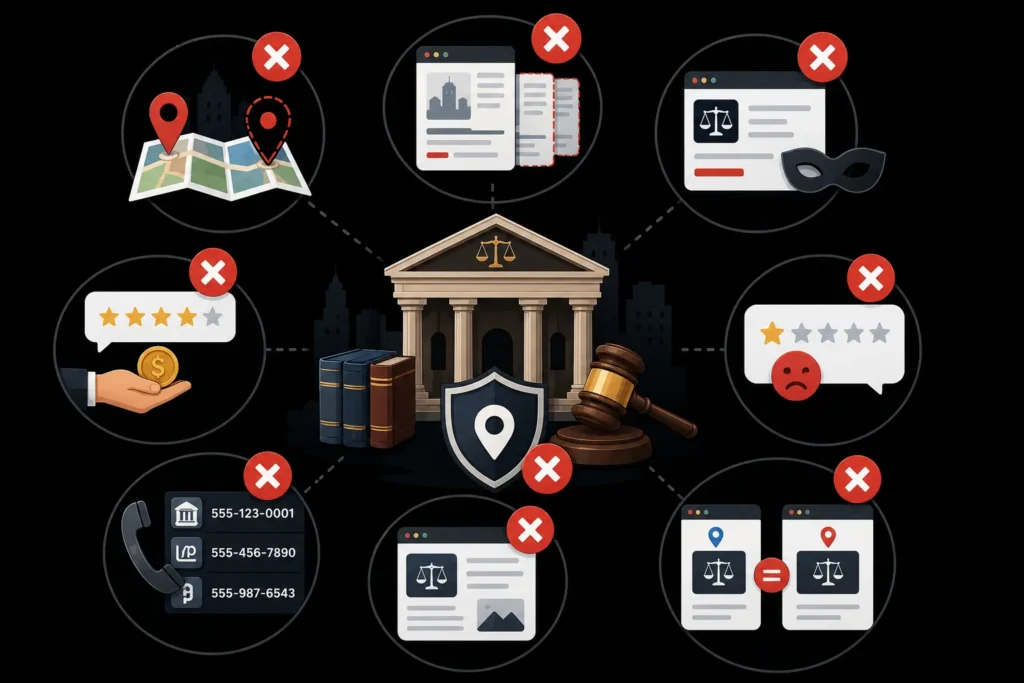
Several practices can limit local search visibility or create unnecessary risks.
Avoid creating fake office locations, publishing duplicate city pages, using misleading business names, buying reviews, ignoring negative feedback, and listing different phone numbers across directories.
Law firms should also avoid creating thin practice-area pages with very little useful information.
Another common mistake is using the same content across multiple office or city pages. Every important page should reflect the actual services, location, and client needs it targets.
How Long Does Local SEO Take for Lawyers?
Local SEO does not provide guaranteed rankings within a fixed period.
A law firm may notice early improvements after correcting major profile, website, or citation problems. However, ranking for competitive legal keywords can take several months of consistent work.
The timeline depends on:
- Competition in the city
- Number of established law firms
- Current website authority
- Google Business Profile history
- Quality and recency of reviews
- Strength of practice-area pages
- Accuracy of directory listings
- Quality of local backlinks
A new law firm in a major city will generally require more time than an established firm operating in a less competitive location.
Should Lawyers Use Google Ads with Local SEO?
Google Ads can provide immediate visibility for valuable legal searches while local SEO is developing.
However, cost per click can be high for competitive practice areas such as personal injury, criminal defence, corporate law, and divorce law.
A combined strategy can work well. Google Ads can generate immediate enquiries, while local SEO builds long-term visibility across Google Maps and organic results.
The advertising landing page should closely match the searcher’s legal need and location. Sending every visitor to a general homepage may reduce conversion rates.
Should Law Firms Use Paid Ads with Local SEO?
Google Ads can help law firms generate immediate visibility and attract potential clients who are actively searching for legal services. Paid campaigns are especially useful for competitive practice areas, urgent legal searches, and locations where organic rankings may take time to improve.
However, relying only on paid advertising can become expensive because traffic usually stops as soon as the campaign budget ends. Local SEO supports long-term growth by improving your law firm’s visibility in Google Maps, local search results, and location-based searches. Optimizing your Google Business Profile, service pages, local citations, reviews, and website content can help your firm attract consistent enquiries over time.
Using Google Ads and local SEO together creates a balanced legal marketing strategy. Paid ads can generate faster enquiries while your local SEO campaign gradually builds organic rankings, trust, and sustainable visibility. This approach allows your law firm to reach more potential clients at different stages of their search journey.
MoxSEO provides consultation SEO strategies for law firms looking to improve their Google Maps rankings, increase local search visibility, and generate more qualified legal enquiries.
Need more legal enquiries? Get a free local SEO consultation from MoxSEO today.
Frequently Asked Questions
What is the most important local SEO factor for lawyers?
A complete and accurate Google Business Profile is one of the most important elements. However, rankings also depend on reviews, proximity, website relevance, practice-area content, citations, and local authority.
How many reviews does a law firm need?
There is no fixed number. Compare your firm with the lawyers already ranking for your target practice areas and city. Focus on earning genuine, recent reviews consistently rather than reaching a specific number.
Can a law firm rank in multiple cities?
Yes, but each city requires a genuine strategy. Create profiles only for eligible physical offices. For other service areas, use detailed and useful location pages without presenting fake office addresses.
Should every legal service have a separate page?
Major practice areas should normally have dedicated pages. This allows the firm to explain each service in detail and target more specific searches than a single general services page.
Is local SEO suitable for individual lawyers?
Yes. Solo lawyers can compete locally by focusing on a specific practice area, maintaining a complete profile, publishing useful content, earning reviews, and building strong local relevance.
Related guides in Local SEO
- Local SEO for Plumbers: How to Get More Service Calls from Google
- Local SEO for Restaurants: A Complete Guide for Restaurant Owners
- Local SEO for Small Businesses: A Practical Guide to More Local Customers
- Local SEO Guide: How to Rank Your Business in the Local Pack (2026)
- Local SEO Packages: What to Include, What to Pay, and What to Avoid
Need this handled for you? Explore our Local SEO service.

Samruddhi Kadam is an SEO Associate at MoxSEO with 2 years of experience in keyword research, on-page SEO, content optimization, competitor analysis, and website performance tracking. She focuses on improving organic visibility, creating search-friendly content, and identifying practical opportunities to strengthen rankings. Through consistent analysis and data-driven execution, Samruddhi helps businesses attract relevant traffic and build a stronger presence in search results.