




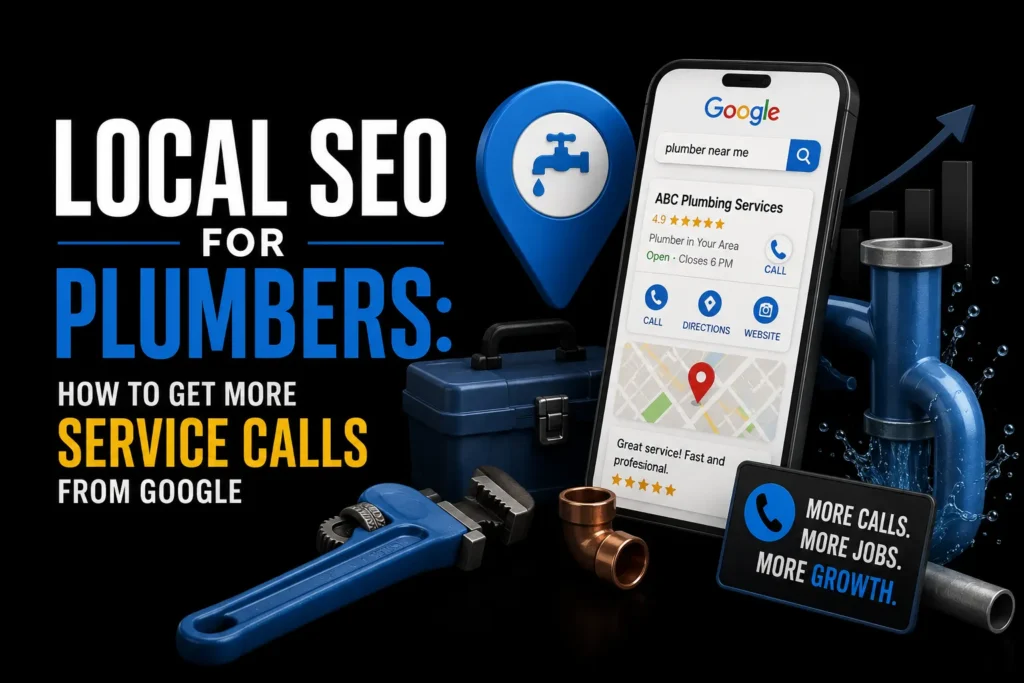
Plumbing customers rarely have time to compare dozens of businesses. When a pipe bursts, a drain becomes blocked, or a water heater stops working, most homeowners immediately search Google for terms such as “plumber near me,” “emergency plumber,” or “drain cleaning service.”
The plumbing companies that appear prominently in Google Maps and the local search results are more likely to receive these calls. Businesses that are difficult to find online may lose potential customers, even when they offer excellent service.
Local SEO for plumbers helps plumbing businesses improve their visibility for location-based searches. It focuses on optimizing your Google Business Profile, website, reviews, local directory listings, service pages, and geographic relevance.
This guide explains the most important local SEO strategies plumbers can use to rank higher, attract nearby customers, and generate more service calls from Google. For a broader understanding of local search, read our guide to local SEO consulting.
TL;DR: Effective local SEO for plumbers requires a complete Google Business Profile, consistent business information across online directories, regular customer reviews, optimized plumbing service pages, and useful location pages for the cities you serve. Long-term success comes from maintaining accurate information and consistently demonstrating that your business is active, trusted, and relevant to local customers.
Why Local SEO Is Important for Plumbers
Plumbing is usually a location-dependent and time-sensitive service. Customers want a professional who can reach their property quickly, especially during emergencies.
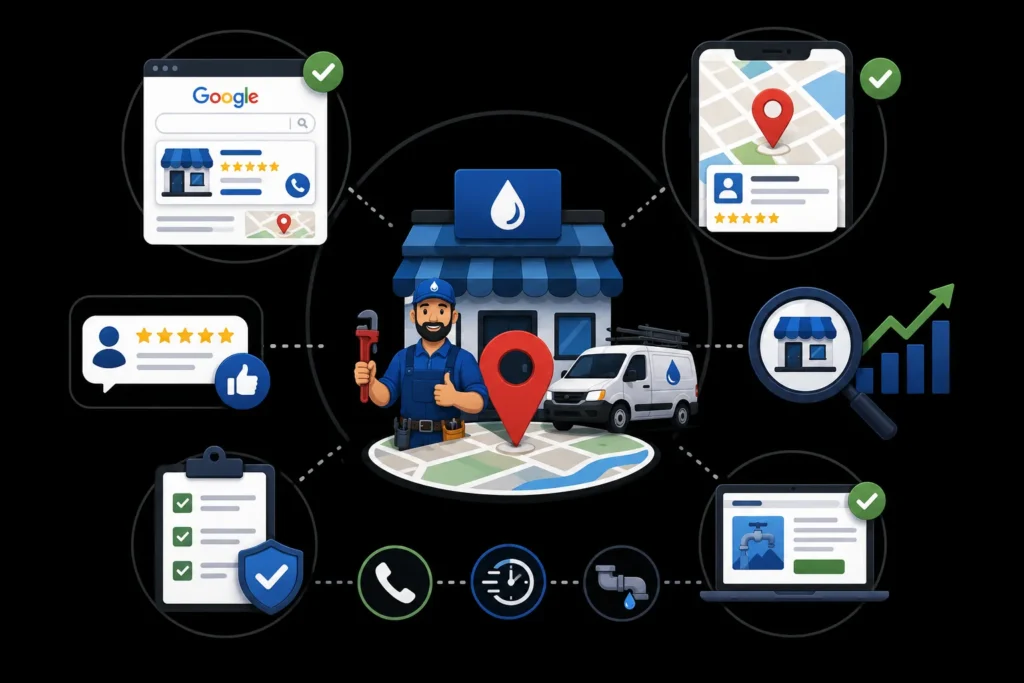
When someone searches for a plumber, Google generally considers factors such as:
- How closely the business matches the search
- How near the business is to the searcher
- How established and trustworthy the business appears
- The quality and quantity of customer reviews
- The relevance of the business website
- The consistency of business information across the internet
Local SEO helps strengthen these signals.
Unlike services with long purchasing cycles, plumbing customers may call a business within minutes of searching. They often choose one of the first credible companies they see in the local pack or organic results.
This means search visibility can directly influence the number of enquiries, calls, and bookings a plumbing business receives.
Step 1: Claim and Optimize Your Google Business Profile
Your Google Business Profile is one of the most important elements of local SEO for plumbers. It allows your business to appear in Google Maps, the local pack, and branded search results.
Start by claiming and verifying your profile. Once verified, complete every relevant section accurately.
Select the Correct Business Category
Choose Plumber as your primary business category when plumbing is your main service.
You may also select relevant secondary categories available in your location. Only add categories that accurately describe services your business genuinely provides.
Avoid selecting unrelated categories simply to appear for more searches. Incorrect categories can confuse customers and weaken the relevance of your profile.
Add Accurate Contact Information
Your profile should include your correct:
- Business name
- Phone number
- Website address
- Business hours
- Appointment link
- Physical address or service area
- Emergency availability
Use a local phone number whenever possible. Make sure the number connects directly to your plumbing business and is answered during the hours displayed on your profile.
Configure Your Service Area
Service-area plumbers should specify the cities, towns, and neighbourhoods they regularly serve.
Do not add distant locations that your team cannot realistically reach. A focused and accurate service area is more useful than a large list of unrelated cities.
Your website should also clearly explain where your plumbing services are available.
Write a Useful Business Description
Your business description should explain what you do, where you operate, and what makes your plumbing company useful to customers.
Naturally mention important services such as:
- Emergency plumbing
- Leak detection
- Drain cleaning
- Pipe repair
- Toilet repair
- Water heater installation
- Bathroom plumbing
- Commercial plumbing
Avoid keyword stuffing, promotional exaggeration, unnecessary capital letters, or claims that cannot be verified.
Add Plumbing Services
Use the services section to list your main plumbing solutions. Include a short and clear description for each service.
For example, instead of adding only “Leak Repair,” explain that the service covers leaking pipes, taps, toilets, water lines, and other common household plumbing problems.
This gives customers more information and helps Google understand the services your company provides.
Upload Authentic Photos
Photos can make your business appear more credible and active.
Upload original images of:
- Your plumbing team
- Branded service vehicles
- Tools and equipment
- Completed installations
- Before-and-after repairs
- Office or workshop
- Team members working on-site
Avoid relying entirely on stock images. Customers are more likely to trust photos that show the real people and equipment behind the business.
Continue adding fresh photos instead of uploading everything once and leaving the profile inactive.
Publish Google Business Profile Posts
Google Business Profile posts can be used to share:
- Seasonal plumbing advice
- New services
- Limited-time offers
- Maintenance reminders
- Emergency service availability
- Recently completed projects
Posting occasionally shows that the business is active and gives potential customers more reasons to contact you.
Keep Business Hours Updated
Accurate hours are particularly important for emergency plumbing companies.
Update your profile during public holidays, temporary closures, or changes in availability. Customers may become frustrated and leave negative reviews when the listed opening hours are incorrect.
Step 2: Build Consistent Local Citations
A local citation is an online mention of your business name, address, and phone number. Citations can appear on directories, business listing websites, industry associations, and local platforms.
Important citation sources for plumbing businesses may include:
- Bing Places
- Apple Business Connect
- Yelp
- Justdial
- Sulekha
- IndiaMART
- Local chamber of commerce websites
- Home service platforms
- Plumbing association directories
- City-specific business directories
The value of a citation depends on its accuracy, relevance, and credibility. A smaller number of accurate listings is generally better than hundreds of low-quality or automated directory submissions.
Maintain NAP Consistency
NAP means name, address, and phone number.
These details should be presented consistently across your Google Business Profile, website, social profiles, and directory listings.
For example, avoid using different versions of your business name across platforms unless they are genuine legal or branding variations.
Small formatting differences are not always serious, but conflicting phone numbers, outdated addresses, duplicate listings, or incorrect business names can create confusion.
Remove Duplicate and Outdated Listings
Search for old listings connected to previous addresses, phone numbers, or company names.
Where possible, update, merge, or remove inaccurate listings. Duplicate profiles may divide customer reviews and make it harder for search engines to identify the correct business information.
Step 3: Create a Reliable Review System
Reviews influence both local visibility and customer decisions.
A plumbing company with recent, detailed, and positive reviews is generally more appealing than a competitor with very little customer feedback.
Instead of asking for reviews occasionally, make review requests part of your normal customer-service process.
Ask Customers at the Right Time
The best time to request a review is shortly after completing a successful job.
Your plumber can politely ask the customer before leaving or explain that a review helps local homeowners find the business.
The request should remain optional and should never pressure the customer.
Make the Process Simple
Customers are more likely to leave a review when the process takes only a few seconds.
You can provide:
- A direct Google review link
- A QR code on an invoice
- A review card
- A text message after the appointment
- A link in a follow-up email
Do not offer misleading incentives or request only positive reviews. Ask customers for honest feedback about their experience.
Encourage Detailed Reviews
Detailed reviews can be more helpful than one-word responses.
Customers may naturally mention the service they received, such as emergency leak repair, drain cleaning, or water heater installation. They may also mention their city or neighbourhood.
Never write the review for the customer or tell them exactly what to say.
Respond to Every Review
Thank customers who leave positive feedback and respond calmly to negative reviews.
A professional response to criticism should:
- Acknowledge the concern
- Avoid arguing publicly
- Protect the customer’s private information
- Offer to discuss the issue directly
- Explain the next step where appropriate
Review responses show prospective customers that the business takes service quality seriously.
Focus on Consistent Review Growth
A steady flow of genuine reviews is more sustainable than collecting many reviews during a short campaign and then receiving none for several months.
Create a process that allows your business to request feedback after every eligible job.
Step 4: Create Individual Plumbing Service Pages
A website with one general services page may struggle to rank for every plumbing service.
Create a dedicated page for each important service your company offers, such as:
- Emergency plumber
- Drain cleaning
- Leak detection
- Pipe repair
- Toilet repair
- Tap repair
- Water heater repair
- Water heater installation
- Sewer line repair
- Bathroom plumbing
- Commercial plumbing
Each page should clearly explain the problem, service process, customer benefits, service area, and how to book an appointment.
Avoid creating thin pages with only a few sentences and a repeated contact form. Every page should provide enough useful information to satisfy someone searching for that specific service.
Step 5: Build High-Quality Service Area Pages
When your plumbing company serves several cities or neighbourhoods, location pages can help your website appear for searches such as:
- Plumber in Bangalore
- Emergency plumber in Jaipur
- Drain cleaning in Pune
- Plumbing company in Andheri
Create a separate page only for locations where you genuinely provide services.
A common URL structure may look like:
/plumber-in-city-name//emergency-plumber-city-name//plumbing-services-area-name/
What to Include on a Location Page
A useful service-area page can include:
- Plumbing services available in the area
- Response availability
- Local contact information
- Types of properties served
- Common plumbing problems in the location
- Nearby landmarks or neighbourhoods
- Customer testimonials from the area
- Frequently asked questions
- A clear call-to-action
The content should be genuinely tailored to the location.
Do not create dozens of pages where only the city name changes. Near-duplicate location pages provide little value and may create quality problems across the website.
Avoid Fake Office Addresses
Do not create false business addresses or virtual office listings simply to rank in additional cities.
If you do not have a staffed location in a city, present the page as a service-area page rather than pretending it is a physical office.
Step 6: Optimize Your Website for Local Plumbing Searches
Your website should make it easy for both customers and search engines to understand your services, location, and contact details.
Optimize Page Titles
Your homepage title can combine your main service and primary location.
For example:
Trusted Plumber in Jaipur for Home and Business Repairs
Individual service pages should use titles relevant to their specific topics.
For example:
Emergency Plumbing Services in Jaipur
Avoid repeating the same title across every page.
Use Clear Headings
Each page should have one clear main heading supported by descriptive subheadings.
Headings should explain the page rather than simply repeat keywords. They also help visitors quickly find the information they need.
Add Your Business Information
Display your business name, phone number, operating hours, and primary service area clearly.
Place a click-to-call button prominently on mobile devices. Emergency customers should not have to search through several pages to find your number.
Improve Mobile Usability
Many plumbing searches happen on smartphones. Your website should:
- Load quickly
- Use readable text
- Have large buttons
- Avoid intrusive pop-ups
- Display forms correctly
- Make phone numbers clickable
- Keep navigation simple
Test important actions such as calling, requesting a quote, and submitting a booking form on different mobile devices.
Add LocalBusiness Structured Data
LocalBusiness structured data can help search engines understand your business details.
Depending on the website, the markup may include:
- Business name
- Website
- Phone number
- Address
- Opening hours
- Service area
- Business type
- Social profiles
The information in the structured data should match the visible information on your website and business listings.
Create a Useful FAQ Section
Answer genuine questions plumbing customers commonly ask, such as:
- How quickly can a plumber arrive?
- Do you provide emergency plumbing?
- How much does drain cleaning cost?
- Can you repair a leaking water heater?
- Which areas do you serve?
- Do you provide commercial plumbing?
Helpful answers can improve topical relevance and help customers decide whether to contact your business.
Step 7: Publish Helpful Plumbing Content
Blog content can help your business appear for informational searches before a customer is ready to book.
Useful topics may include:
- What to do when a pipe bursts
- Signs of a hidden water leak
- Why a drain keeps getting blocked
- When to replace a water heater
- How to prevent frozen pipes
- Reasons for low water pressure
- When a leaking tap needs professional repair
- Common plumbing problems in older homes
The goal is not to publish as many articles as possible. Focus on questions your actual customers ask.
Each article should provide practical information while directing readers to a relevant plumbing service when professional help is required.
Step 8: Earn Relevant Local Links
Links from reputable websites can strengthen the authority of your plumbing website.
Plumbing businesses may earn links through:
- Local trade associations
- Chamber of commerce memberships
- Supplier partnerships
- Community sponsorships
- Local news coverage
- Home-improvement websites
- Property management partnerships
- Local business collaborations
Avoid purchasing large numbers of low-quality links. Link building should focus on relevance, reputation, and genuine local relationships.
Step 9: Track Calls, Rankings, and Leads
Local SEO should be measured using real business outcomes rather than rankings alone.
Track metrics such as:
- Calls from Google Business Profile
- Website contact-form submissions
- Appointment requests
- Direction requests
- Website visits from local search
- Conversion rates
- Rankings for important local keywords
- Number and quality of customer reviews
- Leads generated by individual service pages
Call tracking can be useful, but it must be configured carefully so that your main business information remains consistent.
Review performance regularly and identify which services and locations generate the most valuable enquiries.
Common Local SEO Mistakes Plumbers Should Avoid
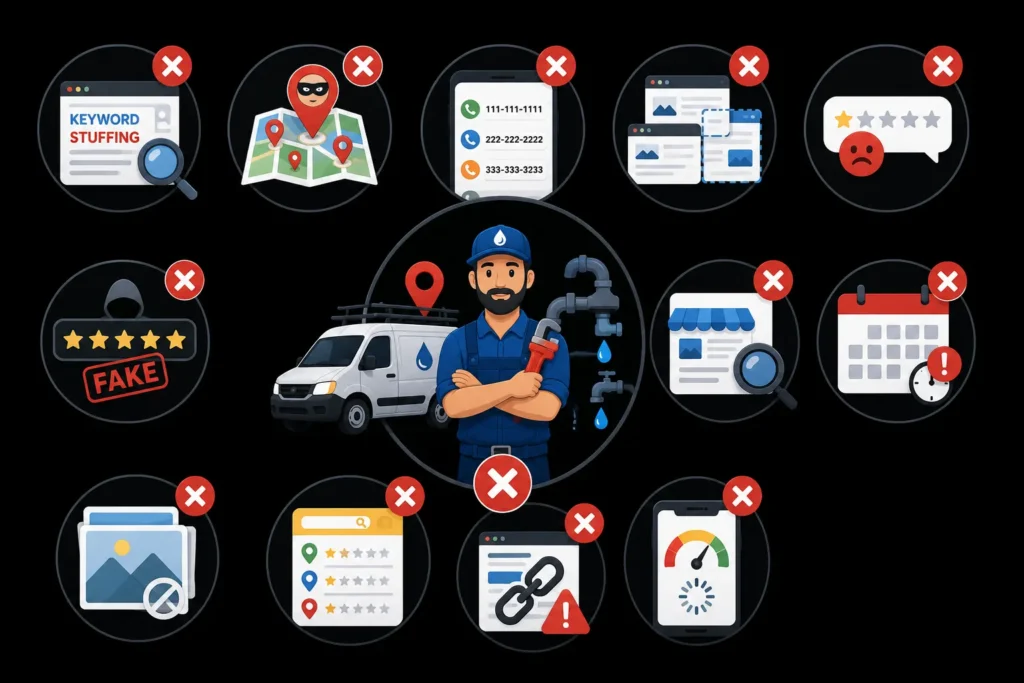
Some local SEO mistakes can limit visibility or create unnecessary risk.
Avoid:
- Keyword stuffing the business name
- Creating fake business locations
- Using different phone numbers everywhere
- Publishing duplicate city pages
- Ignoring negative reviews
- Buying fake reviews
- Selecting irrelevant business categories
- Leaving holiday hours outdated
- Using only stock photos
- Creating low-quality directory listings
- Building spammy backlinks
- Neglecting mobile website performance
Local SEO works best when your online information accurately represents the real plumbing business.
How Long Does Local SEO Take for Plumbers?
Local SEO is a long-term process rather than an instant ranking method.
A plumbing business may notice early improvements within a few weeks after correcting major profile, website, or citation issues. However, meaningful progress in a competitive area may take several months.
The timeline depends on:
- Competition in your location
- Current website quality
- Existing reviews
- Google Business Profile history
- Number of established competitors
- Website authority
- Accuracy of citations
- Quality of service and location pages
Businesses with established profiles may improve faster than completely new plumbing companies.
Should Plumbers Use Google Ads Alongside Local SEO?
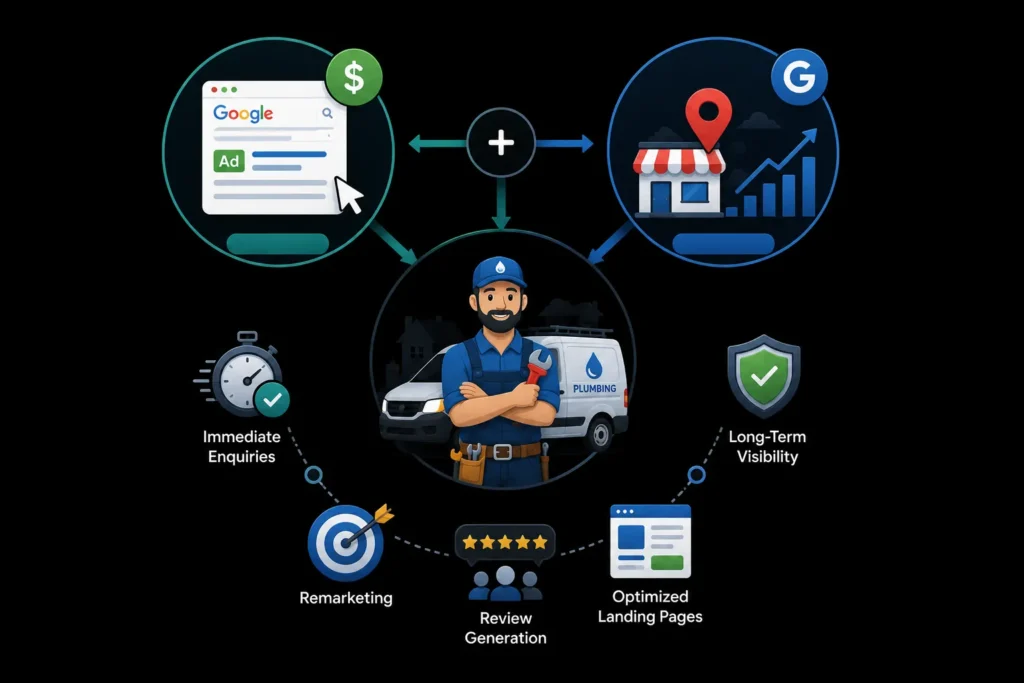
Google Ads can provide immediate visibility for high-intent searches, especially for emergency plumbing services.
However, competitive plumbing keywords can be expensive. Paid campaigns also stop producing traffic when the advertising budget is paused.
Local SEO can take longer to build, but it may provide more sustainable organic visibility.
Many plumbing companies use both strategies:
- Google Ads for immediate enquiries
- Local SEO for long-term visibility
- Remarketing for previous website visitors
- Review generation to improve trust
- Optimized landing pages to increase conversions
The correct combination depends on your location, competition, services, and marketing budget.
Should Plumbers Use Google Ads?
Google Ads can generate immediate plumbing leads, while local SEO builds long-term visibility. Using both can deliver faster and more consistent results.
Want more plumbing calls? Get a free local SEO consultation from MoxSEO.
Frequently Asked Questions
How many reviews does a plumber need to rank locally?
There is no universal number of reviews required. Compare your review quantity, rating, quality, and recency with the plumbing businesses already ranking in your area. Continue collecting genuine reviews consistently instead of stopping after reaching a specific number.
Can a plumber rank in a city without an office there?
A plumbing company may gain visibility in nearby service areas through strong location pages, relevant content, reviews, and an accurately configured service area. However, proximity remains an important local factor, so businesses physically closer to the searcher may have an advantage.
Should plumbers create a page for every neighbourhood?
Create location pages only for meaningful areas where you regularly provide services. Each page should contain useful and location-specific information. Avoid generating hundreds of near-identical pages with only the neighbourhood name changed.
Is a Google Business Profile enough for local SEO?
A Google Business Profile is important, but it is not the entire strategy. Your website, reviews, citations, local links, service pages, mobile performance, and business reputation also contribute to local search success.
How often should a plumbing company publish content?
There is no required publishing frequency. One useful and well-researched article can be more valuable than several weak posts. Choose a realistic schedule and focus on answering customer questions connected to your services.
Related guides in Local SEO
- Local SEO for Restaurants: A Complete Guide for Restaurant Owners
- Local SEO for Small Businesses: A Practical Guide to More Local Customers
- Local SEO Guide: How to Rank Your Business in the Local Pack (2026)
- Local SEO Packages: What to Include, What to Pay, and What to Avoid
- Local SEO Services Near Me: How to Rank in Your Area
Need this handled for you? Explore our Local SEO service.

Samruddhi Kadam is an SEO Associate at MoxSEO with 2 years of experience in keyword research, on-page SEO, content optimization, competitor analysis, and website performance tracking. She focuses on improving organic visibility, creating search-friendly content, and identifying practical opportunities to strengthen rankings. Through consistent analysis and data-driven execution, Samruddhi helps businesses attract relevant traffic and build a stronger presence in search results.