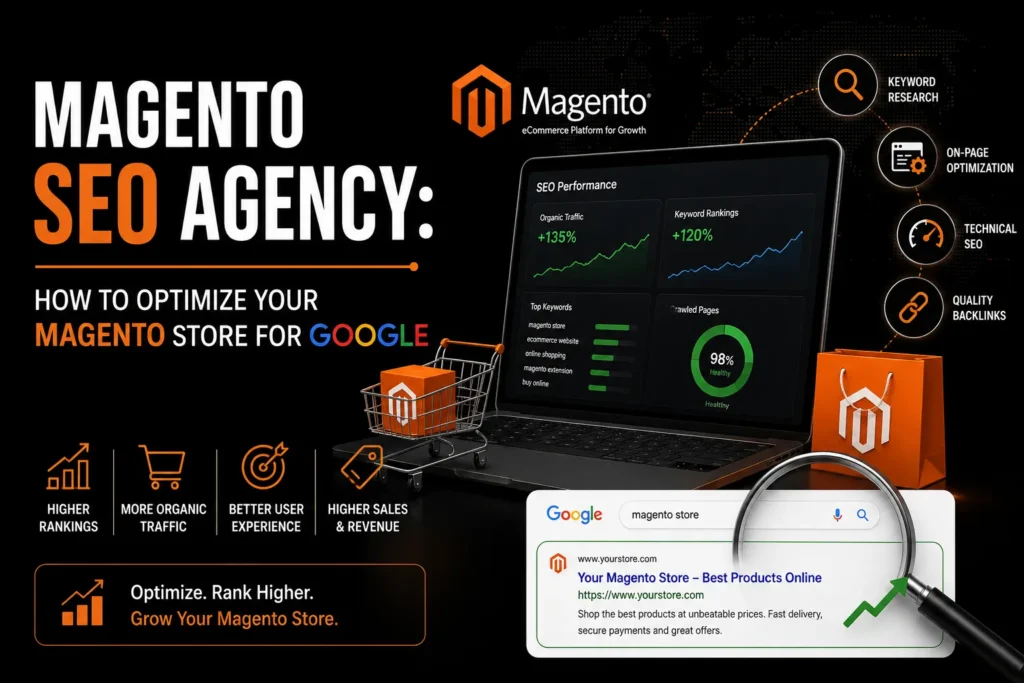
Magento is a powerful ecommerce platform built for businesses that need extensive customization, large product catalogues, multiple storefronts, and advanced integrations. However, this flexibility can also make Magento SEO more technically demanding than SEO for many other ecommerce platforms.
Product variants, category paths, layered navigation, URL parameters, extensions, JavaScript, and multiple store views can create crawlability, duplication, performance, and indexing problems when they are not configured correctly.
A Magento SEO agency combines ecommerce SEO expertise with an understanding of Magento’s technical architecture. It helps search engines crawl the correct pages, improves product and category visibility, strengthens website performance, and converts organic traffic into revenue.
This guide explains what a Magento SEO agency does, the SEO challenges associated with Magento, how much professional services may cost, and how to choose the right agency for your store.
For comparisons with other ecommerce platforms, read our guides to WooCommerce SEO and Shopify SEO.
TL;DR: A Magento SEO agency helps ecommerce stores resolve technical issues such as duplicate URLs, faceted navigation, slow page performance, weak product content, incorrect canonical tags, and inefficient crawling. Choose an agency with Magento-specific case studies, technical SEO experience, developer support, and reporting that connects organic visibility with ecommerce revenue.
What Is a Magento SEO Agency?
A Magento SEO agency is an SEO company that specializes in optimizing websites built with Magento Open Source or Adobe Commerce.
General SEO knowledge is useful, but Magento stores often require deeper technical involvement. Recommendations may need changes to extensions, templates, server configuration, caching, JavaScript, category settings, URL rewrites, or store-view configurations.
A specialist agency should understand how Magento handles:
- Products and product variants
- Categories and subcategories
- Layered navigation
- URL rewrites
- Canonical tags
- Multiple store views
- Internal search pages
- Product availability
- Pagination
- Caching
- JavaScript and frontend themes
- Structured product information
The agency should work closely with developers, content teams, merchandisers, and ecommerce managers rather than treating SEO as a separate activity.
Why Magento SEO Requires Specialized Expertise
Magento provides significant control over ecommerce functionality, but every customization can affect search performance.
A large store may contain thousands of products and categories. Filters can generate many combinations of URLs, while products may be accessible through several category paths.
Custom themes and third-party extensions can add scripts, increase page weight, alter metadata, introduce crawlable URLs, or interfere with structured data.
A Magento SEO strategy must therefore consider both search visibility and the technical operation of the store.
The objective is not to make every available URL indexable. The objective is to help Google discover, understand, and rank the pages that provide genuine search value.
What Does a Magento SEO Agency Do?

A Magento SEO engagement usually begins with an audit and continues through technical implementation, page optimization, content creation, authority building, and performance reporting.
Conduct a Magento Technical SEO Audit
The agency should review how search engines access and interpret the store.
A technical audit may examine:
- Crawled and indexed URLs
- Robots.txt directives
- XML sitemaps
- Canonical tags
- Redirects
- Product and category URL structures
- Parameter-based URLs
- Faceted navigation
- Pagination
- Internal search results
- Duplicate product pages
- Broken links
- Orphan pages
- Store-view configurations
- Mobile usability
- Structured data
- Page performance
- JavaScript rendering
The audit should not provide only a long list of errors. Each finding should be prioritized according to its effect on crawling, indexing, rankings, customer experience, and revenue.
Improve Crawlability and Indexing
Google must be able to find important product and category pages without wasting excessive resources on duplicate or low-value URLs.
A Magento SEO agency should determine which pages need to be:
- Indexed
- Canonicalized
- Redirected
- Blocked from crawling
- Removed from internal links
- Consolidated
- Added to XML sitemaps
- Improved with unique content
The agency should also review Google Search Console to identify indexing problems, excluded pages, sitemap issues, and unexpected URL patterns.
Optimize Magento Site Architecture
A clear site structure helps customers browse the store and helps search engines understand the relationship between categories, subcategories, and products.
An effective structure may follow a logical hierarchy such as:
Home page → Main category → Subcategory → Product page
Important categories should be accessible within a small number of clicks. Product pages should link back to relevant categories, while related products and supporting content should strengthen internal connections.
The agency should avoid creating unnecessary category levels that make important products difficult to reach.
Manage Product and Category URLs
Magento can generate URL rewrites when product names, category names, or URL keys change.
An agency should review whether:
- URLs are short and readable
- Important keywords are used naturally
- Old URLs redirect correctly
- Redirect chains exist
- Products are accessible through multiple URLs
- Category paths are included in product URLs
- Tracking parameters are being indexed
- Deleted product URLs have suitable destinations
Adobe Commerce allows canonical tags to be configured for product and category pages, making correct canonical setup an important part of duplicate-URL management.
Magento-Specific SEO Challenges
Several technical problems appear frequently on large Magento websites.
Faceted Navigation and Filter URLs
Layered navigation allows customers to filter products by attributes such as:
- Price
- Brand
- Colour
- Size
- Material
- Rating
- Availability
- Product type
This improves product discovery, but every filter combination can create another URL.
For example, customers may filter one category by brand, colour, price, and size. Different combinations can create hundreds or thousands of URLs containing largely similar product listings.
When these URLs are freely crawled and indexed, they can:
- Waste crawl resources
- Create duplicate content
- Dilute internal authority
- Compete with main category pages
- Fill search results with low-value pages
- Make indexing reports difficult to analyse
A Magento SEO agency should classify filters based on search demand and business value.
Some filtered pages may deserve indexation when customers actively search for them. For example, a well-optimized brand-and-category page may have commercial value.
Other filter combinations should remain available to users without becoming indexable search landing pages.
Duplicate Product URLs
A product may appear in several categories and become accessible through more than one URL.
Sorting options, tracking parameters, session data, product variants, and URL rewrites can create additional versions.
The agency should identify the preferred URL and make sure canonical tags, internal links, sitemaps, and redirects support that version consistently.
Canonical tags should not be used as a substitute for fixing weak internal architecture. If duplicate URLs are repeatedly linked throughout the site, search engines may continue spending resources on them.
Product Variant Duplication
Magento stores may sell one product in several colours, sizes, materials, or configurations.
The correct SEO setup depends on whether each variation has independent search demand.
A separate page may be appropriate when a variant:
- Has meaningful keyword demand
- Offers substantially different features
- Needs unique images and descriptions
- Has a separate model number
- Serves a distinct customer need
When variants differ only slightly, consolidating them into one strong product page may provide a better customer and search experience.
Internal Search Result Pages
Store search pages are useful for customers but can create an unlimited number of low-value URLs.
Internal search results should generally not become a substitute for properly optimized categories and landing pages.
The agency should check whether search result URLs are being crawled, indexed, included in sitemaps, or linked through navigation.
Thin Category Pages
Many Magento category pages contain only product grids and a short generic sentence.
These pages may struggle to rank when competitors offer clearer introductions, useful buying guidance, relevant filters, FAQs, and stronger internal links.
Category content should help customers make decisions without pushing products too far down the page.
Useful category-page elements may include:
- A concise introduction
- Important product attributes
- Selection advice
- Popular use cases
- Relevant subcategories
- Buying considerations
- Frequently asked questions
- Links to supporting guides
Out-of-Stock and Discontinued Products
Deleting unavailable products immediately can waste existing rankings, backlinks, and customer demand.
The agency should develop different rules for temporarily unavailable and permanently discontinued items.
Temporarily unavailable pages may remain live when the product is expected to return. The page can display stock information, availability notifications, and related alternatives.
A permanently discontinued page may be redirected when a close replacement exists. When no suitable replacement is available and the page still provides useful information, keeping it accessible with alternatives may be more helpful than redirecting every discontinued item to a general category.
Magento Site Speed and Core Web Vitals
Magento performance depends on hosting, caching, catalogue size, theme quality, extensions, images, scripts, and third-party integrations.
Adobe Commerce and Magento Open Source support full-page caching, while Adobe recommends Varnish for on-premises production environments because it is faster than the built-in full-page cache.
A Magento SEO agency should work with developers to review:
- Server response times
- Full-page caching
- CDN configuration
- Image sizes and formats
- Lazy loading
- Unused JavaScript
- Render-blocking resources
- Third-party scripts
- Font loading
- Theme performance
- Extension overhead
- Database queries
- Mobile performance
The current Core Web Vitals are:
- Largest Contentful Paint: Loading performance
- Interaction to Next Paint: Responsiveness to user interactions
- Cumulative Layout Shift: Visual stability
Interaction to Next Paint has replaced First Input Delay as a Core Web Vital, so agencies should discuss LCP, INP, and CLS rather than relying on outdated FID reporting.
Improving performance is not only an SEO task. Faster product and category pages can also reduce customer frustration and support conversion performance.
Product Page Optimization
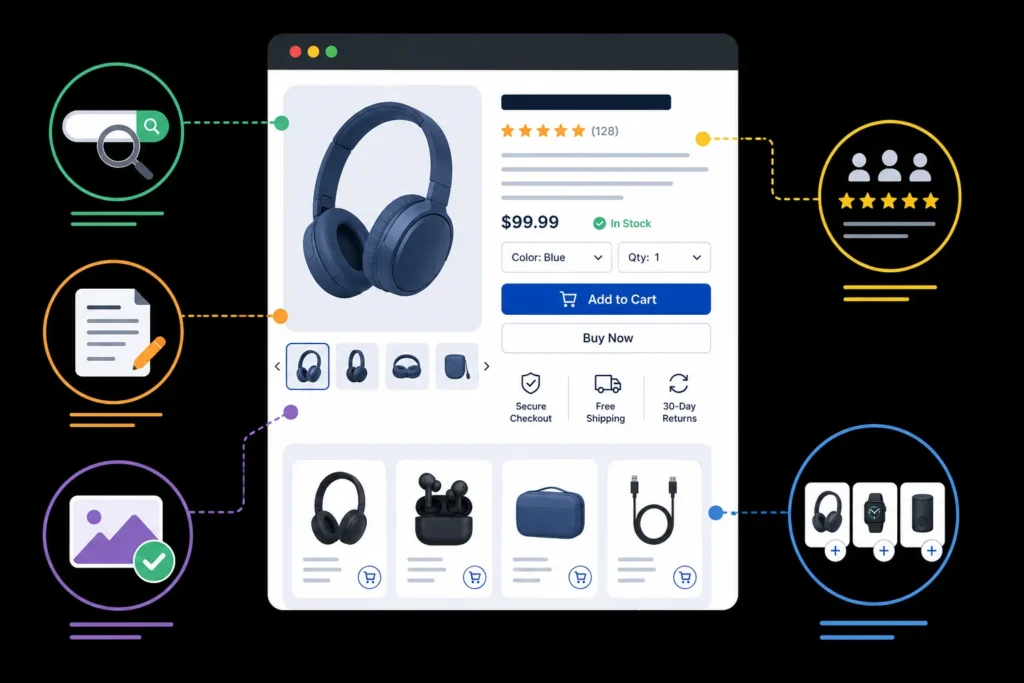
Product pages target customers who may already be close to making a purchase.
Each important product page should provide enough information for users and search engines to understand the item.
Product Titles
Product titles should be clear, accurate, and aligned with how customers search.
A useful title may include:
- Product type
- Brand
- Model
- Important feature
- Size or specification
Avoid adding the same unnecessary keywords to every title.
Product Descriptions
Manufacturer descriptions often appear across many ecommerce websites.
Using the same description makes it difficult for the store to provide unique value. Priority products should have original descriptions that explain benefits, specifications, use cases, compatibility, and customer concerns.
Product Images
Product images should use descriptive filenames and accurate alternative text.
Image compression and suitable dimensions are also important because large image files can slow product pages.
Customer Reviews
Authentic customer reviews can provide additional information, address objections, and strengthen trust.
Reviews should remain visible on the page and should not be added only for search engines.
Related Products
Related products, alternatives, bundles, and accessories can improve internal linking and help customers continue shopping.
Recommendations should be relevant rather than automatically showing unrelated products.
Category Page Optimization
Category pages often target broader commercial searches and may attract more organic traffic than individual product pages.
A Magento SEO agency should optimize:
- Category titles
- Meta descriptions
- H1 headings
- Introductory copy
- Product ordering
- Subcategory links
- Filter behaviour
- Internal links
- Supporting content
- FAQs
- Images
- Indexation rules
The agency should map one primary keyword group to each important category to reduce competition between similar pages.
Adobe Commerce provides separate SEO settings for categories and products, including URL keys, meta titles, and meta descriptions.
Structured Data for Magento Stores
Structured data can help Google understand product information such as pricing, availability, ratings, shipping details, and return policies.
Relevant structured data may include:
- Product
- Offer
- AggregateRating
- Review
- BreadcrumbList
- Organization
- WebSite
Google supports Product structured data for ecommerce pages and also allows merchants to provide product information through Merchant Center feeds.
The agency should validate structured data and confirm that:
- Prices match visible page content
- Availability is current
- Currency is correct
- Reviews are genuine
- Product identifiers are accurate
- Variant information is consistent
- Markup is not duplicated by extensions
- Structured data remains valid after theme updates
Adding schema does not guarantee rich results, but accurate markup helps search engines interpret page information.
Content Strategy for Magento SEO
Product and category optimization alone may not capture customers at the beginning of their buying journey.
A content strategy can target informational and comparison-based searches before customers are ready to purchase.
Useful ecommerce content may include:
- Buying guides
- Product comparisons
- Size guides
- Compatibility guides
- Product care instructions
- Gift guides
- Seasonal guides
- Frequently asked questions
- Industry explainers
- Best-product lists
- Troubleshooting content
Each guide should connect naturally to relevant categories and products.
Content should support the shopping journey rather than attract unrelated traffic that is unlikely to convert.
Internal Linking for Magento Stores
Internal links help distribute authority and guide search engines toward important commercial pages.
Useful internal links may come from:
- Main navigation
- Subcategory menus
- Breadcrumbs
- Product descriptions
- Related products
- Buying guides
- Blog articles
- Brand pages
- Footer links
High-priority categories should receive more prominent and relevant internal links than low-value pages.
The agency should also identify orphan products and categories that cannot be reached easily through normal navigation.
Magento SEO vs Shopify SEO vs WooCommerce SEO

Each platform can perform well in organic search when it is configured and managed correctly.
Magento
Magento provides extensive flexibility and is suitable for large or complex stores.
It may be a strong option for businesses that need:
- Large catalogues
- Multiple storefronts
- Custom checkout processes
- Advanced product configurations
- B2B functionality
- Complex integrations
This flexibility usually requires experienced developers and ongoing technical maintenance.
Shopify
Shopify offers a more managed ecommerce environment and is generally easier for smaller teams to operate.
It provides many SEO fundamentals but offers less control over certain technical and URL behaviours.
Read our guide to choosing a Shopify SEO for more information.
WooCommerce
WooCommerce runs on WordPress and offers significant flexibility through themes and plugins.
Its SEO performance depends heavily on hosting, plugin quality, technical maintenance, and WordPress configuration.
Read our complete WooCommerce SEO guide for additional guidance.
The best platform is not determined by SEO alone. Store size, budget, development resources, integrations, operations, and customization requirements should also influence the decision.
How Much Does a Magento SEO Agency Cost?
Magento SEO pricing depends on catalogue size, technical condition, competition, target markets, content requirements, and development involvement.
One-Time Magento SEO Audit
A comprehensive audit may cost approximately Rs 30,000 to Rs 75,000.
The audit may include crawl analysis, indexation, canonical tags, faceted navigation, website architecture, performance, content, and structured data.
Monthly Magento SEO Services
Ongoing services may cost around Rs 40,000 to Rs 1,50,000 per month.
A monthly package may include:
- Technical monitoring
- Product optimization
- Category optimization
- Content planning
- Internal linking
- Structured data reviews
- Developer recommendations
- Reporting
- Link acquisition
Advertising spend and major development work are generally charged separately.
Project-Based Magento SEO
A specialized project may cost approximately Rs 50,000 to Rs 3,00,000 or more.
Projects may include:
- Faceted navigation restructuring
- Website migration
- Category redesign
- Core Web Vitals improvements
- International store setup
- URL migration
- Structured data implementation
International Magento SEO agencies may charge approximately $1,000 to $5,000 or more per month, depending on the project’s complexity and required resources.
These figures should be treated as general estimates. Request a detailed proposal based on your actual store.
How to Choose the Right Magento SEO Agency
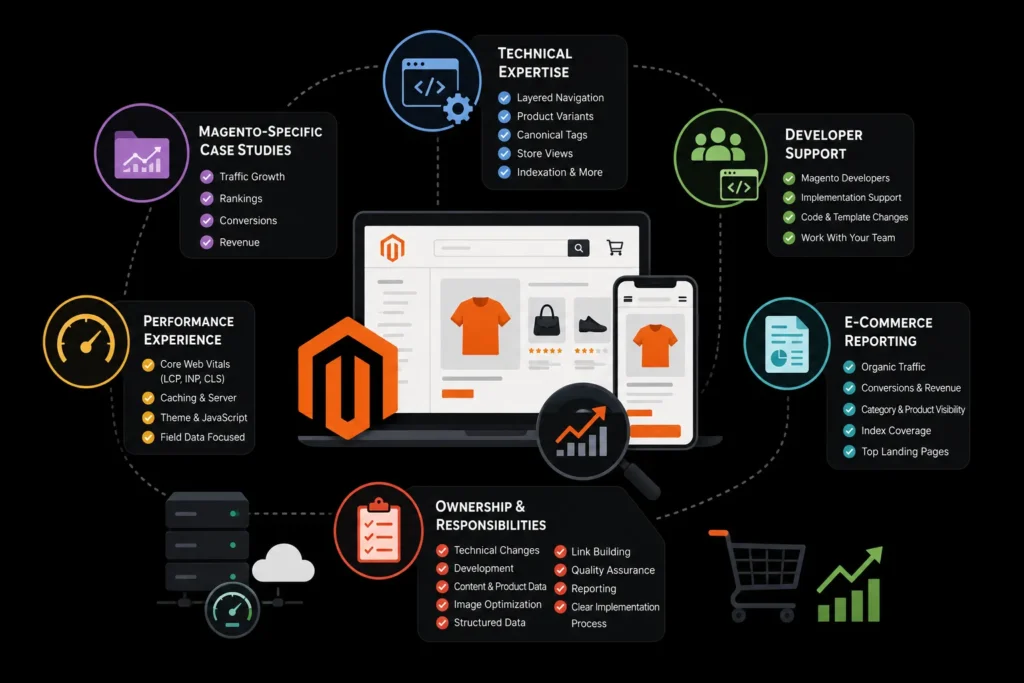
Magento SEO requires both strategic SEO knowledge and technical implementation experience.
Ask for Magento-Specific Case Studies
General SEO case studies are not enough.
Ask for examples showing how the agency improved a Magento store’s:
- Organic traffic
- Category rankings
- Product visibility
- Index coverage
- Core Web Vitals
- Organic conversions
- Revenue
The agency should explain the original problem, technical solution, implementation process, and measurable outcome.
Test Its Technical Knowledge
Ask the agency how it would handle:
- Layered navigation
- Product variants
- Category-path URLs
- Canonical tags
- Internal search pages
- Store views
- URL parameters
- JavaScript rendering
- Caching
- Out-of-stock products
The team should be able to explain its approach clearly rather than providing generic SEO answers.
Confirm Developer Support
Many Magento SEO recommendations require code, theme, extension, server, or template changes.
Ask whether the agency has Magento developers or will work directly with your existing development team.
You should also clarify whether development work is included in the monthly fee.
Review Its Performance Experience
Ask how the agency measures and improves LCP, INP, and CLS.
It should be able to discuss caching, server performance, themes, JavaScript, third-party scripts, images, and field data.
A high Lighthouse score from a single test should not be treated as the only performance measure.
Check Its Ecommerce Reporting
Monthly reports should connect SEO work with commercial outcomes.
Useful metrics include:
- Organic traffic
- Non-brand traffic
- Category visibility
- Product visibility
- Organic conversions
- Transactions
- Revenue
- Average order value
- Index coverage
- Technical fixes
- Best-performing landing pages
Follower counts, impressions, or keyword totals alone do not show whether the store is generating more organic revenue.
Confirm Ownership and Responsibilities
Before signing an agreement, determine who will handle:
- Technical changes
- Development
- Content writing
- Product data
- Category descriptions
- Image optimization
- Structured data
- Link building
- Quality assurance
- Reporting
A clear implementation process prevents recommendations from remaining unfinished.
How Long Does Magento SEO Take?
The timeline depends on the store’s condition, catalogue size, competition, and speed of implementation.
Technical corrections may begin affecting crawling and indexing within several weeks after Google recrawls the updated pages.
Meaningful growth in non-brand traffic, rankings, and revenue commonly requires three to six months of consistent work. Highly competitive stores or major migrations may require longer.
Progress may be slower when:
- Development changes are delayed
- The site has extensive duplication
- Product content is copied
- Categories are poorly structured
- The domain has limited authority
- Competitors have stronger content and links
- The store frequently changes URLs
The agency should establish short-term technical milestones and longer-term commercial goals.
Grow Your Magento Store Through Organic Search
Magento SEO requires more than optimizing product titles and publishing blog posts.
Your store needs a crawlable architecture, controlled faceted navigation, consistent canonical signals, useful category pages, original product information, accurate structured data, strong internal links, and reliable performance.
The right Magento SEO agency should understand both ecommerce search strategy and Magento’s technical requirements. It should work with your developers, prioritize changes according to business impact, and measure success through organic transactions and revenue.
Need professional help optimizing your Magento store? Get a free consultation from MoxSEO and discover how a customized Magento SEO strategy can improve your rankings, qualified traffic, and ecommerce sales.
Frequently Asked Questions
Is Magento good for SEO?
Magento can support strong SEO performance because it provides control over products, categories, metadata, URL keys, store views, and technical configurations. However, large catalogues and customizations require careful management to prevent crawling, duplication, and performance issues.
Can I manage Magento SEO myself?
Store owners can handle basic tasks such as editing titles, descriptions, category copy, and image alt text. Technical work involving layered navigation, canonical tags, performance, JavaScript, and URL architecture may require Magento development and specialist SEO knowledge.
How long does Magento SEO take to produce results?
Some technical improvements may appear within several weeks, while substantial traffic and revenue growth often requires three to six months or longer. The timeline depends on competition, website authority, catalogue quality, and implementation speed.
Does every Magento filter page need to be blocked?
No. Some filtered pages may target valuable searches and deserve dedicated optimization. The agency should evaluate search demand and commercial value instead of applying one rule to every filter.
Should I migrate from Magento to Shopify for SEO?
A migration should not be based only on SEO. Magento offers greater flexibility, while Shopify can be easier to operate. Consider catalogue complexity, integrations, development resources, maintenance costs, and customization needs before changing platforms.
A poorly planned migration can cause temporary or long-term ranking losses through changed URLs, missing redirects, lost content, or altered internal links.

Samruddhi Kadam is an SEO Associate at MoxSEO with 2 years of experience in keyword research, on-page SEO, content optimization, competitor analysis, and website performance tracking. She focuses on improving organic visibility, creating search-friendly content, and identifying practical opportunities to strengthen rankings. Through consistent analysis and data-driven execution, Samruddhi helps businesses attract relevant traffic and build a stronger presence in search results.