





Expanding into international markets creates new opportunities, but ranking in multiple countries requires more than translating your existing website.
Search behaviour, language preferences, competition, terminology, buying habits, and content expectations can differ significantly between markets. A keyword that performs well in India may have different wording, intent, or search demand in the United Kingdom, Germany, the United States, or another country.
An international SEO consultant helps businesses build organic search visibility across multiple countries and languages. They plan the website structure, research local keywords, manage hreflang implementation, improve localized content, and ensure search engines display the correct pages to the correct audience.
This guide explains what an international SEO consultant does, when you should hire one, how international SEO works, what it costs, and how to choose the right consultant for your business.
TL;DR: An international SEO consultant helps your website rank across different countries and languages through market research, localized keyword strategies, hreflang implementation, technical SEO, content localization, and country-specific authority building. Businesses usually hire a consultant before entering a new market or when their existing international pages are not ranking or converting.
What Is an International SEO Consultant?
An international SEO consultant is a specialist who helps websites improve their organic search performance across multiple regions, countries, or languages.
Regular SEO usually focuses on one primary audience. International SEO requires additional planning because search engines need to understand:
- Which countries your website targets
- Which languages each page supports
- Which page version should appear for each user
- How different regional pages relate to one another
- Whether content is properly localized
- Which domain or folder represents each market
An international SEO consultant combines technical SEO, keyword research, content strategy, website architecture, localization, and digital authority building.
Their goal is not simply to generate international traffic. The objective is to attract relevant users from each target market and turn that traffic into enquiries, bookings, subscriptions, or sales.
What Does an International SEO Consultant Do?
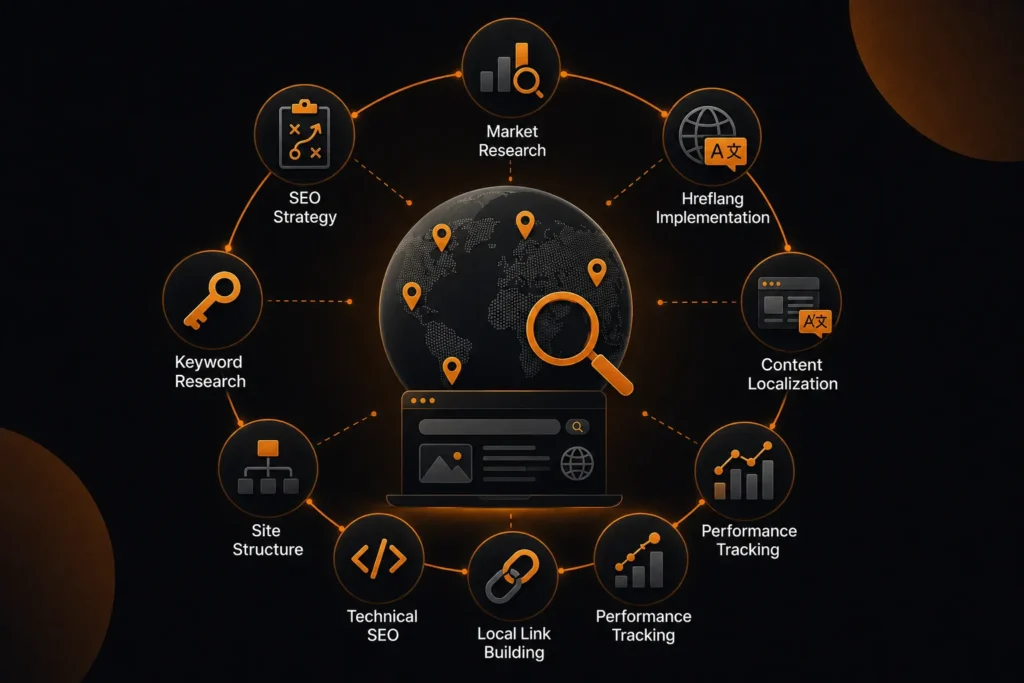
The exact responsibilities depend on your website, industry, existing international presence, and expansion goals.
However, most international SEO consulting projects include the following services.
International Market Research
Before creating pages for multiple countries, the consultant should determine which markets offer realistic opportunities.
This research may include:
- Search demand
- Local competitors
- Keyword difficulty
- Customer behaviour
- Product-market suitability
- Language requirements
- Existing international traffic
- Conversion potential
- Local search engine conditions
A market should not be selected only because it has a large population. The business must also have relevant demand, competitive advantages, suitable pricing, and the ability to serve customers in that location.
International SEO Strategy
The consultant develops a clear plan for targeting different regions and languages.
The strategy should explain:
- Which countries to prioritize
- Which languages to support
- What URL structure to use
- Which pages require localization
- How keywords will be researched
- How technical signals will be implemented
- How local links and authority will be developed
- How performance will be tracked
This strategy helps prevent businesses from creating hundreds of translated pages without a clear search opportunity.
International Keyword Research
Directly translating keywords is one of the most common international SEO mistakes.
People in different countries may use different words to search for the same product or service. Even countries that use the same language may have different terminology.
For example, customers in the United States and United Kingdom may use different words for the same service, product, or location-based need.
An international SEO consultant conducts separate keyword research for every target market. This includes reviewing:
- Local search volume
- Search intent
- Regional terminology
- Commercial keywords
- Informational queries
- Competitor rankings
- Language variations
- Local questions
- Seasonal search patterns
The final keyword strategy should reflect how people actually search in each market rather than how the original content is written.
Website Structure Recommendations
International websites require a clear structure so users and search engines can understand the relationship between regional pages.
The most common international site structures include country-code domains, subdirectories, and subdomains.
The consultant evaluates each option based on your resources, brand strategy, website technology, and expansion plans.
Hreflang Implementation
Hreflang annotations help search engines understand which language or regional version of a page should be presented to different users.
For example, a business may have:
- An English page for India
- An English page for the United Kingdom
- An English page for the United States
- A German page for Germany
- A French page for France
These pages may cover similar products but use different currencies, offers, terminology, legal information, and content.
An international SEO consultant plans and reviews the hreflang setup to ensure the pages are correctly connected.
They should also check:
- Language codes
- Country codes
- Self-referencing annotations
- Return links
- Canonical tags
- Indexable URLs
- Redirect behaviour
- XML sitemap implementation
- The use of an x-default page when appropriate
Hreflang errors can cause search engines to ignore the annotations or show an unsuitable page in search results.
Content Localization
Translation changes words from one language to another. Localization adapts the complete experience for a specific market.
A localized page may require changes to:
- Keywords
- Examples
- Currency
- Measurements
- Dates
- Contact information
- Product availability
- Customer concerns
- Cultural references
- Images
- Calls to action
- Payment methods
- Delivery details
- Legal information
An international SEO consultant works with writers, translators, editors, developers, and regional specialists to ensure the content is useful and commercially relevant.
Automated translation without professional review may produce content that is grammatically correct but unnatural, unclear, or poorly aligned with local search intent.
Technical International SEO
International websites often become technically complex because they contain multiple versions of similar pages.
A consultant may review:
- International URL structures
- Crawlability
- Indexing
- Canonical tags
- Hreflang annotations
- XML sitemaps
- Redirects
- Duplicate content
- Internal linking
- Page speed
- Mobile usability
- JavaScript rendering
- Language selectors
- Regional navigation
- Search Console data
- Server configuration
The consultant should ensure that each market version can be crawled, indexed, and understood correctly.
Local Link Building
A website may have strong authority in its original market but limited recognition in a new country.
Country-relevant backlinks can help search engines understand that the business is trusted and useful within the target region.
International link-building strategies may include:
- Local industry publications
- Regional business directories
- Local media coverage
- Country-specific partnerships
- Relevant associations
- Local guest contributions
- Market-specific digital PR
- Supplier and distributor websites
- Regional resource pages
The focus should be on relevance and quality rather than buying large numbers of low-quality links.
Performance Tracking
International SEO performance should be measured separately for each market.
A consultant may track:
- Organic traffic by country
- Organic traffic by language
- Market-specific keyword rankings
- Indexed international pages
- Search impressions
- Click-through rates
- Leads and sales by country
- Conversion rates
- Revenue by region
- Landing-page performance
- Hreflang errors
- Local backlink growth
Combining all international traffic into one report can hide problems. One country may be growing while another is losing rankings or generating low-quality traffic.
When Should You Hire an International SEO Consultant?
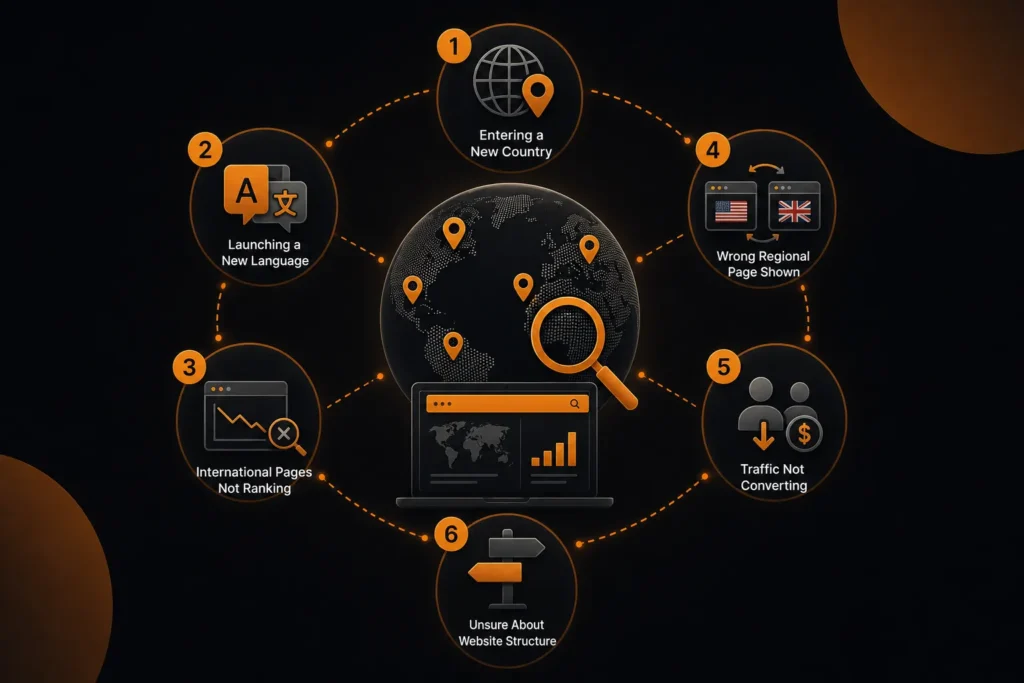
Not every business needs international SEO immediately.
Consider hiring a consultant in the following situations.
You Are Entering a New Country
International SEO should ideally be planned before new country pages are developed.
A consultant can help you choose the correct structure, identify local keywords, plan content requirements, and avoid technical mistakes that may become expensive to fix later.
You Are Launching a New Language Version
Adding another language involves more than translating your homepage and service pages.
You need keyword research, localized metadata, internal linking, hreflang implementation, translated navigation, and market-specific calls to action.
Your International Pages Are Not Ranking
You may already have pages for several countries but receive little organic visibility.
Possible causes include weak localization, technical errors, incorrect hreflang, limited local authority, poor keyword targeting, or search engines indexing the wrong pages.
Search Engines Show the Wrong Regional Page
A user in one country may see a page created for another country.
This can result in incorrect currency, unsuitable offers, irrelevant shipping details, or unfamiliar language.
A consultant can investigate indexing, canonical, hreflang, redirect, and internal-linking issues.
International Traffic Is Not Converting
High international traffic does not always mean the SEO strategy is successful.
Visitors may leave because the page uses the wrong currency, language, terminology, pricing, contact method, payment option, or value proposition.
A consultant can identify whether the problem relates to traffic quality, localization, usability, or market suitability.
You Are Unsure About Website Structure
Choosing between separate domains, subdirectories, and subdomains can affect cost, maintenance, branding, and authority.
This decision should be made before large amounts of international content are published.
International SEO Website Structure Options
There is no single structure that is correct for every website.
The right option depends on your budget, technical resources, market presence, and long-term plans.
Country-Code Top-Level Domains
Examples include:
- example.co.uk
- example.de
- example.fr
Country-specific domains provide a clear connection with a particular market. They can also support local branding and customer trust.
However, every domain must be managed and promoted separately. This can increase development, content, maintenance, and link-building costs.
This structure may suit established companies with dedicated teams and significant resources for each country.
Subdirectories
Examples include:
- example.com/uk/
- example.com/de/
- example.com/fr/
Subdirectories keep all regional content on one primary domain.
They are generally easier to manage and allow different country sections to benefit from the authority of the main website.
For many businesses, subdirectories provide a practical balance between SEO performance, technical management, and international expansion costs.
Subdomains
Examples include:
- uk.example.com
- de.example.com
- fr.example.com
Subdomains allow teams to separate regional websites while keeping them connected to the main brand.
They may be useful when different markets use separate technology, content management systems, or operational teams.
However, they may require more technical coordination and separate authority-building efforts.
How Hreflang Supports International Rankings
Hreflang does not automatically improve rankings. Its main purpose is to help search engines select the most suitable page version for a user.
For example, an English-language page created for India may differ from an English page created for the United States.
Without clear signals, search engines may struggle to determine which page should appear in each country.
A correct hreflang setup helps connect equivalent regional pages.
Each page should generally reference itself and its alternate versions. The relationships should also be reciprocal, meaning linked pages return the same hreflang connection.
The consultant should confirm that hreflang points only to valid, indexable, canonical URLs.
Translation vs Localization in International SEO
Translation focuses on language accuracy. Localization focuses on relevance for the target market.
A translated page may preserve the original structure and messaging. A localized page may change the examples, offers, keywords, tone, images, pricing, and conversion elements.
For example, a service page targeting the United Kingdom may require different terminology and pricing than a page targeting India or the United States.
Effective localization should consider:
- Local search behaviour
- Regional language variations
- Customer expectations
- Competitor messaging
- Currency
- Tax information
- Shipping availability
- Local proof and testimonials
- Preferred contact methods
- Legal requirements
A technically correct international website may still fail if the content feels generic or unsuitable for local users.
Common International SEO Mistakes
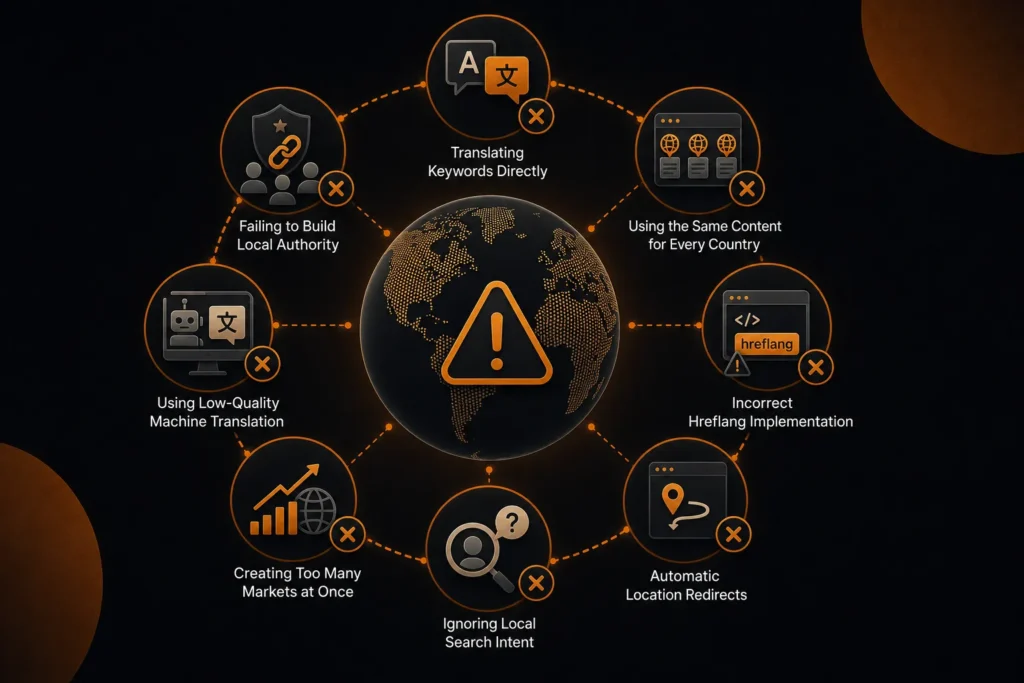
International SEO mistakes can affect rankings, user experience, and conversions across several markets.
Translating Keywords Directly
A direct translation may not match the words customers use in the target country.
Conduct independent keyword research for each language and location.
Using the Same Content for Every Country
Changing only the country name is rarely enough.
Regional pages should provide meaningful differences such as local pricing, availability, examples, terminology, and customer information.
Incorrect Hreflang Implementation
Common issues include invalid codes, missing return links, non-indexable URLs, conflicting canonical tags, and annotations pointing to redirected pages.
Automatic Location Redirects
Automatically forcing users to a regional page can create a poor experience, especially for travellers, multilingual users, or people using international networks.
A visible country and language selector usually gives users more control.
Ignoring Local Search Intent
A keyword may have informational intent in one country and commercial intent in another.
Content should be based on the local search results and customer journey.
Creating Too Many Markets at Once
Launching ten country sections without enough content, localization, or promotion can spread resources too thin.
It is often better to build a strong presence in one or two priority markets before expanding further.
Using Low-Quality Machine Translation
Automated tools can support translation workflows, but important commercial pages should be reviewed by a fluent editor or local subject expert.
Failing to Build Local Authority
Publishing localized content alone may not be enough in competitive markets.
The website may also need local links, mentions, partnerships, reviews, and market-specific trust signals.
How Much Does an International SEO Consultant Cost?
International SEO pricing depends on the number of markets, website size, languages, competition, content requirements, and technical complexity.
One-Time International SEO Audit
A detailed audit may cost approximately Rs 30,000 to Rs 75,000.
It may cover site structure, hreflang, indexing, localized content, keyword targeting, technical problems, and international visibility.
Monthly Consulting Retainer
Ongoing consulting may cost around Rs 40,000 to Rs 1,50,000 per month.
Monthly services may include strategy, technical monitoring, content planning, keyword research, reporting, localization support, and international authority building.
Project-Based International SEO
A specific project may cost approximately Rs 50,000 to Rs 3,00,000 or more.
Projects may include:
- Hreflang implementation
- International website migration
- Country-section launch
- URL restructuring
- Market-entry research
- Multilingual content planning
- International technical audit
International consultants serving global businesses may charge approximately $1,000 to $5,000 or more per month, depending on experience and project scope.
Request a detailed proposal that explains the markets, deliverables, responsibilities, timelines, and additional costs.
How to Choose the Right International SEO Consultant
International SEO requires a combination of strategic, technical, and content expertise.
Use the following factors to evaluate a consultant.
Review International Case Studies
Ask for examples showing results in specific countries or languages.
A useful case study should explain:
- The markets targeted
- The original problem
- The website structure
- The strategy used
- Technical changes
- Content improvements
- Ranking or traffic results
- Business outcomes
Overall traffic growth is not enough if the consultant cannot explain which regions improved.
Test Their Hreflang Knowledge
Ask how they would handle multiple pages targeting the same language across different countries.
A qualified consultant should be able to discuss self-referencing annotations, reciprocal links, x-default, canonical tags, XML sitemap implementation, and common validation errors.
Check Relevant Market Experience
Experience in your target country is valuable because keyword behaviour, competition, and content expectations vary.
The consultant does not need to live in every target market, but they should have a process for working with local writers, researchers, translators, and subject experts.
Ask About Localization
Avoid consultants who recommend simply translating every page.
A good consultant should discuss local keyword research, market-specific content, cultural adaptation, local proof, pricing, calls to action, and conversion behaviour.
Evaluate Their Technical Skills
International SEO often involves developers, content management systems, migrations, redirects, canonical tags, JavaScript, and server configurations.
The consultant should be able to identify technical problems and provide clear implementation instructions to your development team.
Review Their Reporting Process
Reports should separate results by country, language, directory, and conversion goal.
Ask how frequently reporting is provided and which metrics will be used to evaluate success.
Confirm the Scope of Work
Clarify whether the consultant will only provide recommendations or also support implementation.
You should know who is responsible for:
- Technical changes
- Translation
- Content writing
- Keyword research
- Link building
- Development
- Quality assurance
- Reporting
Clear responsibilities help prevent delays.
How Long Does International SEO Take?
International SEO is a long-term strategy.
Technical corrections such as hreflang fixes, canonical changes, and indexing improvements may begin showing results within a few weeks after search engines recrawl the website.
However, meaningful organic growth in a new market commonly takes six to twelve months.
The timeline depends on:
- Website authority
- Competition
- Market size
- Technical condition
- Content quality
- Number of localized pages
- Local backlinks
- Brand recognition
- Available resources
Entering a competitive market with a new regional section usually takes longer than improving an established international website.
Expand Your Organic Visibility Internationally
Ranking in multiple countries requires more than publishing translated versions of your existing pages.
A successful international SEO strategy combines market research, localized keyword targeting, suitable website architecture, accurate hreflang implementation, regional content, technical optimization, and country-relevant authority.
The right international SEO consultant can help you avoid expensive structural mistakes and create a clear strategy for entering new markets.
Need an international SEO consultant for your business? Get a free consultation from MoxSEO and discover how a customized international search strategy can help you reach customers across multiple countries and languages.
Frequently Asked Questions
What is the difference between regular SEO and international SEO?
Regular SEO usually targets one primary country or language. International SEO targets multiple countries or languages and requires additional planning for website structure, localized keywords, hreflang, regional content, and market-specific authority.
Do international websites need hreflang?
Hreflang is useful when a website has alternate pages for different languages or regions. It helps search engines understand the relationship between these pages and select the most suitable version for users.
Should I use country domains or subdirectories?
Subdirectories are practical for many businesses because they are easier to manage and remain under one primary domain. Country-specific domains may suit established businesses with separate teams, budgets, and branding for each market.
Can I use automatic translation for international SEO?
Automatic translation can support the initial process, but important pages should be reviewed by fluent editors or regional experts. Content should also be adapted to local keywords, terminology, customer expectations, and conversion behaviour.
How many countries should I target first?
Most businesses should begin with one or two priority markets. This allows enough resources for proper research, content localization, technical implementation, and promotion before expanding further.
Why is my international traffic not converting?
Low conversions may result from irrelevant keywords, unsuitable language, incorrect currency, weak localization, poor local trust, unavailable payment methods, or visitors landing on the wrong regional page.
Related guides in International SEO
- International SEO Services: A Guide to Global Search Visibility
- International SEO Agency: How to Rank Across Countries
Need this handled for you? Explore our International SEO service.

Samruddhi Kadam is an SEO Associate at MoxSEO with 2 years of experience in keyword research, on-page SEO, content optimization, competitor analysis, and website performance tracking. She focuses on improving organic visibility, creating search-friendly content, and identifying practical opportunities to strengthen rankings. Through consistent analysis and data-driven execution, Samruddhi helps businesses attract relevant traffic and build a stronger presence in search results.