






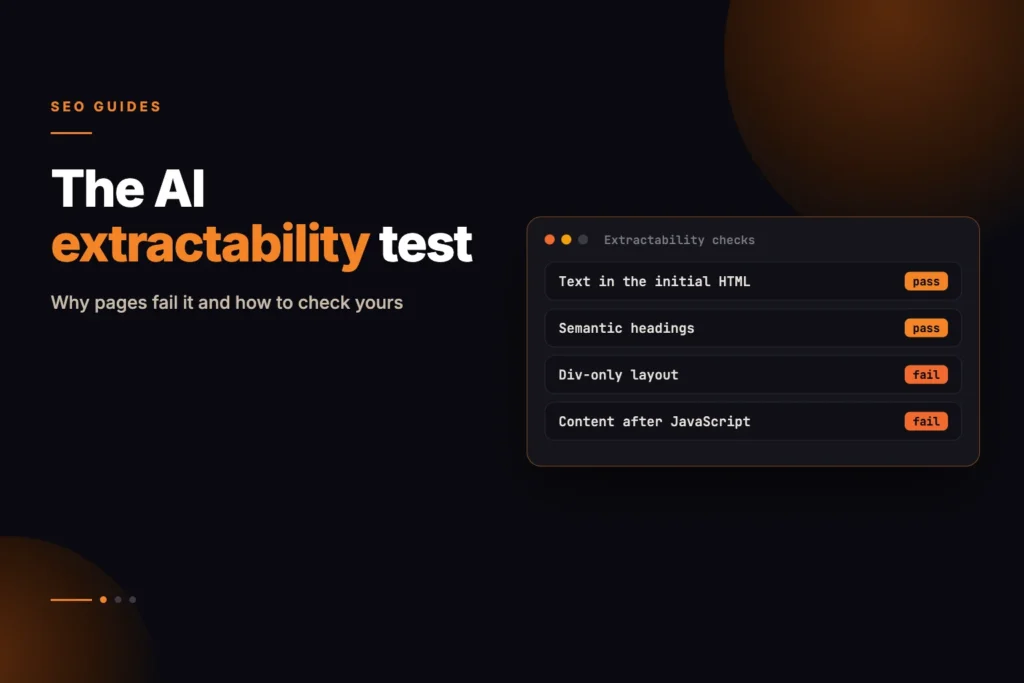
In the legacy era of SEO, a website was judged by two primary metrics: how fast it loaded (Core Web Vitals) and how many authoritative backlinks it possessed (PageRank). Today, as Google’s AI Overviews, Perplexity AI, and ChatGPT Search answer a growing share of informational queries, a third, far more critical metric has emerged: AI Extractability.
If a Large Language Model (LLM) cannot effortlessly parse, isolate, and extract facts from your HTML Document Object Model (DOM), your brand will be excluded from the conversational AI ecosystem. In our study of 243 high-traffic domains (homepages drawn from the Tranco top-1M list), only 3.3% reached the “Strong” band on our extractability score, and 64.6% scored “Weak”. Put another way, roughly 97% did not pass at the top level. Here is why your website is likely failing, and exactly how to fix it.
Short answer: AI extractability is how easily a machine can lift a clear, self-contained answer from your page. Pages that open with a direct answer, use question-form headings, keep facts in lists and real tables, put the text in the initial HTML, and declare an author, dates and structured data are easier to extract and quote. You can test these signals in minutes with our free checker, which reads the HTML the server returns.
Chapter 1: The New Metric: AI Extractability
Extractability is not readability. Readability refers to how easily a human can consume your content—short paragraphs, engaging typography, and relevant images. Extractability is a purely technical metric. It measures the mathematical efficiency with which an algorithmic crawler can identify an entity, locate the definitive statement about that entity, and export it into a vector database without context loss.
An extractable page has zero semantic ambiguity. An LLM never has to guess whether a string of text is a navigation link, a marketing tagline, or a factual definition.
Chapter 2: Why Visual Design Doesn’t Matter to LLMs
One of the hardest concepts for modern marketing teams to grasp is that AI models are completely blind to CSS. Your beautifully designed, parallax-scrolling SaaS landing page with gradient backgrounds and hover states looks like a chaotic wall of text to an LLM.
When developers prioritize visual layout over semantic HTML structure, they inadvertently destroy extractability. If you use CSS grid to visually align a heading next to a paragraph, but structurally in the DOM they are separated by 40 lines of container <div> code, the LLM will fail to connect the heading (the question) with the paragraph (the answer).
Chapter 3: The Three Pillars of Extractable HTML
To pass the extractability test, your HTML architecture must be built on three foundational pillars:
- Semantic Tagging: Using HTML5 native tags (
<article>,<section>,<aside>) to explicitly define the purpose of a block of content. - Proximity: The principle of “Zero-Distance DOM.” Related entities (like a question and an answer, or a product and its price) must sit adjacent to each other in the raw HTML code, not just visually on the screen.
- JSON-LD Anchoring: Deploying detailed Schema markup to serve as a machine-readable redundant backup to your HTML text.
Chapter 4: Failing the Test: The JavaScript Trap
The most common reason enterprise sites fail the extractability test is heavy reliance on Client-Side Rendering (CSR). Frameworks like React, Angular, and Vue are incredible for building web applications, but they can be hostile to real-time AI crawlers.
Real-time crawlers like OAI-SearchBot (OpenAI’s crawler for ChatGPT search features, as described in OpenAI’s bot documentation) fetch pages on behalf of search features. OpenAI does not document whether its crawlers execute JavaScript, so the safe assumption is that they may not. If your core factual text is not present in the initial HTML payload and requires JavaScript to render into the DOM, the crawler may never see it. To fix this, critical definitions and pricing tables must be statically rendered (SSR or SSG). Our AI fetch timeout risk checker can help you gauge how risky a slow or script-dependent page is.
Chapter 5: Failing the Test: The Div Soup Problem
“Div Soup” occurs when page builders (like Elementor or WPBakery) wrap simple text in dozens of nested, meaningless <div> containers to achieve complex visual layouts.
Every time an LLM crawler encounters a <div>, it must work out whether the container holds semantic value or just layout instructions. Deeply nested divs make it harder for a parser to separate main content from layout, which can lead to extraction errors. There is no published threshold for how deep is too deep, so the practical rule is to keep the structure as flat as the design allows.
Chapter 6: Failing the Test: Missing Semantic Relationships
If you list your pricing as a massive image file, or if you build your feature comparison matrix using CSS flexbox instead of native HTML <table> tags, you have destroyed the semantic relationship between the data points. AI models are trained to parse tabular data (rows and columns). If you break that native structure, the model cannot extract the comparison logic.
Chapter 7: How the AI Extractability Checker Works
You cannot fix what you cannot see. Because humans perceive the web visually, it is almost impossible for a marketer to look at a webpage and determine if it is extractable. That is why MoxSEO engineered the AI Answer Extractability Checker.
Our tool fetches one public URL and reads the HTML the server returns, without running JavaScript. It removes scripts, navigation, header, footer and forms first, then runs nine weighted structural checks on what is left. For each check it shows a pass or fail, why it matters and how to fix it, plus a panel showing what the checker read: the opening paragraph, the heading outline and the schema types it found. If that panel is empty while the page looks full in a browser, the content is probably rendered by JavaScript.
What Are the Nine Checks and How Are They Scored?
| Check | Pass condition | Raw points |
|---|---|---|
| Opening answer | First paragraph of eight or more words runs 25 to 90 words | 20 |
| Lists or tables | At least two lists or tables in the main content | 15 |
| H2 sections | At least three H2 sections | 15 |
| H1 | Exactly one H1 | 10 |
| Question headings | At least two headings phrased as questions | 10 |
| Paragraph length | No more than two paragraphs over 120 words | 10 |
| Structured data | At least one JSON-LD schema.org type | 10 |
| Author and dates | Author declared, plus datePublished or dateModified | 10 |
| External citations | Links to two or more other domains | 10 |
The checks total 110 raw points, shown on a 100-point scale. There is no partial credit: each check passes or fails. The weights reflect our own judgement about what makes a passage quotable, not a published standard, so treat the score as a diagnostic rather than a guarantee of citation.
Chapter 8: Interpreting Your Extractability Score
When you run your URL through our Extractability Checker, you will receive a diagnostic score. Here is how to interpret the results:
- Weak (Score below 55): Your page is missing several basics, often because the content is trapped in JavaScript or Div Soup, or because there is no direct answer. LLMs have trouble isolating your core facts, so you are at risk of being omitted or misquoted.
- Workable (Score 55-79): The LLM can find your text, but struggles with the relationship between headings and answers. You need to implement the Zero-Distance DOM rule.
- Strong (Score 80+): Your page is semantically clean, backed by JSON-LD, and well placed to be quoted in AI answers.
What Did the 243-Domain Study Find?
MoxSEO’s AI Answer Extractability Study, authored by Sakshi Kumari, drew 506 domains from the Tranco top-1M list on 26 July 2026. Of those, 243 returned a fetchable homepage and were scored. The results:
- Strong (80+): 8 sites, or 3.3%.
- Workable (55-79): 78 sites, or 32.1%.
- Weak (below 55): 157 sites, or 64.6%. The median score was 45 out of 100.
- Pass rates by check were lowest for author and dates (5.8%), question-form headings (16.9%) and a direct answer near the top (20.6%).
The study has limits worth knowing. It scored homepages, not articles, so editorial pages may do better. The 48% yield probably skews toward sites with lighter bot protection. The raw data is published with the study so you can check it yourself.
Chapter 9: Remediation: Step-by-Step Fixes for Developers
If your site fails the test, hand this exact checklist to your engineering team:
- Implement SSR: Move from Client-Side Rendering to Server-Side Rendering for all high-value content pages.
- Refactor DOM Trees: Flatten the DOM. Replace layout-driven
<div>tags with semantic HTML5 tags. - Inject Schema: Ensure every single page has a valid JSON-LD script block containing
Article,FAQPage, orProductschema. - Use Native Tables: Rebuild all feature comparisons and pricing tiers using strict HTML
<table>markup.
What Content Fixes Raise Extractability Without Developer Time?
Most of the cheapest wins are editorial and can be done in a CMS:
- Open with the answer. Put a 25 to 90 word direct answer to the page’s main question in the first paragraph.
- Rewrite headings as questions where that is how people search, for example “How much does X cost?”
- Turn dense paragraphs into lists or tables, and split any paragraph over 120 words.
- Show the author and dates on the page and in the markup.
- Cite at least two outside sources, ideally primary ones, with normal links.
- Check one H1 per page; page builders often add several.
A hypothetical example: a software company’s pricing page shows its plans as three styled boxes made from nested divs, with the headline “Plans that grow with you” and the explanation in a script-loaded widget. A more extractable version has an H1, an opening sentence that says what the plans are and who they suit, a real table of plans and prices, and question-form headings such as “What is included in each plan?”. The design can look the same; the structure underneath is what changes.
How Do I Check Whether AI Crawlers Can Reach My Pages at All?
Extractability only matters if bots can fetch the page. OpenAI’s documentation describes OAI-SearchBot as the crawler for ChatGPT search features and GPTBot as the crawler for content that may be used to train its models, and says both are controlled separately through robots.txt. If you block the search crawler, your pages may not appear in ChatGPT search answers. Check your rules with our AI crawler access checker, review structured data with the schema markup validator, and consider publishing a guide for AI systems with the llms.txt generator. Our AI crawler blocking study looks at how common blocking is.
Chapter 10: Conclusion – Engineering for Extraction
The era of treating a website like a digital magazine is over. In the age of Generative Engine Optimization, your website is an API for artificial intelligence. By ruthlessly auditing your site with the MoxSEO AI Extractability Checker and executing the developer remediation steps, you ensure your brand narrative is permanently injected into the world’s most powerful conversational engines.
Frequently Asked Questions
What is AI extractability?
AI extractability is how easily a machine can identify and lift a clear, self-contained answer from your page. It depends on structure, such as a direct opening answer, headings, lists, tables and structured data, and on the text being present in the initial HTML.
Does a high extractability score guarantee AI citations?
No. The score measures structure, not the quality or authority of your content, and AI products choose sources in ways they do not fully disclose. A strong score removes avoidable obstacles; it does not promise a citation.
Does the checker run JavaScript?
No. It reads the HTML the server returns and removes scripts, navigation, header, footer and forms before running its checks. If the content only appears after JavaScript runs, the checker will show little or nothing, which is the same problem a non-rendering crawler would face.
How long should the opening answer be?
The checker passes a first paragraph of 25 to 90 words that directly answers the page’s main question. In our study the median opening paragraph was 18 words, and 69 sites had no substantial opening paragraph at all.
Do I need schema markup for AI search?
Structured data is one of the nine checks, and it gives machines a second, explicit copy of key facts. It does not replace clear on-page text, but it helps. Validate it with the schema markup validator and keep it consistent with the visible content.
Should I block AI crawlers?
That is a business decision. OpenAI says blocking OAI-SearchBot means a site will not appear in ChatGPT search answers, while GPTBot controls use for model training and is set independently. Decide per crawler, and check your robots.txt matches your intent.
Want a specialist to review your pages? See our AI SEO service, read how we work on the methodology page, or contact us.
👉 Audit your website now using the Free AI Extractability Checker.
Related Enterprise SEO & AI Search Resources:
Explore our specialized AI SEO & Generative Engine Optimization Services, review our comprehensive AI SEO Packages, or audit your site with the free AI Answer Extractability Checker and llms.txt Generator.