



For twenty years, Search Engine Optimization was a monoculture. You optimized for Google’s algorithm, and the rest of the web followed suit. Today, the monopoly of the blue-link Search Engine Results Page (SERP) is fractured. Brands must now navigate a bifurcated ecosystem, optimizing simultaneously for two distinct, competing artificial intelligence paradigms: ChatGPT Search (OpenAI) and Google AI Overviews (SGE).
While both systems use Large Language Models (LLMs) to synthesize answers, their underlying retrieval mechanics, ranking signals, and user intents are fundamentally different. A strategy that dominates Google AI Overviews will often fail completely in ChatGPT Search. To maintain digital visibility, enterprise SEOs must master the dual-engine strategy.
What is the difference between ChatGPT Search and Google AI Overviews?
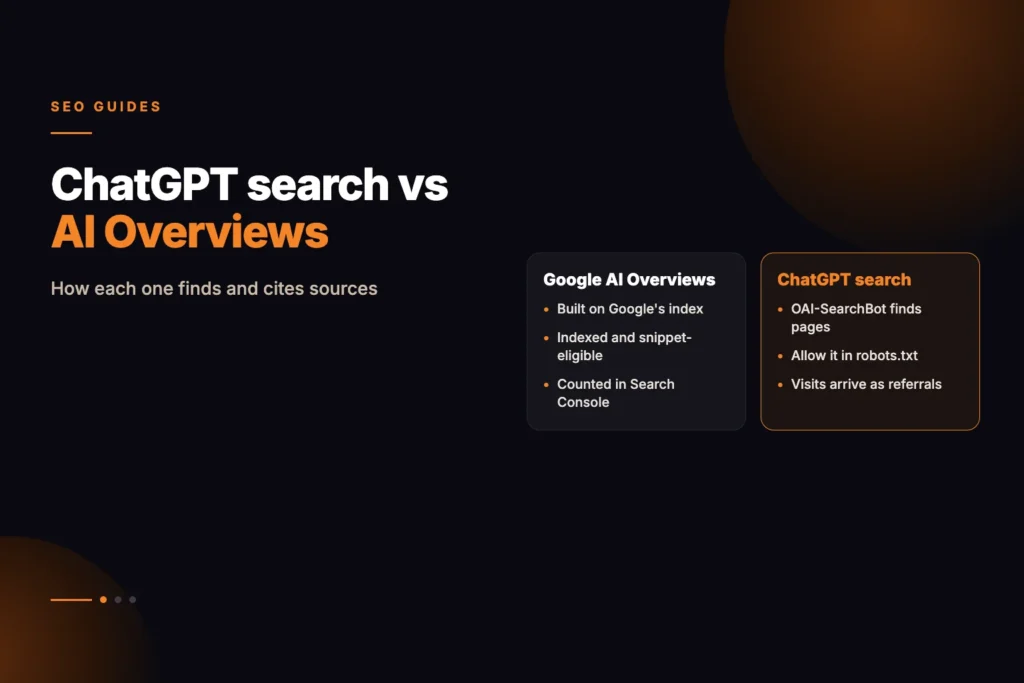
Google AI Overviews are generated inside Google Search and link to pages that are indexed and eligible to appear in Search with a snippet, with no additional technical requirements. ChatGPT Search surfaces sites through OpenAI’s own crawler, OAI-SearchBot, which you control separately in robots.txt. So the practical difference is which crawler, index and controls decide whether your page can be cited. The two are not interchangeable.
Accuracy note (October 2026): the chapters below mix what Google and OpenAI document with practitioner interpretation. Where a claim is not documented by either company we say so, and where official documentation contradicts a statement we have corrected it. The section “What do Google and OpenAI actually document?” lists only documented points, each with a link.
Chapter 1: The Fragmentation of the SERP
The traditional SERP was a routing mechanism. Google evaluated billions of documents and presented the user with a ranked list of URLs. The user clicked the link, left Google, and consumed the content on the creator’s domain.
The AI-driven SERP is a synthesis mechanism. Both Google and OpenAI are transitioning from search engines to “Answer Engines.” Their goal is zero-click resolution: keeping the user within their interface by extracting the answer directly from your content and citing you in a footnote. However, how they choose which domain to cite varies drastically.
Chapter 2: Understanding Google AI Overviews (SGE)
Google AI Overviews (formerly Search Generative Experience) sits on top of Google’s traditional infrastructure. It is triggered primarily for complex, multi-layered informational queries that previously required a user to synthesize data from multiple blue links (e.g., “What are the best CRM tools for a healthcare startup with HIPAA compliance?”). Google’s documentation adds that AI Overviews appear only when the system judges them additive to classic Search, and they often do not trigger.
Because Google has a massive existing index and a legacy of algorithmic trust, many practitioners find that AI Overviews cite domains that already have strong traditional authority. Google does not document authority as a requirement; its stated condition is that a page is indexed and eligible to appear with a snippet.
Chapter 3: Understanding ChatGPT Search (OpenAI)
ChatGPT Search is not burdened by a legacy index of twenty years of PageRank. When a user queries ChatGPT, the model retrieves current web data, reads the DOM of the top results, and synthesizes an answer conversationally. OpenAI documents its crawler OAI-SearchBot as the bot used to surface websites in ChatGPT’s search features; the sources we could open do not describe which other providers are involved, so treat claims about the Bing API as unconfirmed.
ChatGPT prioritizes real-time extraction, semantic HTML structure, and citation consensus over historical domain authority. These priorities are practitioner observations rather than something OpenAI publishes as ranking signals.
What do Google and OpenAI actually document?
The table lists only differences stated in official documentation: Google Search Central’s page on AI features and your website and OpenAI’s overview of its crawlers. OpenAI’s help-centre and announcement pages returned access errors when we tried to open them, so this comparison does not use them.
| Question | Google AI Overviews (Google documentation) | ChatGPT Search (OpenAI documentation) |
|---|---|---|
| What makes a page eligible to be linked? | It must be indexed and eligible to appear in Search with a snippet. Google says there are no additional technical requirements. | OpenAI says OAI-SearchBot is used to surface websites in ChatGPT’s search features and recommends allowing it in robots.txt, and allowing its published IP ranges. |
| How is the system described? | AI Overviews and AI Mode may use “query fan-out”, running multiple related searches, so they can show a wider and more diverse set of links than classic search. Overviews appear only when judged additive, and often do not trigger. | Not detailed in the crawler documentation. We do not state how links are chosen. |
| Do I need special files or markup? | No. Google says no special optimisations, new machine-readable files, AI text files or special schema.org structured data are required. | The crawler documentation does not mention llms.txt or any special markup. Access is controlled through robots.txt. |
| How do I control it? | Googlebot robots.txt rules govern crawling for Search. To limit what is shown, use nosnippet, data-nosnippet, max-snippet or noindex. Google-Extended covers AI training and grounding in other Google systems. | Separate robots.txt settings per crawler: OAI-SearchBot for search, GPTBot for training of generative AI foundation models, ChatGPT-User for user-initiated actions, where robots.txt rules may not apply. |
| How fast do changes apply? | For preview controls, allow time for recrawling, which can take days to months. | OpenAI says it can take about 24 hours from a robots.txt update for its systems to adjust. |
| Where do I see the traffic? | Included in Search Console’s Performance report under the Web search type. | Not covered in the crawler documentation. |
Two details matter for planning. First, OpenAI says sites opted out of OAI-SearchBot will not be shown in ChatGPT search answers, though they can still appear as navigational links. Second, OpenAI says each robots.txt setting is independent, so you can allow OAI-SearchBot for search visibility while disallowing GPTBot to opt out of training.
Chapter 4: Core Difference 1 – PageRank Reliance vs Real-Time Extraction
The most critical difference between the two systems is their reliance on legacy authority metrics.
- Google AI Overviews: To be linked from a Google AI Overview, a page must be indexed and eligible to appear in Search with a snippet. Google also says its systems may run multiple related searches and show a wider and more diverse set of links than classic search, so ranking in the top 10 for the exact query is not a documented requirement. Traditional SEO work still matters because it gets your pages indexed, understood and trusted. Pages with few links and little authority are, in practice, less likely to be chosen, but this is a practitioner observation and not something Google documents.
- ChatGPT Search: OpenAI is far more democratic regarding domain authority. If a low-authority site has highly extractable, semantically perfect HTML that directly answers the user’s prompt, ChatGPT will frequently cite it over a high-authority site burdened with messy, JavaScript-heavy DOMs. (This is a practitioner view; OpenAI does not publish ranking factors.)
Chapter 5: Core Difference 2 – Informational Synthesis vs Conversational Reasoning
The user intent driving the queries is vastly different between the two platforms.
Google AI Overviews are highly transactional and informational. They excel at aggregating product reviews, summarizing local business data (via Google Maps integration), and providing synthesized definitions. They are triggered by traditional search behaviors.
ChatGPT Search handles multi-step conversational reasoning. Users don’t just ask “Best CRM”; they ask, “I have a budget of $500/month, a team of 10, and I need Salesforce integration. Analyze the top 3 CRMs and tell me which is best.” ChatGPT will extract pricing tables, feature lists, and integration specs from multiple sites and perform comparative logic.
Chapter 6: Core Difference 3 – Traditional E-E-A-T vs Citation Consensus
Google relies heavily on its E-E-A-T framework (Experience, Expertise, Authoritativeness, Trustworthiness). Google says E-E-A-T itself is not a specific ranking factor, and that a page only needs to be indexed and eligible to appear with a snippet to be linked from an AI Overview.
ChatGPT relies on Citation Consensus. When ChatGPT searches the web, it reads multiple sources. If five different domains all state a specific fact, and your domain contradicts it (even if your domain has higher authority), ChatGPT will likely output the consensus fact. To control your narrative in ChatGPT, your brand information must be consistent across third-party review sites, PR mentions, and your official domain.
Note: “Citation consensus” is a working model used by practitioners, not an OpenAI-documented mechanism. The advice that follows from it, keeping your brand facts consistent everywhere, is sound regardless. Our NAP consistency checker and entity schema generator help with that.
Chapter 7: How to Optimize for Google AI Overviews
Optimizing for Google SGE requires a hybrid of traditional SEO and semantic structuring:
- Maintain Traditional SEO: You must still build backlinks, optimize core web vitals, and target high-volume keywords to ensure you rank in the top 10 candidate set.
- Information Gain: Google’s LLM specifically looks for “Information Gain”—unique data, original research, or proprietary insights that the other top 9 ranking pages do not possess.
- Target “Long-Tail Synthesis” Queries: Optimize for queries that require combining multiple data points (e.g., “How does [Product A] compare to [Product B] for [Specific Use Case]?”).
Correction: the “top 10 candidate set” and “Information Gain” points above are practitioner heuristics. Google’s documentation says only that a page must be indexed and snippet-eligible, that no extra optimisation is required, and that structured data should match the visible text on the page. Original, useful content is still good practice, and you can check yours with our AI answer extractability checker.
Chapter 8: How to Optimize for ChatGPT Search
Optimizing for OpenAI requires strict technical adherence to Generative Engine Optimization (GEO) principles:
- Allow
OAI-SearchBotin robots.txt: This is the documented step. OpenAI recommends allowing the bot and its published IP ranges, and says robots.txt changes can take about 24 hours to take effect. Check yours with our AI crawler access checker. Anllms.txtfile is optional: neither OpenAI’s crawler documentation nor Google’s AI features page requires one, so do not rely on it as a roadmap forOAI-SearchBot. If you want one anyway, our llms.txt generator can create it. - Deploy AI-Quotable Blocks: Ensure your pages have zero-distance DOM structures, where exact H3 questions are followed immediately by direct paragraph answers.
- Rigorous JSON-LD Schema: Use accurate
Product,Organizationand similar schema that matches the visible page, so your prices and features are stated clearly in machine-readable form. Avoid relying on FAQPage markup: Google stopped showing the FAQ rich result in Search on 7 May 2026 and has since removed its FAQ structured data documentation. Validate markup with our schema markup validator.
Chapter 9: The Hidden Role of the Bing Index
Many practitioners report that ChatGPT Search draws on Bing’s index to retrieve real-time data, and that a site de-indexed or poorly ranked in Bing is therefore hard to find in ChatGPT. We could not confirm this in OpenAI documentation we were able to open, so treat it as unverified. Even so, Bing Webmaster Tools is free, takes minutes to set up and shows whether your pages are indexed, so it is worth having. The documented requirement is simpler: do not block OAI-SearchBot.
How do you set up for both engines, step by step?
- Check indexing and snippets for Google. Confirm the page is indexed in Search Console, and that you have not set
nosnippetor a very lowmax-snippeton pages you want linked. - Check crawler access for OpenAI. Review robots.txt for
OAI-SearchBot,GPTBotandChatGPT-User, and decide each separately. You can allow search while disallowing training. - Make the answer easy to lift. Put a direct 40 to 60 word answer under a question heading, then supporting detail.
- Make facts consistent. Name, address, pricing, product features and author names should read the same on your site and your profiles.
- Make markup match the page. Schema that disagrees with visible text creates doubt.
- Measure what you can. In Search Console, AI Overview traffic is included in the Web search type. For ChatGPT, check your server logs for the crawler user agents and your analytics referrals.
What mistakes do brands make with AI search?
| Mistake | Why it hurts | Fix |
|---|---|---|
| Blocking all AI bots with one rule | Blocking OAI-SearchBot keeps you out of ChatGPT search answers | Decide search, training and user-initiated agents separately |
| Believing a file will guarantee citations | Neither company documents an AI text file as a requirement | Spend the time on crawl access and clear content first |
| Hiding the answer in a long introduction | Nothing short to quote | Lead with the answer |
| Schema that contradicts the page | Conflicting facts | Generate markup from the same source as the page |
| Treating practitioner theories as rules | Wasted effort on unproven tactics | Prefer documented steps, and test the rest |
Chapter 10: Conclusion – The Dual-Engine Strategy
The era of single-engine optimization is over. Brands that rely solely on traditional Google PageRank will find themselves slowly erased from conversational AI platforms like ChatGPT. Conversely, brands that optimize purely for AI extraction while ignoring traditional link building will fail to trigger Google AI Overviews.
The modern SEO strategy requires a dual-engine approach: maintaining robust traditional authority to feed Google’s SGE, while ruthlessly optimizing HTML structure, deploying JSON-LD schema, and managing citation consensus to dominate the real-time retrieval logic of ChatGPT Search.
Frequently asked questions
Do I need to rank in the top 10 to appear in a Google AI Overview?
Google does not document a top 10 requirement. It says a page must be indexed and eligible to appear in Search with a snippet, and that its systems may run multiple related searches and show a wider set of links than classic search.
How do I let ChatGPT Search include my site?
OpenAI says OAI-SearchBot is used to surface websites in ChatGPT’s search features, and recommends allowing it in robots.txt and allowing its published IP ranges. Sites opted out will not be shown in ChatGPT search answers.
Can I appear in ChatGPT search but block training?
Yes. OpenAI states that its robots.txt settings are independent. Allow OAI-SearchBot for search and disallow GPTBot to indicate your content should not be used to train its generative AI foundation models.
Do I need llms.txt for either one?
Google says no new machine-readable files, AI text files or markup are required for AI Overviews or AI Mode. OpenAI’s crawler documentation does not mention llms.txt. It may be harmless, but it is not a documented requirement.
Where do AI Overview clicks show up in my reports?
Google says sites appearing in AI Overviews and AI Mode are included in overall search traffic in Search Console, in the Performance report under the Web search type. There is no separate AI Overview report in that documentation.
Related Enterprise SEO & AI Search Resources:
Explore our specialized AI SEO & Generative Engine Optimization Services, review our comprehensive AI SEO Packages, or audit your site with the free AI Answer Extractability Checker and llms.txt Generator. See also our AI answer extractability study and AI crawler blocking study.