




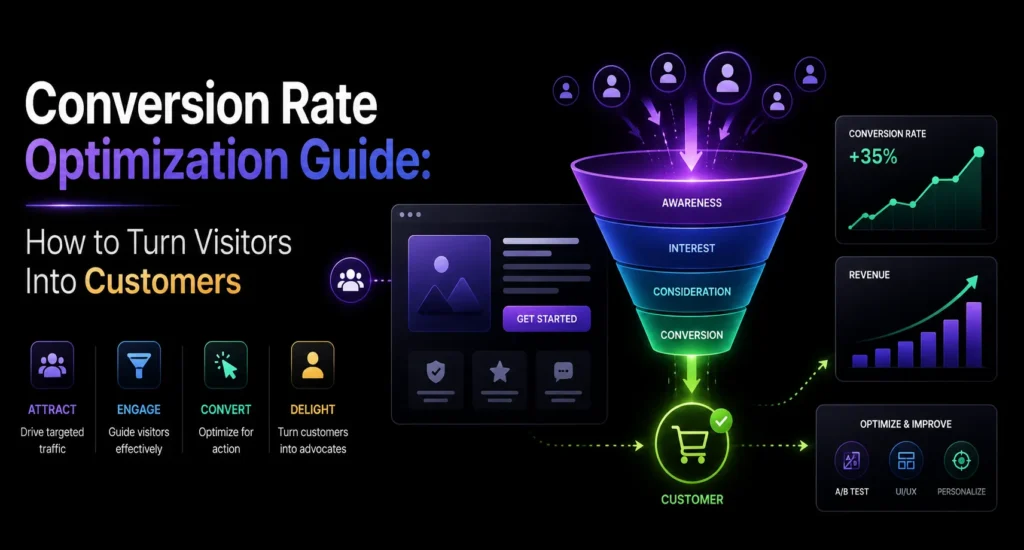
Conversion rate optimization (CRO) is the process of increasing the percentage of your website visitors who take a desired action, whether that is filling out a form, making a purchase, booking a call, or signing up for a newsletter. Most businesses focus on driving more traffic but ignore what happens after visitors arrive. If your conversion rate is low, more traffic just means more wasted visitors. CRO ensures your traffic actually turns into revenue.
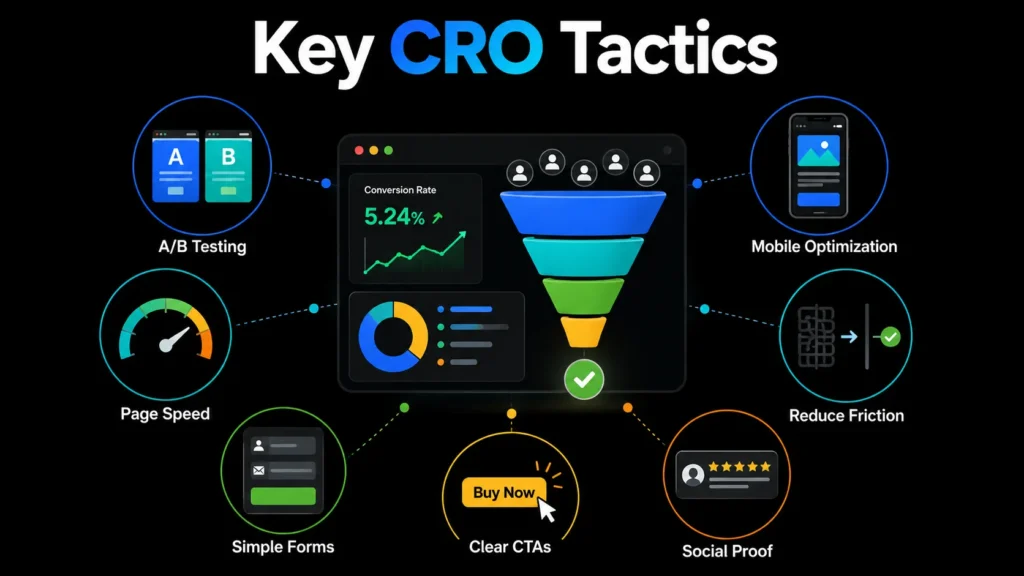
TL;DR: Conversion rate optimization (CRO) is the process of improving your website to increase the percentage of visitors who convert. Key tactics include A/B testing, improving page speed, simplifying forms, writing clearer CTAs, reducing friction, and using social proof. Even small CRO improvements compound with traffic growth. MoxSEO offers digital marketing services that include CRO.
What Is Conversion Rate Optimization?
CRO is the systematic process of improving your website or landing page to increase the percentage of visitors who complete a desired action. A conversion can be anything: a purchase, a lead form submission, a phone call, a signup, or a download. The conversion rate is the number of conversions divided by the number of visitors, expressed as a percentage.
For example, if your landing page gets 1,000 visitors per month and 20 of them fill out your contact form, your conversion rate is 2%. If CRO improvements increase that to 4%, you double your leads without spending any more on traffic.
How Does a CRO Process Work, Step by Step?
A CRO process works in a loop: measure what people do, work out why they stop, make one focused change, and check whether the numbers moved. It replaces opinions about design with evidence from your own visitors. The steps below apply to a lead-generation site, a store or a landing page.
- Define the conversion. Decide what counts: a form submitted, a purchase, a call booked. Track it correctly before changing anything, or you will have nothing to compare against.
- Find where people drop out. Look at conversion rate by page, device and traffic source, and at each step of a multi-step flow.
- Find out why. Use session recordings, heatmaps, form analytics, on-page surveys and the questions your sales or support team hear repeatedly.
- Write a hypothesis. Use the format: “Because we saw [evidence], we think changing [element] will improve [metric].”
- Prioritise. Do first the ideas that are backed by evidence, likely to matter, and easy to ship.
- Test or release, then measure. Run an A/B test if you have enough traffic. If you do not, make the fix and compare before and after over a comparable period.
- Record what you learned. Keep a log of tests and results so you do not repeat failed ideas.
Key CRO Tactics
1. A/B Testing
A/B testing compares two versions of a page to see which performs better. Test one element at a time: headline, CTA button color, form length, image, or page layout. Use a tool like VWO or Optimizely; Google Optimize was discontinued on 30 September 2023. Run tests long enough to cover full weekly cycles and reach statistical significance.
2. Improve Page Speed
Every second of delay reduces conversions. Portent‘s analysis of B2B sites found that a site loading in 1 second had a conversion rate 3 times higher than one loading in 5 seconds (correlation, not proof of cause). Optimize images, use caching, minimize JavaScript, and use a CDN. See our Core Web Vitals guide for detailed speed optimization tips.
Google publishes the thresholds it treats as good on web.dev: Largest Contentful Paint of 2.5 seconds or less, Interaction to Next Paint of 200 milliseconds or less, and Cumulative Layout Shift of 0.1 or less, measured at the 75th percentile of real visits. Use them as a practical speed target for your key landing pages.
3. Simplify Forms
Long forms kill conversions. Reduce your form to the minimum number of fields needed. Every additional field reduces submission rates. If you only need a name and email, do not ask for a phone number, company name, and job title. Use multi-step forms for longer processes, as they feel less overwhelming than one long form.
4. Write Clearer CTAs
Your call to action should tell visitors exactly what to do and what they will get. “Get Your Free Quote” is better than “Submit.” “Download the Free Guide” is better than “Click Here.” Use action verbs, create urgency where appropriate, and make the CTA button visually prominent.
5. Use Social Proof
People trust what other people trust. Add customer testimonials, case studies, review counts, client logos, and trust badges to your landing pages. Social proof reduces perceived risk and increases conversion rates. Show real names and companies, not generic “John D.” testimonials.
6. Reduce Friction
Friction is anything that makes it harder for a visitor to convert. Common sources of friction include too many form fields, required account creation, slow page load, confusing navigation, unclear value proposition, and too many steps in the checkout process. Identify and remove friction points at every stage of your funnel.
7. Optimize for Mobile
A large share of web traffic comes from mobile devices. If your mobile experience is poor, you are likely losing conversions. Ensure your mobile site has large tap targets, fast load times, simplified forms, and a clear CTA above the fold. For ecommerce-specific CRO, see our guide to ecommerce conversion rate optimization. For Shopify stores, see our Shopify CRO guide.
What Tools Do You Need, and What Does Each Answer?
| Question | Tool type | Examples |
|---|---|---|
| How many visitors convert, and from where? | Web analytics | Google Analytics |
| Where do people click, scroll or stop? | Heatmaps and recordings | Hotjar, Crazy Egg |
| Which form field causes drop-off? | Form analytics | Form analytics features in session tools |
| Does version B beat version A? | A/B testing | VWO, Optimizely |
| Is the page technically sound? | Page audit | Our on-page audit tool |
Common CRO Mistakes and How to Avoid Them
- Stopping a test early. A variant that leads after two days may not lead after two weeks. Decide the duration before you start and stick to it.
- Testing too little traffic. If a page gets only a handful of conversions a month, an A/B test cannot give a trustworthy answer. Fix clear friction first and compare before and after.
- Changing several things at once. You will not know which change caused the result.
- Tracking the wrong conversion. A rise in button clicks means little if completed enquiries or sales do not rise. Track the outcome that matters to the business.
- Ignoring segments. A blended average can hide a strong desktop result and a weak mobile one.
- Copying best-practice lists blindly. A tactic that worked elsewhere is a hypothesis for your site, not a guarantee.
Turn More Website Visitors Into Customers
Driving more traffic is valuable, but traffic alone does not guarantee more leads or sales. Conversion rate optimization helps you get better results from the visitors already reaching your website. By improving page speed, simplifying forms, strengthening CTAs, adding credible social proof, and removing unnecessary friction, you can create a smoother path from interest to action.
The best CRO strategy is not based on assumptions. It starts with accurate tracking, user behaviour analysis, clear hypotheses, and continuous testing. Even small improvements can increase enquiries, purchases, bookings, and overall marketing ROI without requiring a larger advertising budget.
MoxSEO helps businesses identify conversion barriers and improve landing pages, website journeys, forms, messaging, and mobile experiences. Whether your goal is more qualified leads or higher online sales, our team can build a practical CRO strategy around your audience and business objectives.
If the fix needs new pages or a rebuild, see our landing page development and website redesign services. MoxSEO’s published starting price for digital marketing packages is $519 per month, listed on the packages page; a written proposal confirms the final fee.
Request a free CRO consultation and start turning more of your website traffic into measurable growth.
Frequently Asked Questions
What is a good conversion rate?
A good conversion rate depends on your industry and the type of conversion. Benchmarks vary widely by industry, offer and traffic source. The key is to measure your current rate and improve it incrementally through testing.
How long does CRO take?
Simple changes (simplifying forms, changing CTA text, adding social proof) can improve conversion rates within days. A/B tests need enough traffic and time to reach statistical significance. A full CRO program with continuous testing and optimization is an ongoing process, not a one-time project.
What is the difference between CRO and SEO?
SEO brings visitors to your site. CRO turns those visitors into customers. Both are necessary. Driving 10,000 visitors to a page that converts at 1% gives you 100 conversions. Improving the conversion rate to 3% with the same traffic gives you 300 conversions. CRO multiplies the value of your SEO traffic. For professional help, see our guide to conversion rate optimization services.
What tools do I need for CRO?
Essential CRO tools include Google Analytics (to track conversions), an A/B testing tool (VWO or Optimizely), a heat mapping tool (Hotjar or Crazy Egg), and a form analytics tool. Google Optimize was discontinued on 30 September 2023. Google’s conversion tracking setup guide covers how to define and measure conversions in Google Analytics.
Should I focus on traffic or conversions first?
Start with conversions. If your site converts at 1%, doubling your traffic gives you 2x conversions. But doubling your conversion rate to 2% also gives you 2x conversions, without spending more on traffic. Ideally, do both: improve conversion rate first, then scale traffic. This way, every additional visitor is more likely to convert.
What is the difference between a macro and a micro conversion?
A macro conversion is the main goal, such as a purchase or a submitted enquiry. A micro conversion is a smaller step toward it, such as adding to cart, watching a demo or starting a form. Track both, but judge success by the macro conversion.
Can I do CRO without A/B testing?
Yes. If traffic is low, use research instead: recordings, surveys, customer questions and analytics. Fix clear problems such as slow pages, long forms and unclear calls to action, then compare results before and after over a similar period.
How do I calculate conversion rate?
Divide the number of conversions by the number of visitors and multiply by 100. For example, 20 form submissions from 1,000 visitors is a 2% conversion rate. Calculate it per page, device and traffic source, not just for the whole site.
Does page speed affect conversion rate?
Slow pages create friction, especially on mobile. Google publishes good thresholds for Core Web Vitals on web.dev: LCP of 2.5 seconds or less, INP of 200 milliseconds or less and CLS of 0.1 or less. Meeting them removes a common cause of drop-off.
Related guides in CRO
- Conversion Rate Optimization Services: What They Include and How They Work
- Ecommerce Conversion Rate Optimization: A Complete Guide for Online Stores
- Shopify Conversion Rate Optimization: How to Increase Your Store’s Sales
Need this handled for you? Explore our Services service.