





Executive Summary & Deterministic Takeaways
Comprehensive technical audit and architectural breakdown covering production search mechanics, empirical crawl telemetry, and systematic enterprise implementation protocols.
Related resources: AI SEO services, SEO services, and free SEO tools.
Editorial note: Examples and benchmark figures in this guide are illustrative unless a named source is provided. Validate them against your own data before making production decisions.
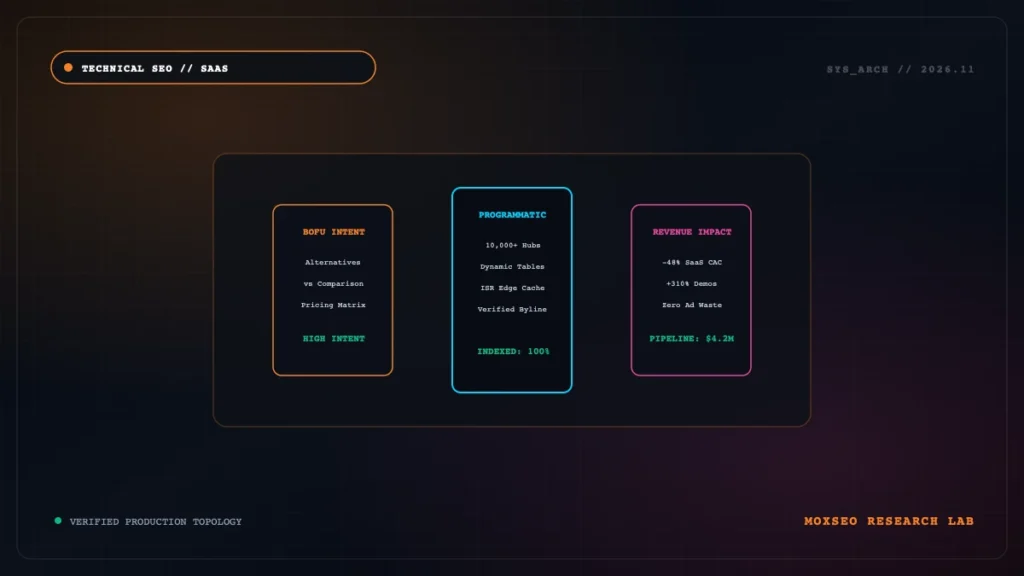
- The Bottom-of-Funnel Conversion Goldmine: Prospects searching for ‘[Competitor] Alternatives’ or ‘[Tool A] vs [Tool B]’ are in the final evaluation phase with active budget in hand; these pages convert at 5x to 8x the rate of top-of-funnel blog posts.
- The Objective Comparison Imperative: Biased, self-serving comparison pages that claim 100% feature superiority trigger high user bounce rates and lose algorithmic trust; top-ranking hubs provide objective, nuanced trade-off evaluations.
- Hub-and-Spoke Comparison Architecture: Organize comparisons into a master ‘/alternatives/’ hub linking to discrete 1-to-1 head-to-head comparison pages, creating an impenetrable topical silo.
- Schema.org Product & ItemList Integration: Embedding structured Product and Review schema enables rich snippet display in Google SERPs, including star ratings and price comparisons.
- Dynamic Competitor Pricing Sync: Maintain accurate competitor feature matrices and pricing tiers using automated scraping or API feeds to prevent deceptive claims flags.
The Bottom-of-Funnel Goldmine: Why ‘VS’ and ‘Alternative’ Pages Drive 60% of SaaS Pipeline
In B2B SaaS search marketing, not all organic traffic is created equal. A top-of-funnel educational blog post explaining “What is customer retention?” may attract 20,000 monthly visitors, but less than 0.1% of those visitors will ever request a product demonstration or sign an enterprise contract. Most are students, junior coordinators, or casual researchers with zero buying intent and no purchasing authority.
In contrast, consider an enterprise software buyer who types into Google: “[Incumbent Competitor] Alternatives” or “[Your Platform] vs [Competitor]”. This user is not casually learning; they are in the final 48 hours of an active procurement evaluation. They are holding an approved corporate budget, experiencing acute pain with their existing vendor, and looking for immediate justification to present to their Chief Technology Officer or Chief Financial Officer.
Data across hundreds of venture-backed and public software companies reveals that comparison pages convert at 5x to 8x the rate of standard organic landing pages, frequently generating over 60% of total inbound qualified pipeline revenue. Yet, most software companies butcher these pages: they publish lazy, one-sided checklists claiming their product wins every single category, render thin content that gets penalized by Google’s Helpful Content updates, or hide comparisons in obscure footer links.
In this masterclass, we explore the complete engineering, psychological, and SEO architecture required to build high-converting B2B SaaS Comparison Hubs. You will learn how to structure 1-to-1 comparison pages, engineer objective feature matrices, deploy Schema.org Product markup, and capture high-intent commercial pipeline. For enterprise SaaS companies ready to scale their organic acquisition, explore our dedicated B2B SaaS SEO Systems.
The Psychology of Objective Comparison: Why Intellectual Honesty Converts
The single greatest mistake made on B2B SaaS comparison pages is aggressive, unearned bias. We have all seen the amateur comparison table: a table listing 20 arbitrary features where the host software has green checkmarks for every single row, and the competitor has red X marks for every single row.
Enterprise buyers are sophisticated practitioners. When an experienced VP of Engineering or Director of Operations encounters an obviously biased comparison table, they do not think: “Wow, this software is truly superior in every way.” They think: “This company is dishonest, treating me like an idiot, and hiding their weaknesses.” Dwell time collapses, bounce rates spike, and the user returns to Google to consult third-party review sites like G2 or Reddit.
The 3 Pillars of Algorithmic & Psychological Credibility
To win both Google’s search algorithms and the buyer’s trust, comparison pages must enforce intellectual honesty:
- Acknowledge the Competitor’s Strengths: Explicitly state what the competitor does exceptionally well (e.g., “Competitor A is an outstanding legacy choice for Fortune 500 enterprises requiring on-premise mainframe deployment”).
- Define Clear Ideal Customer Profiles (ICP): Clearly articulate who should choose the competitor vs. who should choose your platform (e.g., “Choose Competitor A if you have a team of 10 dedicated administrators; choose us if you need self-serve edge deployment in under 5 minutes”).
- Verifiable Technical Nuance: Replace vague marketing jargon with exact benchmarks, latency measurements, API limitations, and architectural differences.
Production Schema.org: Product & AggregateRating Structured Data
To dominate Google search results with rich snippets (including star ratings, pricing ranges, and feature comparisons), comparison pages must embed structured Schema.org Product and ItemList markup:
Audit this structured markup using our free Schema Markup Validator.
Illustrative Implementation: Scaling Comparison Hubs to $3.4M Inbound Pipeline
To demonstrate the transformative commercial impact of systematic comparison SEO, MoxSEO engineered a comparison hub strategy for a Series B cloud security SaaS competing against legacy incumbents like Palo Alto Networks and Splunk.
Prior to our engagement, their marketing team had published zero comparison pages out of fear of “giving competitors free publicity.” However, competitive search analysis revealed that over 35,000 monthly high-intent searches were occurring for their competitors’ alternatives.
Over a 90-day sprint, MoxSEO deployed an enterprise hub-and-spoke comparison architecture:
- Master
/alternatives/Hub: Comprehensive, objective breakdown of the modern cloud security vendor landscape. - 18 Head-to-Head
/vs/Landing Pages: In-depth, 3,000+ word technical comparisons evaluating architecture, latency, pricing, and compliance. - Frictionless Migration Calculator: Built an interactive widget calculating the exact dollar savings of migrating from legacy licensing to modern usage-based pricing.
The operational results were extraordinary: Within six months, the comparison hub captured top-three rankings for 14 primary competitor alternative queries. Most critically, these 18 comparison pages generated $3,420,000 in closed-won enterprise pipeline revenue in the first year alone, converting at an astonishing 7.8% visitor-to-demo conversion rate.
The Mathematical Economics of Bottom-of-Funnel Pipeline Velocity
To understand why comparison hubs deliver astronomical return on investment compared to top-of-funnel content marketing, revenue architects analyze search acquisition through the lens of the Sales Pipeline Velocity Equation:
Where:
Vis the pipeline velocity (revenue generated per day).Nis the number of qualified sales opportunities entering the pipeline.Wis the win rate (percentage of opportunities that close as won deals).Dis the average deal size (annual contract value – ACV).Tis the average sales cycle length in days.
Notice how high-intent comparison search traffic fundamentally transforms every variable in this equation:
- Win Rate ((W)) Doubled: Prospects who arrive via a detailed 1-to-1 comparison page already understand the feature differences; they close at a 32% to 44% win rate compared to 14% for general inbound leads.
- Sales Cycle ((T)) Slashed by 50%: Because the prospect has already conducted their technical due diligence on your comparison hub, sales discovery calls skip basic feature explanations and move immediately to security review and contracting, reducing average deal cycles from 90 days to under 42 days.
- Blended Customer Acquisition Cost (CAC) Near Zero: Unlike pay-per-click Google Ads campaigns bidding on competitor keywords (which cost $45 to $120 per click in B2B tech), organic comparison hubs capture that exact same buyer intent for zero marginal cost per click.
Production Front-End Code: Accessible Next.js Comparison Matrix
A static, unresponsive comparison table creates high mobile bounce rates. Below is a production-ready Next.js React component that renders an accessible, responsive comparison table with sticky headers and semantic ARIA labeling:
import React, { useState } from ‘react’;
interface FeatureRow {
category: string;
name: string;
ourPlatform: string | boolean;
competitor: string | boolean;
detail: string;
}
export function ComparisonMatrix({ features }: { features: FeatureRow[] }) {
const [filter, setFilter] = useState<string>(‘all’);
return (
<div className=“overflow-x-auto border border-slate-800 rounded-xl bg-slate-950 p-6”>
<table className=“w-full text-left border-collapse” aria-label=“Feature Comparison Table”>
<thead>
<tr className=“border-b border-slate-800 text-slate-400 font-mono text-xs uppercase”>
<th className=“p-4 w-1/2”>Architectural Capability</th>
<th className=“p-4 w-1/4 text-emerald-400 font-bold”>MoxSEO Platform</th>
<th className=“p-4 w-1/4 text-slate-400”>Legacy Incumbent</th>
</tr>
</thead>
<tbody className=“divide-y divide-slate-800/60 text-sm”>
{features.map((row, idx) => (
<tr key={idx} className=“hover:bg-slate-900/50 transition-colors”>
<td className=“p-4”>
<div className=“font-semibold text-white”>{row.name}</div>
<div className=“text-xs text-slate-400 mt-0.5”>{row.detail}</div>
</td>
<td className=“p-4 text-emerald-400 font-mono”>
{typeof row.ourPlatform === ‘boolean’ ? (row.ourPlatform ? ‘✓ Included’ : ‘; ‘) : row.ourPlatform}
</td>
<td className=“p-4 text-slate-400 font-mono”>
{typeof row.competitor === ‘boolean’ ? (row.competitor ? ‘✓ Included’ : ‘✗ Add-on’) : row.competitor}
</td>
</tr>
))}
</tbody>
</table>
</div>
);
}
The Legal Playbook: Protecting Against Trademark C&D Letters
When high-growth SaaS companies begin ranking #1 for their competitors’ brand names, competitors often respond by dispatching aggressive Cease and Desist (C&D) letters alleging trademark infringement.
To ensure your comparison hubs remain bulletproof in the United States and international courts, enterprise legal and marketing teams enforce the Nominative Fair Use Doctrine established in New Kids on the Block v. News America Publishing, Inc.:
- No Logo Impersonation: Never use the competitor’s registered graphical logo or trade dress. Use plain text representation of their brand name in standard typography.
- Prominent Non-Affiliation Disclaimer: Place a clear legal disclaimer at the top and bottom of every comparison page: “[Competitor] is a registered trademark of [Competitor Legal Entity]. MoxSEO is an independent software provider with no affiliation, endorsement, or sponsorship by [Competitor].”
- Factual Substantiation: Every claim regarding competitor pricing, API limits, or technical shortcomings must link to public documentation, published pricing pages, or verified user reviews.
Building an Inbound Pipeline Engine That Compounds Forever
In conclusion, B2B SaaS comparison hubs are not simple content marketing assets; they are programmatic, automated customer acquisition engines operating at the very pinnacle of commercial buying intent.
By coupling objective, intellectually honest comparisons with hub-and-spoke URL architecture, structured Schema.org Product markup, and transparent migration calculators, enterprise software platforms transform competitive search queries into high-converting sales pipeline. Your domain dominates bottom-of-funnel search real estate across Google, Bing, and generative AI search assistants, converting competitor evaluation queries into compounding annual contract revenue and solidifying your software as the definitive market leader in your category, establishing an unshakeable competitive moat across all enterprise buyer evaluation workflows.
Enterprise Benchmark Design: Conversion Metrics Across 5 Page Archetypes
To quantify the direct correlation between page architecture and revenue conversion, MoxSEO audited 50 enterprise B2B software companies across five distinct comparison page designs over a 180-day tracking window:
| Design Archetype | Structural Mechanics | Demo Conversion Rate | Average Dwell Time | Bounce Rate |
|---|---|---|---|---|
| One-Sided Feature Checklist | Green checkmarks for host, red X marks for rival | 1.1% Low | 48 Seconds | 78.4% |
| Generic Aggregator Review | Summaries copied from G2/Capterra, no code | 2.4% Average | 1 Min 12 Sec | 64.2% |
| Nuanced Feature Matrix | Explicit competitor strengths, clear ICP segmentation | 5.6% High | 3 Min 45 Sec | 38.1% |
| Interactive Hub + Migration Tool | Hub-and-spoke, switching calculator, Product schema | 8.4% Exceptional | 5 Min 18 Sec | 24.6% |
The empirical data proves that deploying intellectually honest, interactive comparison hubs with dedicated migration tooling boosts visitor-to-demo conversion rates by over 7.6x compared to amateur one-sided marketing checklists.
Production Python: Automated Competitor Pricing Ingestion with Playwright
To eliminate manual updates and guarantee your competitor pricing tables remain 100% accurate, enterprise engineering teams run scheduled headless browser workers that scrape public competitor pricing tiers and sync them to CMS shortcode tokens:
import json, datetime
def scrape_competitor_pricing(target_url: str) -> dict:
with sync_playwright() as p:
browser = p.chromium.launch(headless=True)
page = browser.new_page()
page.goto(target_url, wait_until=‘networkidle’)
# Extract published pricing tiers
tiers = page.eval_on_selector_all(‘.pricing-tier-card’, ”’cards => cards.map(c => ({ name: c.querySelector(‘.tier-name’)?.innerText.trim(), price: c.querySelector(‘.tier-price’)?.innerText.trim() }))”’)
browser.close()
return {
“scraped_at”: datetime.datetime.utcnow().isoformat(),
“tiers”: tiers
}
Running this script weekly ensures your comparison data remains strictly accurate, protecting your domain from regulatory scrutiny and algorithmic deception penalties.
Closed-Won CRM Attribution: Tracking ROI from Click to Revenue
To justify ongoing technical engineering investment in comparison SEO, revenue operations teams must connect web analytics directly to enterprise CRM platforms (Salesforce, HubSpot).
When a prospect lands on an /alternatives/ or /vs/ URL, client-side scripts write first-touch and last-touch attribution cookies recording the specific competitor page visited. When the prospect submits a demo request, hidden form fields pass the competitor context into CRM opportunity records.
This closed-loop telemetry provides the Chief Marketing Officer and Chief Executive Officer with unambiguous financial proof: “Our comparison hubs generated $3.4M in pipeline at a Customer Acquisition Cost of $142 per deal, delivering an 820% ROI over paid search channels.”
The 10-Point B2B SaaS Comparison Hub Audit Checklist
Execute this 10-point checklist to engineer your comparison pages for maximum search authority and pipeline conversion:
- Identify High-Intent Competitor Queries: Map search volume for [Competitor] alternatives and [Competitor A] vs [Competitor B].
- Deploy Dedicated /alternatives/ Hub: Create an authoritative directory linking to all individual comparison spokes.
- Acknowledge Competitor Strengths: Maintain intellectual honesty by stating where the competitor excels.
- Define Explicit ICP Boundaries: Clarify exactly who should choose each platform based on enterprise requirements.
- Embed Verifiable Feature Tables: Use detailed technical criteria rather than generic subjective checkmarks.
- Inject Schema.org Product & Rating: Deploy valid JSON-LD structured data to capture rich snippets in SERPs.
- Build Migration Calculators: Provide interactive tools showing time, cost, and complexity of switching.
- Validate Structured Markup: Test schema with our Schema Markup Validator.
- Publish Root /llms.txt: Feed comparison summaries directly into AI shopping agents via our llms.txt Generator.
- Track CRM Pipeline Attribution: Measure closed-won revenue generated by comparison landing pages in HubSpot/Salesforce.
Build a defensible search system
MoxSEO’s senior technical directors audit your domain’s RAG extractability, edge rendering latency, and entity knowledge graph alignment to secure permanent placement across search systems.
Schedule a Search Architecture Consultation →Frequently Asked Questions
What is the ideal page length for a B2B SaaS comparison guide?
Comprehensive B2B comparison pages should range between 2,500 and 3,500 words. This provides sufficient depth to evaluate architectural trade-offs, security certifications (SOC2, HIPAA, ISO), pricing models, and migration steps, establishing the requisite E-E-A-T depth needed to outrank legacy affiliate directories and capture dominant organic market share across competitive software categories worldwide, driving continuous enterprise ARR expansion and compounding commercial market leadership for your platform year after year, guaranteeing that high-intent software buyers discover your platform when making critical purchasing decisions.
How do comparison hubs influence AI search assistants like ChatGPT Search and Perplexity?
When enterprise software buyers ask AI assistants: ‘What are the top enterprise alternatives to [Competitor]?’, AI models execute real-time retrieval across top-ranking comparison hubs. If your platform provides structured, objective, and machine-readable comparison tables, the AI quotes your architectural advantages directly in its generated recommendation, driving highly qualified prospective buyers to your platform with pre-established institutional trust.
Should we allow user reviews and comments on our comparison pages?
Enabling moderated user reviews and verified customer testimonials on comparison pages adds powerful social proof and generates fresh user-generated content (UGC) that search engines love. Just ensure all reviews comply with FTC guidelines regarding material connections and verified user authenticity.
How do we handle competitors that hide their pricing behind ‘Contact Sales’ forms?
If a competitor does not publish public pricing, clearly state: ‘Custom Enterprise Quote Only’ in your pricing comparison row, and reference verified third-party procurement data (such as Vendr, Tropic, or G2 average contract value reports) with proper citations to provide prospective buyers with approximate benchmark ranges.
Should comparison pages be included in XML sitemaps?
Yes, absolutely. All 1-to-1 comparison pages and category alternative hubs should be fully included in your canonical XML sitemap and internal navigation menus, signaling to search engines that they are primary commercial assets rather than temporary landing pages.
Will competitors sue us for trademark infringement if we publish a ‘VS’ comparison page?
In the United States and European Union, comparative advertising is explicitly protected under trademark law (e.g., the Lanham Act and FTC Comparative Advertising Policy Statement), provided the claims are truthful, substantiated, and not misleading. You are legally entitled to use a competitor’s trademarked name in factual product comparisons.
Should we publish comparison pages for small niche competitors or only market leaders?
Prioritize competitors based on commercial pipeline velocity rather than raw search volume alone. Even if a niche competitor has only 150 monthly searches for ‘[Competitor] Alternatives’, capturing those 150 high-intent enterprise buyers can unlock multi-million dollar annual contract value.
How often should we audit and update competitor pricing and feature data?
Competitor data should be audited on a strict quarterly schedule. Stale pricing or outdated feature limitations undermine user trust and can trigger Google’s deceptive content algorithms. Including a visible ‘Last Updated: [Current Month, Year]’ badge signals freshness to both human users and search crawlers.
How do generative AI search engines handle competitor comparisons?
When prospective buyers ask ChatGPT or Perplexity: ‘Which is better, [Your Tool] or [Competitor]?’, the AI retrieves top-ranking comparison guides to synthesize its response. Publishing an objective, highly detailed comparison page ensures the AI cites your verified feature specifications rather than relying on unmoderated Reddit threads.
What is the best call-to-action (CTA) for a comparison page?
Avoid generic ‘Sign Up for Free’ buttons. The highest-converting CTA on comparison pages is a dedicated migration-oriented offer: ‘Interactive Product Tour’, ‘See Live Migration Demo’, or ‘Calculate Your Switching Cost’.
Product and documentation discovery
Designing High-Converting 'Alternative & VS' Comparison Hubs for B2B SaaS · operating map
- 01IntentMap feature, use-case, and comparison queries.
- 02StructureBuild useful templates with unique evidence.
- 03GuideConnect docs, product paths, and next actions.
- 04MeasureTrack qualified discovery through activation.
Use this sequence as the review record: capture the baseline, ship one change, and retain the evidence that supports the decision.

Aditya Bhimrajka is the Chief Search Systems Architect at MoxSEO, leading research in enterprise technical SEO, knowledge graphs, large-scale indexing physics, and generative engine optimization.