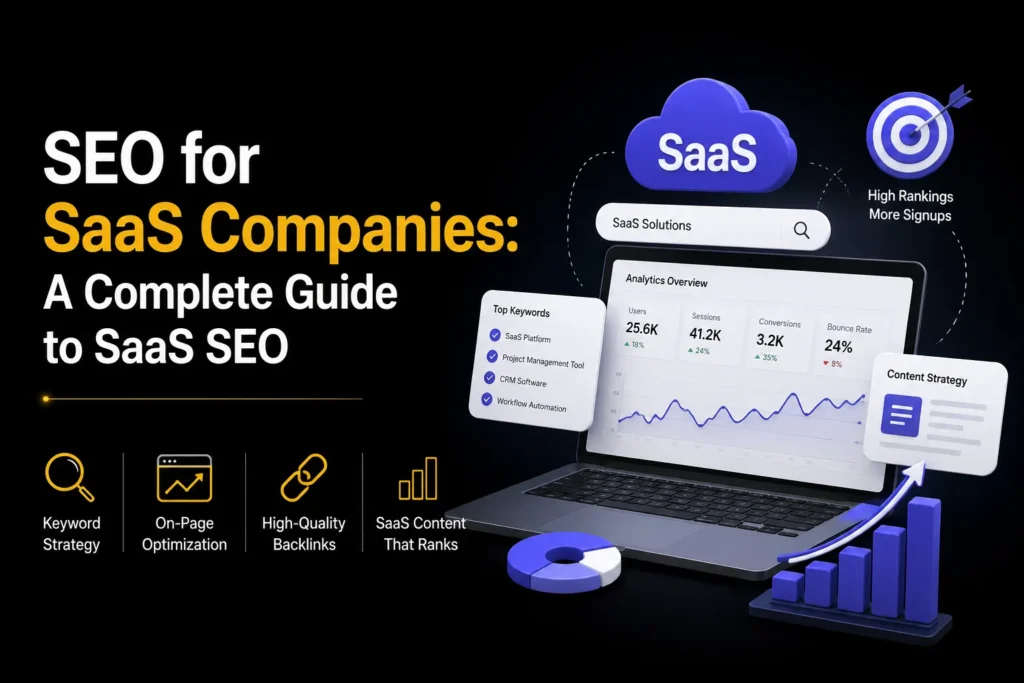
SaaS companies face a unique SEO challenge. Your product is digital, your customers are global, and your competitors are well-funded companies with dedicated SEO teams. But most SaaS companies focus on paid acquisition and neglect organic search, which means a well-executed SEO strategy can give you a sustainable, compounding advantage.
SEO for SaaS is not about ranking for your product name. It is about ranking for the problems your product solves. When someone searches “how to [do the thing your product does],” they should find your content, learn from it, and eventually become a customer. This guide covers the complete SaaS SEO playbook.
TL;DR: SEO for SaaS companies means creating content that answers the problems your product solves, building programmatic landing pages for use cases and integrations, earning backlinks from developer communities and SaaS directories, and optimizing for bottom-of-funnel comparison and pricing searches. The goal is to build a compounding organic acquisition channel.
Why SEO Matters for SaaS Companies
SaaS customer acquisition costs (CAC) are rising. Paid ads on Google, LinkedIn, and Facebook are getting more expensive, and SaaS buyers increasingly research solutions independently before talking to sales. Over 70% of B2B buyers start their research with a search engine, not a sales rep.
SEO is the only acquisition channel that compounds. Every blog post, every landing page, and every backlink builds on the last. While paid ads stop the moment you stop paying, SEO traffic keeps flowing month after month. For SaaS companies with high customer lifetime value (LTV), SEO is the most cost-effective long-term acquisition channel.
The SaaS SEO Content Strategy
Top of Funnel: Problem-Aware Content
These are prospects who have a problem but do not know your product exists. They search for solutions to their problems, not for your product. Create content that answers these searches:
- “How to reduce customer churn”
- “Best way to manage remote team productivity”
- “How to automate invoice processing”
- “Why is my website loading slowly”
Each article should thoroughly answer the question, explain the underlying problem, and naturally introduce your product as one solution. Do not make every article a sales pitch. Provide genuine value first. For more on content strategy, read our on-page SEO guide.
Middle of Funnel: Solution-Aware Content
These prospects know solutions exist and are comparing options. They search for categories and alternatives:
- “Best [product category] tools”
- “[Competitor] alternatives”
- “How to choose a [product category]”
- “[Product category] pricing comparison”
Create comparison pages, buyer’s guides, and alternative-to pages. Be honest about where your product excels and where competitors might be a better fit. Transparency builds trust.
Bottom of Funnel: Product-Aware Content
These prospects are evaluating your product specifically. They search for:
- “[Your product name] reviews”
- “[Your product name] vs [competitor]”
- “[Your product name] pricing”
- “[Your product name] integrations”
Create dedicated pages for each of these searches. Your pricing page should be easy to find and transparent. Create comparison pages for each major competitor. Publish integration pages for every tool you connect with.
Programmatic SEO for SaaS
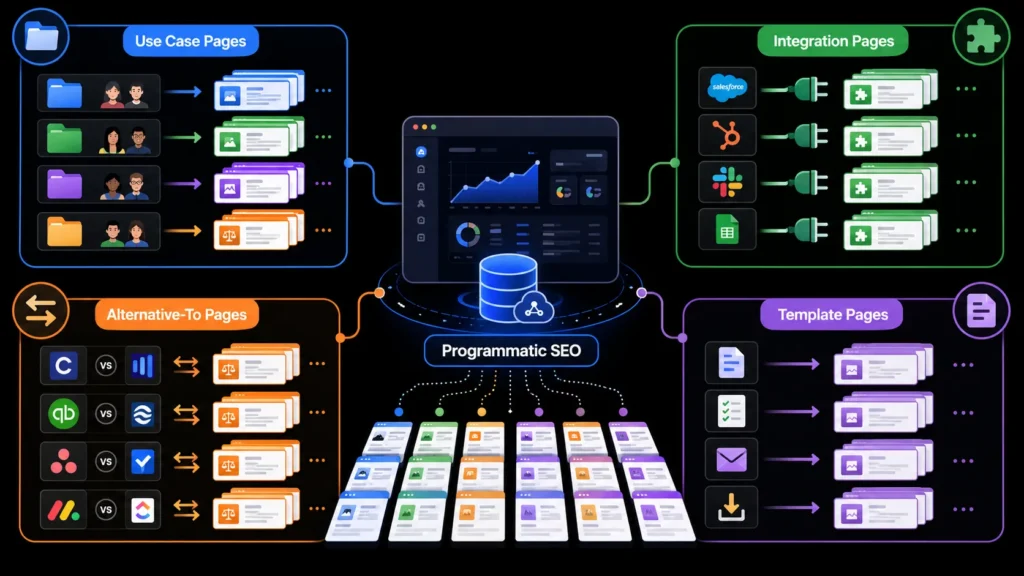
Image Source: AI-generated visual by MoxSEO
Programmatic SEO means creating hundreds or thousands of landing pages automatically, each targeting a specific long-tail keyword. SaaS companies use this to capture searches across many use cases, integrations, and locations.
Use Case Pages
Create a page for every use case your product serves. If you are a project management tool, create pages like “project management for marketing teams,” “project management for software development,” “project management for construction.” Each page should have unique content about how your product serves that specific use case.
Integration Pages
Create a page for every integration: “[Your product] + Slack,” “[Your product] + Salesforce,” “[Your product] + Zapier.” These pages capture searches from users of those tools who are looking for integrations.
Alternative-To Pages
Create pages targeting “[competitor] alternatives” for each of your competitors. These capture high-intent searches from users who are unhappy with their current tool and looking for alternatives.
Template Pages
If your product includes templates, create individual pages for each: “project plan template,” “sprint planning template,” “meeting notes template.” These capture top-of-funnel searches and can be gated behind an email signup.
Keyword Research for SaaS SEO
SaaS keyword research is different from other industries. You need to map keywords to the buyer journey and understand search intent. Use tools like Google Keyword Planner to find keywords with real search volume.
Focus on:
- Problem keywords: “how to [solve problem]”
- Category keywords: “best [product category] software”
- Comparison keywords: “[competitor] vs [competitor]”
- Alternative keywords: “[competitor] alternatives”
- Integration keywords: “[tool] integration with [other tool]”
- Template keywords: “[task] template”
For more on keyword research, read our keyword research guide.
On-Page SEO for SaaS Websites
Product Pages
Your product pages should be optimized for feature-specific keywords. Instead of one generic product page, create separate pages for each major feature: “task automation,” “reporting and analytics,” “team collaboration.” Each page should explain the feature, show screenshots, and include customer testimonials.
Pricing Page
Your pricing page is one of your most important SEO assets. Make it transparent, easy to understand, and optimized for “[product name] pricing” searches. Include a pricing FAQ section to capture long-tail pricing queries.
Documentation and Help Content
Your help docs and API documentation are powerful SEO assets. They capture searches from current users and prospects evaluating your product’s capabilities. Make sure your docs are publicly accessible, well-structured, and optimized for “[product name] how to [task]” searches.
Case Studies
Create case study pages optimized for “[industry] [product category] case study” searches. Each case study should include the problem, solution, implementation, and measurable results. Use schema markup to enhance these pages. Learn more in our schema markup guide.
Building SaaS Backlinks
Backlinks are critical for SaaS SEO. Your competitors have high domain authority, so you need quality links to compete. Earn links from:
- SaaS directories: G2, Capterra, GetApp, Product Hunt, SaaSGenius
- Developer communities: GitHub, Stack Overflow, Dev.to, Hacker News
- Industry blogs and publications: TechCrunch, SaaStr, your industry’s top blogs
- Integration partner websites: Links from your integration partners’ directories
- Guest posts: Write for SaaS blogs, industry publications, and developer communities
- Free tools and calculators: Build free tools that attract links naturally
- Original research and data: Publish industry reports and surveys that journalists link to
For link building strategies, read our guide to link building strategies.
Technical SEO for SaaS Websites
Site Architecture
Your site architecture should reflect the buyer journey: homepage, product pages, pricing, blog, resources, documentation. Use a clear URL structure: /features/[feature-name], /integrations/[integration-name], /blog/[post-slug].
Page Speed
SaaS websites are often built with modern JavaScript frameworks that can be slow to load. Google uses Core Web Vitals as a ranking factor. Optimize your JavaScript, use server-side rendering where possible, and test your speed on PageSpeed Insights. Learn more in our Core Web Vitals guide.
International SEO
If you serve multiple countries, implement hreflang tags to show the right version of your site to each audience. Use country-specific URLs or subdirectories. For more on this, see our international SEO services page.
Content Marketing for SaaS Companies
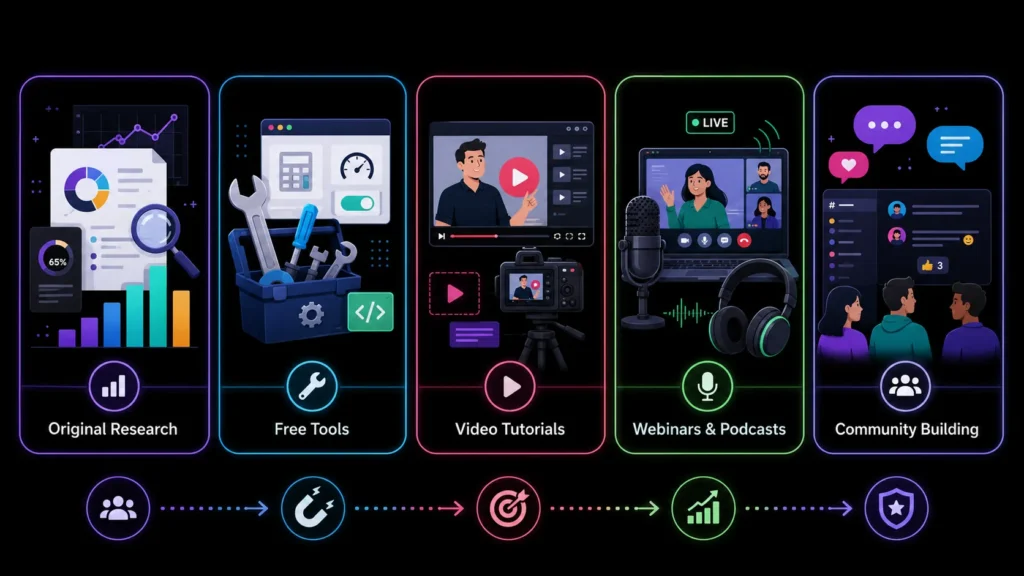
Image Source: AI-generated visual by MoxSEO
Beyond SEO-optimized blog posts, SaaS companies should invest in:
- Original research: Survey your users, publish industry benchmarks, and create data-driven reports that attract press coverage and backlinks
- Free tools: Build simple, useful tools related to your product that attract organic traffic and links
- Video tutorials: Create YouTube tutorials that complement your blog content and capture video search traffic
- Webinars and podcasts: Host industry webinars and podcasts that build authority and earn links
- Community building: Build a community around your product category on Slack, Discord, or your own forum
For content marketing strategies, read our guide to content marketing services.
Tracking SaaS SEO Performance
Track these metrics to measure your SaaS SEO success:
- Organic signups: Track how many trial signups come from organic search
- Organic traffic: Visitors from organic search via Google Analytics
- Keyword rankings: Track your position for category, comparison, and problem keywords
- Content-to-customer conversion: Track how many blog readers eventually become customers
- Backlink growth: Track new referring domains per month
- Organic CAC: Calculate your customer acquisition cost through organic search vs paid channels
Build Sustainable Growth with SEO for SaaS Companies
SEO for SaaS companies should do more than increase blog traffic. It should help potential customers discover your product, understand how it solves their problem, compare it with alternatives, and move toward a free trial, demo, or purchase.
A successful SaaS SEO strategy combines high-intent keyword research, product-focused landing pages, useful educational content, technical optimization, credible backlinks, and accurate conversion tracking. When these elements work together, organic search can become a reliable source of qualified demand and reduce your dependence on paid acquisition.
MoxSEO helps SaaS companies build search strategies around their product, audience, sales funnel, and growth goals. We assess your website structure, technical performance, content gaps, competitor visibility, and conversion journey before recommending the right priorities.
Ready to generate more qualified leads through SEO for SaaS companies? Request a free consultation with MoxSEO and discover the search opportunities that can support long-term organic growth.
FAQs About SEO for SaaS Companies
How long does SaaS SEO take?
SaaS SEO typically takes 6 to 12 months to show significant results because you are competing against well-established companies with high domain authority. Top-of-funnel content can rank faster, while bottom-of-funnel comparison pages may take longer.
Should I hire a SaaS SEO agency?
If your team does not have dedicated SEO expertise, hiring an agency can accelerate results. SaaS SEO requires specialized knowledge of programmatic SEO, content strategy, and technical optimization. Get a free quote to see how we can help.
How much does SaaS SEO cost?
SaaS SEO typically costs between $1,000 and $5,000 per month depending on your competition, the scope of content production, and technical optimization needs. See our SEO packages for transparent pricing.
What is programmatic SEO and do I need it?
Programmatic SEO means creating landing pages at scale using templates and data. It is powerful for SaaS companies with many use cases, integrations, or locations. If your product serves multiple audiences or connects with many tools, programmatic SEO can capture long-tail search traffic that would be impossible to target manually.
Should I create comparison pages against competitors?
Yes. Comparison pages like u0022[your product] vs [competitor]u0022 capture high-intent searches from buyers who are actively evaluating options. Be honest and fair in your comparisons. Google values helpful, balanced content over biased marketing pages.
Related guides in Industry SEO
- SaaS SEO Consultant: How to Choose the Right One
- SEO for Dentists: How to Get More Dental Patients from Google
- SEO for Doctors: How Healthcare Providers Can Attract More Patients
- SEO for Hotels: How to Increase Direct Bookings from Search
- SEO for Lawyers: A Complete Guide to Law Firm SEO
Need this handled for you? Explore our SEO Services service.