




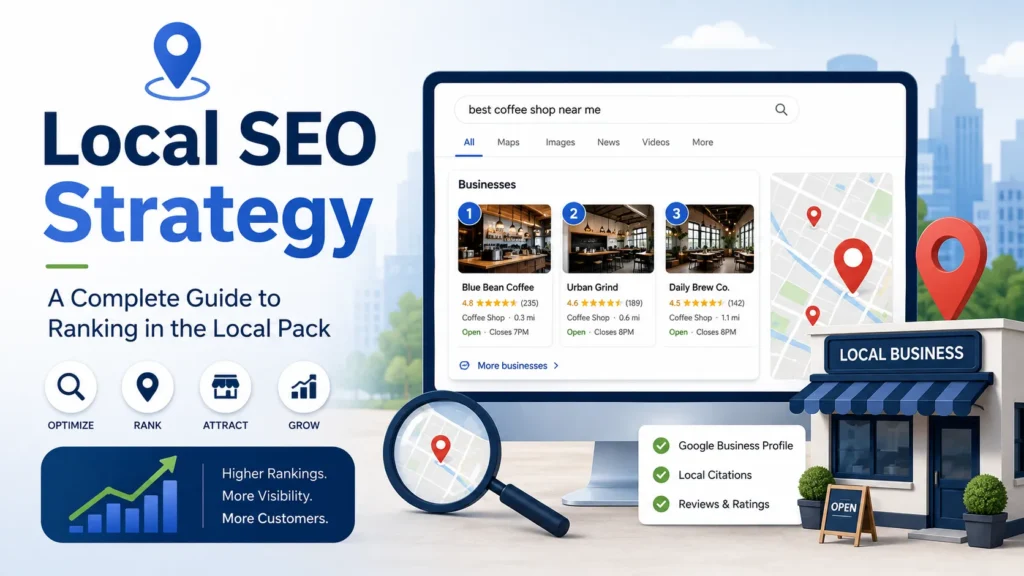
If your business serves customers in a specific city, neighbourhood, or service area, appearing in standard organic results is only part of the opportunity. Many local customers make decisions directly from Google Maps and the Local Pack, often before visiting a website.
A strong local SEO strategy helps your business appear when nearby customers search for the products or services you offer. It improves how Google understands your location, services, reputation, and relevance while making it easier for potential customers to call, request directions, book an appointment, or visit your business.
Local visibility depends on more than adding a city name to a webpage. Businesses need an accurate Google Business Profile, consistent business information, optimized location pages, genuine reviews, relevant local content, trusted citations, and authoritative local backlinks.
This guide explains how to build a practical local SEO strategy for 2026 that strengthens Google Maps visibility, improves Local Pack rankings, and turns location-based searches into measurable leads and customers.
What Is a Local SEO Strategy?
A local SEO strategy is a structured plan to improve your visibility in location-based search results. Unlike traditional SEO, which focuses on ranking pages for broad keywords, local SEO targets searches with geographic intent. This includes “near me” searches, city + service queries (like “SEO services in Mumbai”), and Google Maps lookups.
Google determines local rankings using three core factors:
- Relevance: How well your business listing matches what the searcher is looking for.
- Distance: How close your business is to the searcher’s location or the area they specified.
- Prominence: How well-known and trusted your business is, based on reviews, citations, backlinks, and overall online authority.
Your local SEO strategy needs to improve all three. The steps below cover exactly how to do that.
Step 1: Claim and Optimize Your Google Business Profile
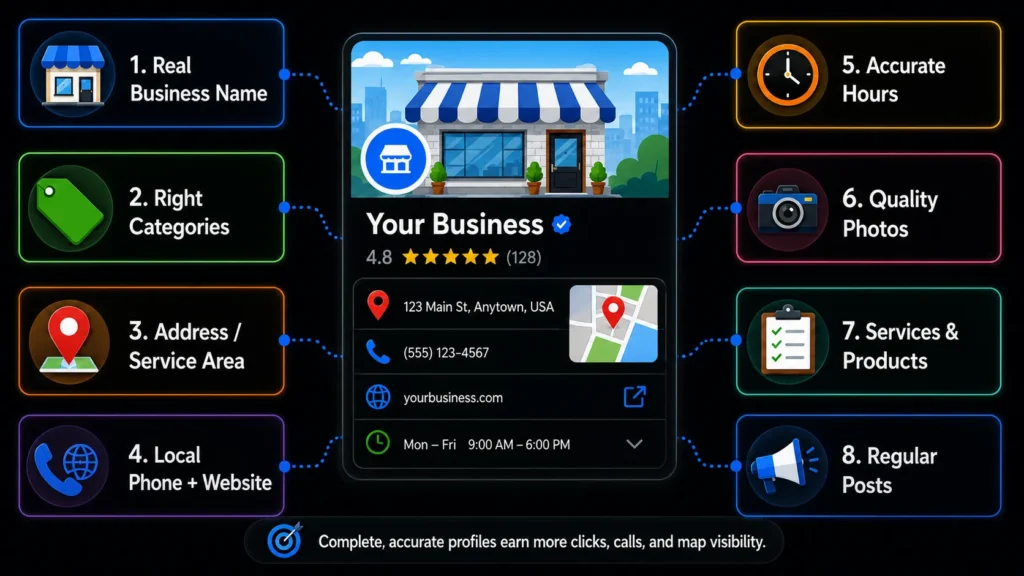
Image Source: AI-generated visual by MoxSEO
Your Google Business Profile (GBP) is the single most important asset in local SEO. It is what powers your listing in the local pack and Google Maps. If you have not claimed your profile yet, go to business.google.com and verify your business now.
Once claimed, optimize every field:
- Business name: Use your real business name. Do not keyword-stuff it with city names or services.
- Categories: Choose the most accurate primary category. Add secondary categories only if they genuinely apply. The primary category carries the most weight for local pack ranking.
- Address and service area: List your physical address if you have a storefront. If you serve customers at their locations, set your service area instead.
- Phone number and website: Use a local phone number if possible. Link to your homepage or a dedicated location page, not a social media profile.
- Business hours: Keep these accurate and updated for holidays.
- Photos: Add high-quality photos of your storefront, team, products, and interior. Businesses with more photos get more clicks and calls.
- Services and products: List every service you offer with descriptions and prices where possible.
- Posts: Publish regular GBP posts about offers, events, and updates. These keep your profile active and signal freshness to Google.
Step 2: Build Consistent NAP Citations Across Directories
NAP stands for Name, Address, Phone number. Google cross-checks your business information across dozens of directories and listing sites. If your NAP is inconsistent, Google loses confidence in your business data, which hurts your local rankings.
Here is how to manage citations effectively:
- Make sure your NAP is identical everywhere: your website, Google Business Profile, Facebook, JustDial, IndiaMART, Yelp, and any industry-specific directories.
- Use the same format for your phone number and address every time. Even small differences like “St.” vs “Street” can cause confusion.
- Audit your existing citations using a tool like BrightLocal or Whitespark. Find inconsistencies and fix them.
- Build new citations on relevant local and industry directories. Quality matters more than quantity. A listing on a respected industry directory is worth more than 50 spammy ones.
NAP consistency is one of the most overlooked local SEO ranking factors. Get this right early and maintain it as your business grows.
Step 3: Optimize Your Website for Local Search
Your website needs to send clear local signals to Google. This means optimizing both your content and your technical setup for location-based search.
Create Location-Specific Pages
If you serve multiple cities, create a dedicated page for each location. Each page should have:
- A unique title tag that includes the city and service (e.g., “Digital Marketing Agency in Pune | MoxSEO”).
- A unique H1 that matches the page’s focus.
- City-specific content that is genuinely useful, not just a template with the city name swapped in.
- Local schema markup (Service schema with areaServed set to the city).
- Internal links from your homepage and other relevant pages.
Optimize Title Tags and Meta Descriptions
Every page on your site should have a title tag that includes your primary keyword and your city or region where relevant. Keep title tags under 60 characters so they do not get truncated in search results. Write meta descriptions that include your location and a clear call to action, keeping them between 120 and 155 characters.
Add Local Business Schema
LocalBusiness schema tells Google exactly what your business does, where it is located, and what areas it serves. Add it to your homepage and location pages. Include your business name, address, phone number, opening hours, geo-coordinates, and service area. This structured data helps Google understand your business and can enable rich results in search.
Improve Page Speed and Mobile Experience
Most local searches happen on mobile devices. If your site loads slowly or is hard to use on a phone, visitors will leave and Google will rank you lower. Test your site with Google’s PageSpeed Insights tool. Aim for a load time under 3 seconds on mobile. Fix common issues like large images, render-blocking scripts, and unused CSS.
Step 4: Build a Review Generation System
Reviews are one of the strongest local SEO ranking factors. They signal prominence and trust to Google, and they directly influence whether a searcher clicks on your listing or a competitor’s.
Here is how to build a system that generates reviews consistently:
- Ask every customer: Send a review request via email or SMS after every completed job or purchase. Timing matters. Ask while the experience is fresh.
- Make it easy: Send a direct link to your Google review form. Do not make customers search for it.
- Respond to every review: Thank customers for positive reviews and address concerns in negative ones professionally. Google values businesses that actively manage their reviews.
- Diversify review sources: While Google reviews carry the most weight, reviews on Facebook, JustDial, and industry platforms also help.
- Avoid fake reviews: Never buy reviews or post fake ones. Google can detect them and will penalize your listing.
Aim for at least one new Google review per week. The steady flow matters more than the total count. Businesses that consistently get fresh reviews rank higher than those with a large but stale review profile.
Step 5: Create Locally Relevant Content
Content is what helps you rank for the long tail of local search queries. Beyond your core service pages, publish blog posts and resources that answer questions your local customers are asking.
Content ideas that work for local SEO:
- Guides like “How to choose a [your service] in [your city]”
- Local case studies showing results you have delivered for businesses in your area
- Answers to common questions your customers ask (use these for FAQ sections and FAQ schema)
- Local event coverage or community involvement posts
- Comparison posts like “[Service] vs [Alternative]: Which is right for your [city] business?”
Each piece of content should target a specific local keyword and link back to your relevant service or location page. This builds topical authority and helps Google understand the full scope of what you offer.
Step 6: Earn Local Backlinks
Backlinks from local websites are a strong prominence signal. They tell Google that other businesses and organizations in your area trust you.
Ways to earn local backlinks:
- Sponsor local events, charities, or sports teams and ask for a link on their website.
- Join your local chamber of commerce or business association.
- Get featured in local news outlets by sharing newsworthy updates or offering expert commentary.
- Partner with complementary local businesses for cross-promotion.
- Create local resource pages that other sites will want to link to.
Focus on relevance and quality. One link from a respected local news site is worth more than dozens of links from low-quality directories.
Step 7: Track and Measure Your Local SEO Performance
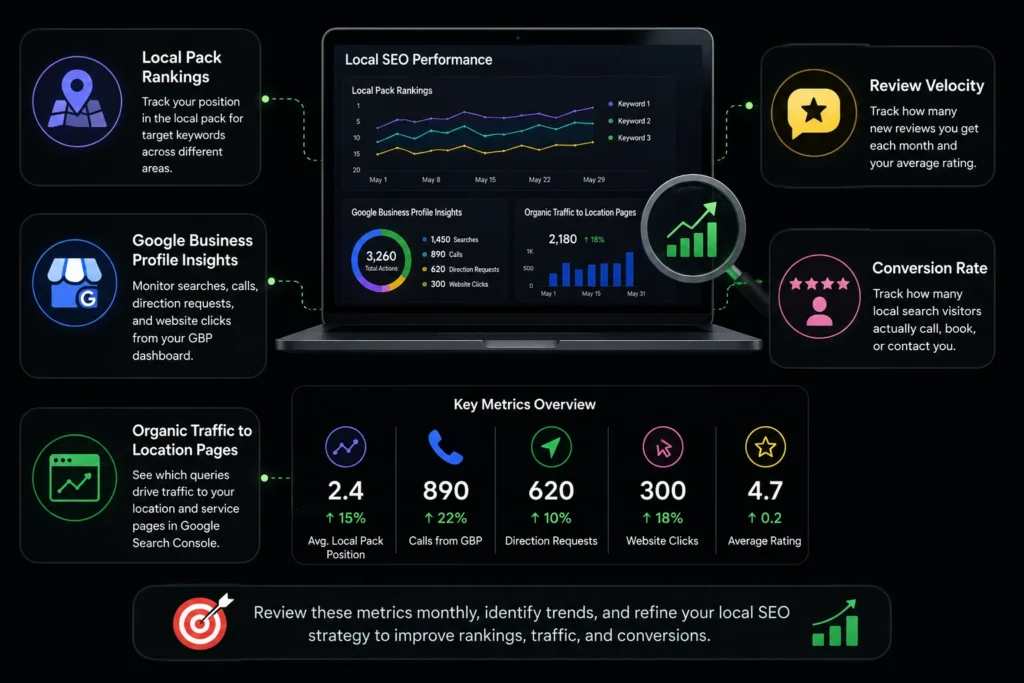
You cannot improve what you do not measure. Set up tracking for these key local SEO metrics:
- Local pack rankings: Use a tool like Local Falcon, BrightLocal, or Whitespark to track where you rank in the local pack for your target keywords across different areas of your city.
- Google Business Profile insights: Track searches, calls, direction requests, and website clicks from your GBP dashboard.
- Organic traffic to location pages: Use Google Search Console to see which queries drive traffic to your location and service pages.
- Review velocity: Track how many new reviews you get per month and your average rating.
- Conversion rate: Track how many website visitors from local search actually call, book, or contact you.
Review these metrics monthly. Look for patterns: which keywords are improving, which pages need more content, which locations are underperforming. Adjust your strategy based on what the data tells you.
Common Local SEO Mistakes to Avoid
- Keyword-stuffing your business name: Adding “Best SEO Company Mumbai Cheap Services” to your GBP name can get your listing suspended.
- Inconsistent NAP across directories: Even small inconsistencies confuse Google and weaken your local rankings.
- Ignoring negative reviews: Unanswered negative reviews hurt trust. Respond professionally and try to resolve the issue.
- Duplicate Google Business Profiles: Having multiple listings for the same location confuses Google and splits your review authority.
- Thin location pages: Pages with just a city name and a phone number offer no value. Google ranks pages that genuinely help users.
- No local backlinks: Without local backlinks, you are missing one of the strongest prominence signals available.
How Long Does Local SEO Take to Show Results?
Local SEO is not an overnight process. Here is a realistic timeline:
- Weeks 1 to 4: GBP optimization and citation cleanup. You may see early improvements in map rankings for low-competition keywords.
- Months 1 to 3: Review generation and on-page optimization start to compound. Local pack rankings for medium-competition keywords begin to improve.
- Months 3 to 6: Content and backlink efforts show results. You should see meaningful traffic and lead increases from local search.
- Months 6 to 12: With consistent effort, you can dominate local pack results for your primary keywords and expand to nearby areas.
The businesses that win at local SEO are the ones that treat it as an ongoing system, not a one-time project. Keep optimizing, keep generating reviews, keep publishing local content, and the rankings will follow.
Turn Local Search Visibility Into Real Business Growth
Local SEO is most effective when Google Business Profile optimization, accurate business information, location-focused website content, customer reviews, local backlinks, and performance tracking work together.
The objective is not simply to rank for more local keywords. A successful strategy should help nearby customers find your business, understand what you offer, trust your reputation, and take the next step through a call, booking, direction request, or store visit.
Consistent local SEO work can strengthen visibility across Google Maps, the Local Pack, and location-based organic searches while reducing dependence on paid advertising for every lead.
MoxSEO helps local businesses identify visibility gaps, improve Google Business Profile performance, strengthen location pages, manage local authority signals, and connect search rankings with enquiries and revenue.
Request a local SEO audit from MoxSEO to uncover the opportunities that can improve your Google Maps visibility, attract more nearby customers, and generate sustainable local growth.
Frequently Asked Questions About Local SEO Strategy
Can I do local SEO myself?
Yes, you can handle the basics yourself: claiming your Google Business Profile, ensuring NAP consistency, and asking customers for reviews. However, as your business grows, managing citations, schema, content, and backlink building across multiple locations becomes time-consuming. Many businesses hire a local SEO agency once they reach that stage.
What is the most important local SEO ranking factor?
Google Business Profile optimization is the most impactful factor for local pack rankings. Your profile’s primary category, completeness, and review profile carry the most weight. After that, NAP consistency and on-page local signals are the next most important.
How many reviews do I need to rank in the local pack?
There is no fixed number. What matters is having a steady stream of fresh reviews, a high average rating (4.5 or above), and thoughtful responses to both positive and negative reviews. Businesses that consistently get new reviews outperform those with a large but stale review count.
Does local SEO work for businesses without a storefront?
Yes. If you are a service-area business (like a plumber, electrician, or agency), you can set a service area in your Google Business Profile instead of showing your address. You will still appear in local searches for the areas you serve.
What is the difference between local SEO and traditional SEO?
Traditional SEO focuses on ranking pages for broad, non-location-specific keywords. Local SEO focuses on ranking your business for location-based searches, including the local pack, Google Maps, and u0022near meu0022 queries. Local SEO puts more weight on your Google Business Profile, citations, and reviews, while traditional SEO puts more weight on content depth and backlinks.
How much does local SEO cost?
Costs vary based on your industry, competition level, and number of locations. Most local SEO services range from affordable packages for single-location businesses to comprehensive plans for multi-location brands. The key is to invest in a strategy that tracks leads and revenue, not just rankings.
Related guides in Local SEO
- Local SEO Company: How to Choose the Right One for Your Business
- Local SEO Consulting: What It Is and How It Grows Your Business
- Local SEO for Dentists: Ranking in the Local Pack for Dental Practices
- Local SEO for Lawyers: A Complete Guide to Ranking in Your City
- Local SEO for Plumbers: How to Get More Service Calls from Google
Need this handled for you? Explore our Local SEO service.

Sakshi Kumari is an SEO Specialist at MoxSEO with expertise in keyword research, on-page SEO, content optimization, technical SEO, and link-building strategies. She focuses on improving organic visibility, strengthening website performance, and creating search-focused content that attracts relevant traffic. Through data-driven analysis and practical SEO execution, Sakshi helps businesses build stronger search presence and achieve sustainable digital growth.