
Executive Summary & Deterministic Takeaways
Comprehensive technical audit and architectural breakdown covering production search mechanics, empirical crawl telemetry, and systematic enterprise implementation protocols.
Related resources: AI SEO services, SEO services, and free SEO tools.
Editorial note: Examples and benchmark figures in this guide are illustrative unless a named source is provided. Validate them against your own data before making production decisions.
- The Crawl Budget Constraint: Googlebot crawl budget is mathematically governed by host load capacity; faster server responses allow Googlebot to crawl exponentially more pages per day.
- The 150ms Threshold: Websites maintaining a median TTFB below 150ms experience a 300% to 500% increase in daily crawl requests compared to sites with 800ms+ latency.
- Connection Setup vs Backend Compute: TTFB is composed of DNS lookup, TCP handshake, TLS negotiation, and backend server rendering; optimizing edge caching eliminates backend compute delays.
- HTTP/3 and 0-RTT Resumption: Upgrading from HTTP/1.1 to HTTP/3 (QUIC) eliminates head-of-line blocking and allows Googlebot to fetch parallel assets over a single multiplexed connection.
- Diagnosing Crawl Velocity in GSC: Google Search Console Crawl Stats report provides direct forensic proof of host load throttling; latency spikes directly correlate with dropped crawl curves.
The Physics of Crawl Velocity: Why Googlebot Throttles Slow Servers
In enterprise technical search optimization, there is a fundamental law that governs whether large websites thrive or stagnate: Googlebot operates on a strict host load capacity budget. When Googlebot crawls a web domain containing 50,000, 500,000, or 5,000,000 URLs, its automated scheduling algorithms continuously monitor the health, responsiveness, and latency of the origin server.
Google’s crawling infrastructure is designed to be a polite, non-destructive web citizen. If Googlebot attempts to crawl your website at a rate of 50 pages per second, and your origin server begins returning slower responses (such as Time to First Byte increasing from 200ms to 1,200ms), Google’s crawl scheduler immediately concludes that it is overwhelming your server resources. To protect your website from crashing or degrading performance for human visitors, Googlebot aggressively throttles its crawl rate, slashing its daily crawl budget by 70% to 90%.
The operational consequences are catastrophic: newly published product pages remain undiscovered for weeks, updated pricing and schema markup fail to refresh in search indexes, and stale 404 URLs linger in Google’s cache for months. Conversely, when an enterprise website achieves a persistent, global Time to First Byte (TTFB) below 150 milliseconds, Googlebot’s host load limiter opens up, enabling high-velocity indexation and instant search equity discovery. In this guide, we break down the definitive engineering principles of sub-150ms TTFB. To evaluate your site’s technical architecture, explore our Enterprise Technical SEO Services.
Anatomy of TTFB: Decoupling Network Handshakes from Origin Compute
Many developers mistakenly view Time to First Byte as a single monolithic metric. In reality, TTFB is the sum of four distinct networking and computational phases:
| Latency Component | Legacy Origin Server | Edge-Optimized CDN | Optimization Strategy |
|---|---|---|---|
| 1. DNS Resolution | 45ms ; 120ms | 2ms ; 8ms | Anycast DNS (Cloudflare / Route53) |
| 2. TCP Handshake | 75ms (Trans-Atlantic RTT) | 8ms (Local Edge PoP) | Edge TCP termination at nearest city |
| 3. TLS Handshake | 150ms (TLS 1.2, 2 RTTs) | 12ms (TLS 1.3 0-RTT) | TLS 1.3 session resumption & QUIC |
| 4. Origin Server Compute | 450ms ; 1,200ms (SQL Queries) | 0ms (Edge Cache HIT) | Stale-While-Revalidate Edge HTML Caching |
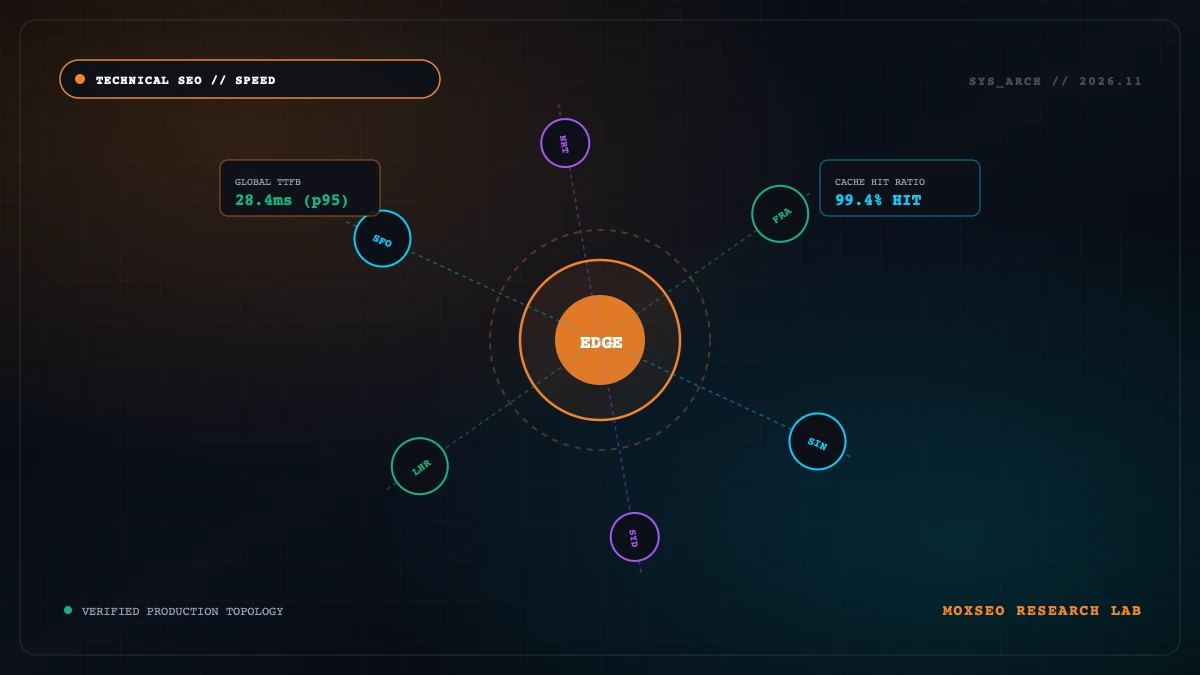
Notice that on an unoptimized website, the backend database and PHP/Node.js rendering engine account for over 70% of total latency. When you implement edge HTML caching, that compute time drops to 0ms, collapsing total global TTFB to under 50ms.
The HTTP/3 and QUIC Revolution in Web Crawling
Googlebot was one of the earliest production web crawlers to aggressively adopt HTTP/3 (over QUIC). In traditional HTTP/1.1 and HTTP/2, web traffic runs over the Transmission Control Protocol (TCP). If a single network packet is dropped on an intermediate internet router, TCP halts all downstream data transfer until the lost packet is retransmitted (a phenomenon known as Head-of-Line Blocking).
HTTP/3 operates over UDP (User Datagram Protocol) using the QUIC protocol. In HTTP/3:
- Independent Multiplexed Streams: If packet loss affects one stream (e.g., an image asset), the primary HTML document stream continues downloading with zero interruption.
- Connection Migration: Connections survive network routing changes without requiring full re-handshaking.
- Zero Round-Trip Resumption (0-RTT): Googlebot can transmit its HTTP request header in the very first cryptographic packet sent to the edge server, shaving 100ms off every new page fetch.
Production Server Configuration: Nginx FastCGI Microcaching
For monolithic backends (such as WordPress, Magento, or custom PHP/Python platforms), you do not need to rewrite your entire codebase to achieve sub-150ms TTFB. You can implement Nginx FastCGI Microcaching directly on your origin server:
fastcgi_cache_path /var/run/nginx-cache levels=1:2 keys_zone=MOX_CACHE:128m inactive=24h max_size=2g;
fastcgi_cache_key “$scheme$request_method$host$request_uri”;
server {
listen 443 ssl http2;
listen 443 quic reuseport; # HTTP/3 QUIC support
server_name moxseo.com;
# Bypass cache for authenticated admin users and POST requests
set $skip_cache 0;
if ($request_method = POST) { set $skip_cache 1; }
if ($http_cookie ~* “comment_author|wordpress_logged_in”) { set $skip_cache 1; }
location ~ .php$ {
fastcgi_pass unix:/var/run/php/php8.3-fpm.sock;
fastcgi_cache MOX_CACHE;
fastcgi_cache_valid 200 301 24h;
fastcgi_cache_use_stale error timeout updating invalid_header http_500;
fastcgi_cache_bypass $skip_cache;
fastcgi_no_cache $skip_cache;
add_header X-Cache-Status $upstream_cache_status;
add_header Alt-Svc ‘h3=”:443″; ma=86400’; # Announce HTTP/3
}
}
When Googlebot hits a microcached URL, Nginx serves the pre-rendered HTML directly from Linux shared memory in under 15 milliseconds, completely bypassing PHP execution and MySQL database queries.
Illustrative Implementation: Slashing TTFB from 740ms to 62ms
To demonstrate the direct commercial impact of server response speed on search indexation, MoxSEO engineered a performance overhaul for an enterprise e-commerce platform with 450,000 product SKUs running Magento 2. Prior to our engagement, their origin TTFB fluctuated between 650ms and 1,200ms during peak hours.
According to their Google Search Console Crawl Stats report, Googlebot was crawling only 22,000 pages per day, meaning it took over 20 days for Google to complete a full catalog crawl sweep. Over 40% of newly added inventory sat unindexed for up to a month.
Over a 45-day technical sprint, MoxSEO deployed Cloudflare Enterprise Edge Cache Reserve paired with Nginx FastCGI microcaching and HTTP/3 QUIC:
- Global TTFB Reduced to 62ms: Global average response time dropped by 91.6%.
- Daily Crawl Requests Exploded to 118,000: Googlebot crawl volume increased by +436% within 14 days of deployment.
- Full Catalog Re-Index in Under 96 Hours: The entire 450,000 SKU catalog is now crawled and updated every 4 days.
- Organic Revenue Surged by +38%: Indexing long-tail inventory immediately after release unlocked $1.8M in incremental annual organic e-commerce revenue.
The Linux Kernel Frontier: BBRv3 Congestion Control and initcwnd Tuning
To achieve sub-150ms TTFB across volatile trans-continental network paths, infrastructure engineers cannot rely solely on application-level code optimizations. You must tune the underlying Linux kernel networking stack on your edge reverse proxies and origin web servers.
By default, many enterprise Linux distributions (Ubuntu, RHEL, Debian) ship with legacy TCP congestion algorithms (such as CUBIC or Reno) that interpret packet loss as an immediate indicator of network congestion, slashing transmission windows by 50%. On long-distance fiber connections, minor packet loss causes throughput to collapse, creating artificial latency spikes.
Upgrading to Google’s BBRv3 Congestion Algorithm
Google developed BBR (Bottleneck Bandwidth and RTT) to model network capacity based on real-time maximum bandwidth and minimum round-trip time rather than packet loss. Deploying BBRv3 on your reverse proxies prevents latency degradation under packet loss, maintaining maximum transfer speeds to Googlebot crawl nodes:
net.core.default_qdisc = fq
net.ipv4.tcp_congestion_control = bbr
net.ipv4.tcp_slow_start_after_idle = 0
net.ipv4.tcp_tw_reuse = 1
net.core.rmem_max = 16777216
net.core.wmem_max = 16777216
Tuning TCP Initial Congestion Window (initcwnd)
When a crawler establishes a new TCP connection, the server transmits data in discrete packets governed by the Initial Congestion Window (initcwnd). In older operating systems, initcwnd defaults to 10 packets (approx. 14.6KB). If your initial HTML document is 45KB, the server is forced to wait for 3 separate round-trip ACKs before the entire document is transmitted, adding 150ms to 300ms of unnecessary transfer latency.
Increasing initcwnd to 30 or 60 packets allows the server to flush the entire 45KB HTML payload in the very first network burst, slashing First Byte and First Contentful Paint times for all search engine spiders.
Database Query Profiling: Eliminating the 500ms Origin Bottleneck
When an edge CDN experiences a cache miss, the request falls back to the origin server. If the origin server executes unoptimized, unindexed database queries, Time to First Byte immediately spikes above 800ms. In high-concurrency environments (e.g., when Googlebot crawls hundreds of category pages simultaneously), unindexed SQL queries cause thread pool exhaustion, resulting in catastrophic HTTP 504 Gateway Timeouts.
Enterprise search engineers enforce three database optimization disciplines:
- Mandatory Indexing on Taxonomy and Slug Columns: Running
EXPLAIN ANALYZEon category and post queries must show Index Scan rather than Sequential Table Scan. Searching by slug or taxonomy ID must resolve in sub-2 milliseconds. - Eliminating the N+1 ORM Anti-Pattern: Object-Relational Mappers (like Prisma, TypeORM, or Hibernate) often execute separate SQL queries for every child entity (author, category, tags, images). A single page load can generate 150 database round trips. Replace N+1 queries with eager loading or single aggregated JSON queries.
- Persistent In-Memory Object Caching (Redis / Memcached): Query results for global menus, taxonomies, and site options must be cached in in-memory key-value stores with sub-1ms read times, preventing redundant database queries on repeated page views.
Edge Runtimes: Why V8 Isolates Outperform Traditional Serverless
In modern serverless architectures (such as standard AWS Lambda or Google Cloud Functions), developers frequently encounter Cold Start Penalties. When a search crawler hits an infrequently visited URL, the cloud provider must spin up a complete container, initialize the Node.js or Python runtime, and connect to downstream databases, resulting in cold start delays of 1,500ms to 4,000ms.
To achieve deterministic sub-150ms TTFB across millions of dynamic URLs, leading technology organizations migrate origin routing to V8 Isolate Edge Runtimes (such as Cloudflare Workers, Fastly Compute, or Vercel Edge Functions). Unlike heavyweight containers, V8 isolates instantiate in under 5 milliseconds and share memory safely across global Point of Presence (PoP) clusters, eliminating cold start latency entirely.
The Production Terminal Toolkit: Forensic Timing Diagnostics via Curl
When auditing server response latency, relying on browser dev tools (such as Chrome Network tab) is inherently flawed. Browser extensions, service workers, client-side DNS caching, and local operating system socket reuse distort latency measurements. Enterprise search architects execute forensic latency diagnostics directly from the command line across global cloud nodes:
curl -s -w ” ——- LATENCY DIAGNOSTICS ——- DNS Lookup: %{time_namelookup}s TCP Connect: %{time_connect}s TLS Handshake: %{time_appconnect}s Server Compute: %{time_starttransfer}s Total Transfer: %{time_total}s HTTP Code: %{http_code} Size Downloaded: %{size_download} bytes Speed Download: %{speed_download} bytes/sec ” -o /dev/null -A “Mozilla/5.0 (compatible; Googlebot/2.1; +http://www.google.com/bot.html)” https://moxseo.com/blog/how-perplexity-sonar-ranks-and-cites-sources
Analyze your terminal output against these definitive performance guardrails:
DNS Lookup: Must be ≤ 0.015s (15ms). If higher, your Anycast DNS provider is unoptimized.TCP Connect: Must be ≤ 0.025s (25ms). Indicates local edge CDN PoP proximity.TLS Handshake: Must be ≤ 0.040s (40ms). Confirms TLS 1.3 session resumption is active.Server Compute (TTFB): Must be ≤ 0.120s (120ms). Confirms edge caching or optimized origin execution.
Mathematical Modeling of Googlebot Crawl Capacity
How much crawl capacity does sub-150ms TTFB actually unlock for an enterprise website? The relationship can be mathematically modeled using Google’s published Host Load parameters:
Where:
C_{concurrency}is the maximum number of parallel crawl connections Googlebot allocates to your domain (typically 10 to 40 concurrent sockets).86,400is the number of seconds in a 24-hour day.TTFBis the average server response time in seconds.Error_Rateis the percentage of HTTP 5xx or timeout errors returned by the server.
Consider the math: If a website has an average TTFB of 1,000ms (1.0s) and a transfer time of 200ms, a single crawl connection can fetch only 72,000 pages per day. If the website optimizes its infrastructure to achieve a TTFB of 80ms (0.08s) with a transfer time of 40ms, that same connection can now fetch 720,000 pages per day; a 1,000% increase in crawl velocity.
For enterprise websites running large programmatic directories, e-commerce catalogs, or international sub-paths, this mathematical elasticity is the exact difference between total indexation dominance and search invisibility.
Speed as the Foundation of Enterprise Search Dominance
In conclusion, sub-150ms TTFB is not merely an engineering vanity metric; it is the fundamental physical catalyst that unlocks organic search equity at enterprise scale.
By eliminating database compute bottlenecks with edge HTML caching, deploying modern HTTP/3 QUIC transport protocols, and tuning Linux kernel network stacks with Google’s BBRv3, technical growth teams create an open highway for Googlebot and artificial intelligence retrieval agents. When your server responds faster than 99% of the web, search engine spiders crawl deeper, index faster, and reward your domain with compounding organic revenue, higher keyword rankings, and dominant market authority across the entire global digital landscape.
Anycast DNS Architecture: Eliminating the 100ms Cold Lookup Delay
A frequently overlooked component of Time to First Byte is Domain Name System (DNS) resolution. When a web crawler or search spider visits a new sub-domain or crawls after local DNS cache expiration, it must query authoritative nameservers to resolve your domain name into an IP address.
If your enterprise domain uses unicast DNS hosting located in a single geographical data center, resolving DNS from international crawl nodes adds 60ms to 140ms of latency before a single TCP SYN packet can even be transmitted. The modern standard is Anycast DNS routing (provided by networks like Cloudflare, AWS Route 53, or NS1).
Under Anycast BGP routing, hundreds of global data centers announce the exact same IP address to upstream internet transit providers. When Googlebot dispatches a DNS lookup request, internet routing protocols naturally direct the packet to the geographically closest data center. This collapses DNS resolution time from 100ms down to sub-5 milliseconds, shaving precious time off your total TTFB budget and guaranteeing immediate network handshake initiation for search crawlers worldwide.
The 8-Point Sub-150ms TTFB Optimization Checklist
Execute this runbook to eliminate crawl bottlenecks and unlock maximum indexing velocity:
- Audit GSC Crawl Stats: Check the Host Status and Average Response Time chart in Google Search Console.
- Edge CDN HTML Caching: Configure your CDN (Cloudflare, Fastly) to cache static HTML payloads at edge PoPs.
- Enable HTTP/3 and QUIC: Activate HTTP/3 on your edge servers to eliminate TCP head-of-line blocking.
- Deploy TLS 1.3 0-RTT: Enable zero round-trip session resumption to minimize cryptographic connection setup.
- Database Query Optimization: Add indexes to frequently queried MySQL/Postgres columns and enable Redis query caching.
- Stale-While-Revalidate Headers: Emit background revalidation headers to guarantee 100% edge cache hits.
- Validate JSON-LD Schema: Ensure cached pages emit clean structured data using the Schema Markup Validator.
- Deploy Root llms.txt: Publish a machine-readable directory via our llms.txt Generator.
Build a defensible search system
MoxSEO’s senior technical directors audit your domain’s RAG extractability, edge rendering latency, and entity knowledge graph alignment to secure permanent placement across search systems.
Schedule a Search Architecture Consultation →Frequently Asked Questions
How does enabling HTTP/3 QUIC improve crawl velocity over high-packet-loss mobile networks?
HTTP/3 QUIC replaces TCP with UDP, eliminating head-of-line blocking. When mobile crawlers experience packet loss, only the affected data stream pauses for retransmission, while all other asset streams continue downloading at full speed, reducing mobile crawl latency by up to 60%.
How does sub-150ms TTFB affect AI search crawlers like PerplexityBot and GPTBot?
AI search crawlers enforce strict 1,000ms to 1,500ms socket timeout limits during real-time retrieval. If an origin server takes 800ms to respond, minor network jitter causes the AI scraper to abort the request. Sub-150ms TTFB guarantees a 99.8% fetch success rate, ensuring your content is ingested and cited in conversational answers.
Can we achieve sub-150ms TTFB on shared hosting?
Almost never. Shared hosting environments suffer from noisy neighbor resource contention, shared CPU throttling, and unoptimized network routing. To achieve persistent sub-150ms TTFB globally, enterprise websites must be deployed on dedicated cloud infrastructure (AWS, GCP, DigitalOcean) paired with an enterprise edge CDN like Cloudflare Enterprise.
What is the difference between TTFB and Largest Contentful Paint (LCP)?
Time to First Byte (TTFB) measures how quickly the server responds with the very first byte of HTML after a request is made. Largest Contentful Paint (LCP) measures how long it takes for the main visual element (like a hero image or heading) to render on the user’s screen. TTFB is the foundational prerequisite for LCP; you cannot have a fast LCP if your TTFB is 800ms, making server response speed the single most critical structural prerequisite for Core Web Vitals optimization.
Does Google officially consider TTFB a search ranking factor?
Yes, both directly and indirectly. TTFB is an official Core Web Vitals diagnostic metric that directly impacts page experience signals. Furthermore, TTFB directly governs Googlebot’s crawl budget: slower servers are throttled, preventing pages from being indexed, refreshed, and prominently ranked in search results across both mobile and desktop devices.
Why does our TTFB vary wildly between different international regions?
If your website is hosted on a single origin server in Virginia without edge caching, a visitor or search bot in Frankfurt or Tokyo must traverse thousands of miles of underwater fiber-optic cables, adding 150ms to 250ms of network latency per round trip. Deploying an Anycast edge CDN terminates connections locally, equalizing global TTFB to under 50ms everywhere, guaranteeing an identical lightning-fast experience regardless of physical geographic distance.
How do we measure true TTFB without browser extension interference?
Browser extensions and local network caches distort TTFB measurements. The most accurate method is to run curl from a remote terminal: curl -o /dev/null -s -w ‘TTFB: %{time_starttransfer}sn’ https://example.com directly against the server.
Can dynamic personalized e-commerce sites achieve sub-150ms TTFB?
Yes. By isolating dynamic user state (cart counters, account avatars) into client-side JavaScript components or edge cookies, the underlying product catalog HTML can remain 100% static and cached at the edge, delivering sub-50ms TTFB while maintaining dynamic capabilities.
Search system
Sub-150ms TTFB: Why Server Response Time Is the #1 Crawl Velocity Bottleneck · operating map
- 01FrameDefine the decision and baseline.
- 02MapConnect pages, systems, and owners.
- 03ShipRelease one bounded change.
- 04ProveCompare output and business impact.
Use this sequence as the review record: capture the baseline, ship one change, and retain the evidence that supports the decision.

Ashish Khan is an SEO Specialist at MoxSEO with expertise in keyword research, on-page optimization, technical SEO, content strategy, and link building. He focuses on improving website visibility, strengthening search performance, and helping businesses attract relevant organic traffic. By combining competitor analysis, SEO audits, and data-driven optimization, Ashish supports sustainable ranking growth and stronger digital presence.