





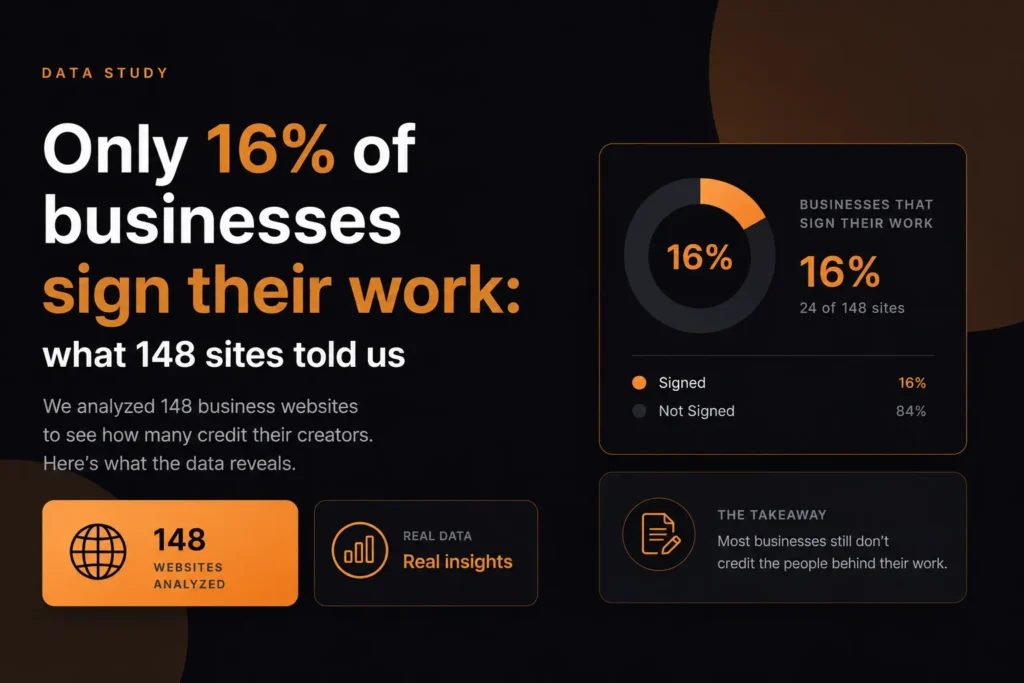
Most business websites explain what they offer, but very few clearly state who created the content and when it was published. Our review of 148 business websites across 20 cities found that only 16.2% included both an author and a date on their homepage.
This gap in author and date attribution on business websites is easy to overlook because it rarely affects the visible design or immediate search rankings. However, it can weaken the machine-readable trust signals used by search engines and AI assistants when evaluating which sources to cite.
The findings also challenge the assumption that businesses in mature markets automatically follow stronger technical standards. Attribution failures appeared across cities, industries, and regions, showing that this is a widespread structural issue rather than a problem limited to smaller or less developed websites.
What is author and date attribution on a business website?
Author and date attribution means a page states, in visible text and in structured data, who created it and when it was published or last updated. Google’s own guidance asks site owners whether it is self-evident to visitors who wrote the content, and recommends accurate bylines linked to author background where readers might expect them. A page without either gives people and machines little to judge it by.
What we measured, and where
Businesses were identified per city through Google Places across agencies, development firms and relevant local verticals, at six to nine sites per city. Every live homepage was fetched and scored against nine weighted structural checks.
The cities spanned established markets and emerging ones deliberately, because the assumption we wanted to test was that maturity predicts technical standards.
It does not. Chennai outperformed London, New York and Sydney on attribution. That result held across re-runs and the per-site data is published so anyone can check it.
The study design has limits worth stating. It covers homepages only, not blog posts or service pages, and it samples six to nine businesses per city, so it describes the pattern across 148 sites and not every business in any one city. Read the numbers as a snapshot of the sampled homepages. Our wider approach is set out on the methodology page.
Why attribution is the check that fails

Attribution means declaring who wrote something and when. It is trivially easy to implement and almost universally skipped, for reasons that are structural rather than technical.
- It has no visible effect on the page, so nobody notices it missing
- No CMS applies it by default to marketing pages
- It carries no immediate ranking penalty, so it never reaches a priority list
- It is invisible to the people approving the page
The consequence is a page that is entirely credible to a human reader and carries no machine-readable evidence of who stands behind it.
Why it matters more than it did
When a search engine returned ten links, the reader evaluated the source themselves. They saw the domain, recognised the brand or did not, and made a judgement before clicking.
When an assistant synthesises an answer, that step disappears. The system decides which sources to draw on, and one of the few machine-readable trust signals available is whether a page states who wrote it and when.
A page with no author and no date is not disqualified. It is simply harder to justify citing over an equivalent page that has both. At scale, that difference compounds.
To be precise about what is established: Google’s helpful content guidance asks “Who, How and Why” questions, including whether it is clear to visitors who authored the content. Its publication-date documentation says Google may show a date in results when it seems useful but does not guarantee it. Neither document says a byline is a ranking factor. Our argument for attribution rests on clarity, accountability and machine readability, not on a claimed ranking boost.
What good attribution actually looks like
Visible on the page and declared in structured data. Both, not either.
- A named person where a person wrote it, not a generic team label
- A linked profile — an author page, or a verifiable external profile
- Published and modified dates, both accurate
- Author in your schema, as a Person with a name and ideally a URL
- Credentials where they are relevant, particularly on advice with consequences
The modified date deserves care. Bumping it automatically on every deploy makes it meaningless, and a reader who checks will notice. Update it when the content genuinely changed.
How should you mark up an author and dates?
Google’s Article structured data documentation sets out the rules for the author property. In summary: use Person for people and Organization for organisations, put only the name in author.name (no job title, honorific or “posted by”), link author.url to a page that identifies the author such as a bio or profile page (sameAs is an accepted alternative), and give each author a separate entry. datePublished and dateModified are recommended, in ISO 8601 format with timezone information.
Google’s publication date guidance adds that you should show a date prominently and label it (for example “Published” or “Last updated”), keep visible dates and structured data dates matching, and avoid future dates or the date of an event the page describes. A minimal, hypothetical example looks like this:
{
  "@context": "https://schema.org",
  "@type": "Article",
  "headline": "Example article title",
  "author": {
    "@type": "Person",
    "name": "Example Author",
    "url": "https://example.com/authors/example-author/"
  },
  "datePublished": "2026-08-28T09:30:00+05:30",
  "dateModified": "2026-08-28T09:30:00+05:30"
}
Check yours with our schema markup validator or build the entity details with the entity schema generator. Remember that Google also asks you not to fabricate creators: made-up names, AI headshots or false credentials are described in its guidance as a form of deception. Only name real people who actually wrote or reviewed the page.
The other eight checks, briefly
Attribution was the worst performer, but it was not measured alone. The full set covers whether a page can be read, understood and quoted by a machine.
- Whether a direct answer appears near the top of the page
- Heading structure, including a single H1 and no skipped levels
- Whether claims carry sources
- Structured data presence and validity
- Crawler access, including AI crawlers specifically
- Content depth relative to the topic
- Whether the page states what the organisation actually does
- Contact and identity information
Only 3% of the 243 homepages in our companion study passed enough of these to be structurally quotable. Attribution is the cheapest of them to fix. The companion work is published as the AI answer extractability study, and crawler access is covered in the AI crawler blocking study.
How to check your own site this week
Three steps, none of which take long.
- Run your most important pages through our extractability checker, which scores attribution alongside the other eight factors
- Add author and date to your templates rather than page by page, so new content inherits it
- Create author pages with real biographies and link them from every byline
The full dataset for all 148 businesses is published under CC BY 4.0 on our research page, with per-check results for every site so you can reanalyse it or compare your own sector against it.
What does a template fix look like, step by step?
- List your page types. Blog post, service page, case study, landing page, homepage.
- Decide who is the accountable author for each type. A named specialist for advice, a named reviewer for service pages, the organisation for pages with no individual author.
- Add a visible byline and labelled dates to the template, such as “Published” and “Last updated”, linked to the author page.
- Output matching structured data from the same fields so the visible text and the markup cannot disagree.
- Build the author pages with a real biography, role and links to verifiable external profiles.
- Test a sample of each page type and recheck after publishing. Then set a rule that the modified date changes only on real edits.
What attribution mistakes should you avoid?
| Mistake | Why it matters | Fix |
|---|---|---|
| Author in schema but not on the page | Visible text and markup disagree | Show the byline and output both from one field |
| Job title inside the author name field | Google asks for only the name there | Use jobTitle separately |
| Invented or stock author | Google describes fabricated creators as deception | Use real people, or the organisation |
| Auto-updated modified date | Signals freshness that is not real | Change it only when content changes |
| Dates without a label | A reader cannot tell published from updated | Label each one |
| Fixing page by page | New pages repeat the gap | Fix the template |
Sources and further reading
- Article structured data, including author
- The Person schema type
- Google Search Central: Influencing your byline date
- Google Search Central: Creating helpful, reliable, people-first content
Make Your Content Easier to Trust, Understand, and Cite
A page can look credible to a visitor while still giving search engines and AI systems very little evidence about who created it, when it was published, or whether the information is current. The MoxSEO study of 148 businesses found that only 16.2% of the websites reviewed declared both an author and a date, making attribution one of the most common structural weaknesses across every market examined.
MoxSEO can help you identify these gaps before they limit the extractability and citation potential of your content. Run your most important pages through the MoxSEO extractability checker to review attribution, heading structure, direct answers, structured data, crawler access, content depth, source support, organisational clarity, and contact information.
The assessment can reveal whether your pages include visible author details, accurate published and modified dates, linked author profiles, valid Person schema, and the other structural signals machines use to understand and evaluate content.
For websites with multiple templates, large content libraries, custom CMS configurations, or inconsistent schema implementation, MoxSEO can also provide a detailed content-structure audit. The review can help your team improve templates at the site level rather than manually correcting every page, creating a more consistent foundation for future content.
Book a consultation with MoxSEO to discuss your website’s attribution gaps, structured data, content extractability, and visibility in AI-generated answers. The consultation can help you prioritise the pages and technical improvements most likely to strengthen machine-readable trust across your website. You can also read about our AI SEO service.
Do not wait for attribution and extractability problems to become embedded across hundreds of pages. Establish clear authorship, accurate dates, verifiable profiles, valid structured data, and stronger machine-readable trust signals across your website.
Book a Consultation with MoxSEO
Frequently asked questions
Does an author byline affect rankings directly?
Not in any measurable, mechanical way. It affects whether a machine can establish who is accountable for a claim, which matters increasingly for citation rather than for ranking.
Can I use the company name as the author?
You can, and it beats nothing. A named person with a linked profile is meaningfully stronger, particularly on advice.
Should I show published or modified dates?
Both. Published establishes when it first appeared; modified establishes currency. Only update modified when the content actually changed.
Does this apply to ecommerce product pages?
Less so. Product pages have their own trust signals. It matters most on advice, analysis and anything where who wrote it changes how much weight it deserves.
Where can I see the raw data?
On the research page. The dataset is CC BY 4.0 with per-check results for all 148 businesses across the 20 cities.
What does Google recommend for author markup?
Google’s Article structured data documentation says to use Person for people and Organization for organisations, put only the name in the name field, link the URL to a page that identifies the author, and give each author a separate entry.
Which date format should structured data use?
Google recommends datePublished and dateModified in ISO 8601 format with timezone information. Without a timezone, it uses the timezone of Googlebot. Keep the visible dates and the structured data dates matching.
Will Google always show my date in search results?
No. Google says a byline date is its estimate of when a page was published or last significantly updated, and that it may show it if it seems useful, but display is not guaranteed.
How many homepages passed the author and date check?
In our review of 148 business websites across 20 cities, 16.2% included both an author and a date on their homepage. The study covers homepages only.

Sakshi Kumari is an SEO Specialist at MoxSEO with expertise in keyword research, on-page SEO, content optimization, technical SEO, and link-building strategies. She focuses on improving organic visibility, strengthening website performance, and creating search-focused content that attracts relevant traffic. Through data-driven analysis and practical SEO execution, Sakshi helps businesses build stronger search presence and achieve sustainable digital growth.