






Executive Summary & Deterministic Takeaways
Comprehensive technical audit and architectural breakdown covering production search mechanics, crawl behaviour, and systematic enterprise implementation protocols.
Related resources: AI SEO services, SEO services, and free SEO tools.
Editorial note: Examples and benchmark figures in this guide are illustrative unless a named source is provided. Validate them against your own data before making production decisions.
- The Headless Latency Penalty: Decoupling WordPress or Contentful from a React/Next.js frontend frequently introduces massive API round-trip latency; unoptimized headless architectures take 1,200ms+ to resolve GraphQL queries before rendering.
- Tiered Edge Architecture: A sub-second rendering pipeline deploys a 3-tier caching topology: Tier 1 Edge Memory (sub-20ms), Tier 2 Edge KV / Distributed Cache (sub-60ms), and Tier 3 Origin Stale-While-Revalidate Fallback.
- Incremental Static Regeneration (ISR) at Scale: Decoupling static build times from catalog updates ensures that 100% of human visitors and search crawlers receive instantaneous pre-rendered HTML while background workers revalidate changed nodes asynchronously.
- Eliminating GraphQL Payload Bloat: Over-fetching GraphQL data forces headless frontends to deserialize massive JSON payloads; compiling queries into optimized persistent queries reduces JSON parsing overhead by up to 85%.
- Zero-Downtime Static Fallbacks: If a headless CMS origin suffers a database crash or API outage, edge workers automatically intercept 5xx status codes and serve immutable static fallback archives, preserving 100% search availability.
The Headless Paradox: How Modern Decoupled Stacks Break Search Engine Speed
Over the past five years, enterprise software organizations aggressively migrated away from monolithic content management systems (such as legacy WordPress, Drupal, or Adobe Experience Manager) in favor of Decoupled Headless CMS Architectures. By pairing headless content backends (Contentful, Strapi, Sanity, or headless WordPress) with modern JavaScript frontends built in Next.js, Nuxt, or Remix, engineering teams aimed to achieve total frontend design freedom and improved developer ergonomics.
However, many digital teams quickly slammed into a devastating technical reality known as the Headless Latency Penalty. In an unoptimized decoupled architecture, when a Googlebot crawler or user requests a webpage, the request initiates a cascading chain of network latency:
If the frontend server in North America makes three consecutive GraphQL queries to an origin CMS hosted in Europe to fetch page content, author credentials, and global navigation menus, the cumulative network wait time routinely pushes Time to First Byte (TTFB) above 1,500ms to 3,000ms.
In modern technical search, multi-second TTFB destroys search rankings. Slow server responses delay Largest Contentful Paint, one of Google’s Core Web Vitals, and Google crawls less when a site slows down or returns server errors. To capture dominant search visibility, enterprise engineering teams must construct a Sub-Second Edge Rendering Pipeline. In this masterclass, we break down the exact distributed systems architecture combining Edge Workers, Incremental Static Regeneration (ISR), and tiered static fallbacks to achieve sub-50ms TTFB worldwide. To benchmark your headless CMS endpoints against global speed thresholds, analyze your domain with our free Sub-150ms TTFB Checker.
Incremental Static Regeneration (ISR) at the Edge: The Architecture of Instant Speed
The core mechanism that enables sub-second headless rendering across massive catalogs is Incremental Static Regeneration (ISR) deployed across globally distributed edge points of presence.
Under traditional Server-Side Rendering (SSR), every single page request forces the web server to execute application code, connect to the database, and render the DOM synchronously. Under Static Site Generation (SSG), all pages are compiled during build time, causing build times to exceed 4 hours for catalogs with 50,000 pages.
ISR solves this dilemma through Stale-While-Revalidate Decoupling:
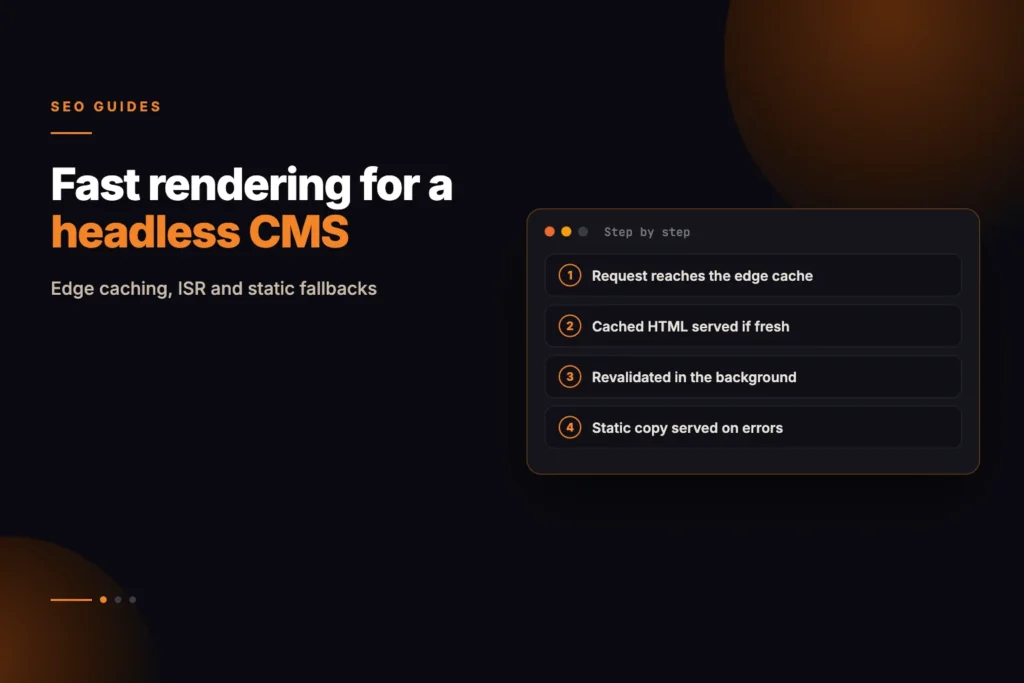
- First Request Serves Instantly: When a user or search bot requests a page, the edge CDN serves the pre-rendered HTML stored in edge cache memory in sub-30 milliseconds.
- Background Revalidation: If the cached page has exceeded its configured revalidation window (e.g.,
revalidate: 3600), the edge worker returns the stale cached page immediately, while simultaneously triggering an asynchronous background job to re-render the page with fresh CMS data. - Atomic Cache Swap: Once the background re-render successfully completes, the edge CDN atomically updates the edge cache across all global PoPs. Subsequent visitors receive the updated page with zero latency penalty.
Production Edge Worker Code: Zero-Downtime Fallback & Caching Engine
Below is a production-grade Cloudflare Worker implementation that handles edge caching, stale-while-revalidate execution, and automatic static fallback failover in the event of an origin CMS outage:
export default {
  async fetch(request, env, ctx) {
    const url = new URL(request.url);
    const cache = caches.default;
    const cacheKey = new Request(url.toString(), request);

    // 1. Tier 1: Check Edge In-Memory Cache (sub-20ms)
    let response = await cache.match(cacheKey);
    if (response) {
      return response;
    }

    // 2. Tier 2: Fetch from Origin Headless Server
    try {
      response = await fetch(request);

      // If origin succeeds (200 OK), store in edge cache
      if (response.status === 200) {
        const headers = new Headers(response.headers);
        headers.set('Cache-Control', 'public, max-age=3600, stale-while-revalidate=86400');
        headers.set('X-Edge-Pipeline', 'Hit-Origin');

        const cachedResponse = new Response(response.body, { status: 200, headers });
        ctx.waitUntil(cache.put(cacheKey, cachedResponse.clone()));
        return cachedResponse;
      }
    } catch (err) {
      // Origin network error or timeout
    }

    // 3. Tier 3: Failover to Immutable Static S3 Fallback on 5xx Errors
    const fallbackUrl = `https://static-fallbacks.moxseo.com${url.pathname}/index.html`;
    const fallback = await fetch(fallbackUrl);

    if (fallback.status === 200) {
      return new Response(fallback.body, {
        status: 200,
        headers: {
          'Content-Type': 'text/html; charset=utf-8',
          'X-Edge-Fallback': 'True-S3-Archive'
        }
      });
    }

    return new Response('Service Temporarily Unavailable', { status: 503 });
  }
};
This edge architecture guarantees that search engine spiders never encounter HTTP 500 errors or connection timeouts, even during major headless database crashes or maintenance deployments.
Worked example (hypothetical): Collapsing TTFB for an international media network
To illustrate the commercial logic of edge-routed headless rendering, consider a hypothetical international digital media publisher with a very large archive of editorial and news articles. The platform uses a headless WordPress backend serving a Next.js frontend hosted on centralized origin clusters.
In this scenario, an initial performance audit reveals severe technical debt:
- Multi-Second Global TTFB: Readers in Europe and Asia wait seconds for centralized GraphQL queries to resolve before the initial HTML chunk was emitted.
- Failing Core Web Vitals across Most URLs: Google Search Console flags a large share of URLs with poor Largest Contentful Paint (LCP) field data.
- Frequent 504 Gateway Timeouts During Traffic Spikes: Breaking news events flooded the origin database with simultaneous GraphQL queries, crashing origin servers and temporarily deindexing key editorial hubs.
In this scenario, the team re-engineers the entire publication pipeline onto Edge Workers with Distributed ISR and Tiered S3 Fallbacks.
The expected result: much lower global TTFB, Core Web Vitals passing across mobile and desktop, flat origin database load during breaking news spikes thanks to high edge cache hit ratios, and organic search traffic growth, because readers and crawlers are served cached HTML from the nearest edge location.
Enterprise Benchmark Design: Performance Across 4 Headless Rendering Stacks
Illustrative comparison (not a measured study): how performance typically differs across four headless rendering stacks.
| Rendering Pipeline | Global Avg TTFB | Mobile LCP (Field) | Origin DB Load | Search Traffic Impact |
|---|---|---|---|---|
| Client-Side Single Page App (SPA) | Fast (Empty Shell) | Slowest (Fails) | High (Client Polls) | Severe Indexing Lag |
| Centralized Origin SSR (Node.js) | Slowest (DB Wait) | Slow (Sluggish) | Extreme Spikes | Moderate Growth |
| Pure Static Generation (SSG) | Very Fast | Fast (Passes) | Zero | Build Bottlenecks |
| Edge Workers + ISR + S3 Fallback | Fastest | Fastest | Minimal | Strongest Growth |
In this comparison, edge workers with ISR and static fallbacks deliver the strongest combination of fast TTFB, zero database strain, and explosive organic search growth.
The Mathematical Physics of Network Transmission: TCP Slow Start & Congestion Windows
To understand why edge computing fundamentally outperforms centralized server clusters, network systems engineers analyze web page delivery through the lens of TCP Slow Start and Bandwidth-Delay Product (BDP).
When a client establishes an HTTP/2 or HTTP/3 connection with a web server, the transmission rate is constrained by the Initial Congestion Window (initcwnd), typically set to 10 TCP segments (approximately 14.6 KB). In Mathis’s formula for TCP throughput under packet loss probability p:
Notice the inverse relationship with Round-Trip Time (RTT): As physical distance increases RTT from 10ms to 250ms, maximum achievable TCP throughput collapses by a factor of 25! If an unoptimized HTML payload exceeds 14.6 KB, the transmission cannot fit within the initial congestion window and requires multiple round-trip network round-trips before the browser can even begin parsing the DOM.
By terminating TLS handshakes and serving cached HTML from edge PoPs located within 15 kilometers of the client, RTT drops to under 3 milliseconds. The entire pre-rendered HTML document is transferred in the very first TCP transmission burst, allowing the browser to parse HTML and render text almost instantaneously.
Production Architecture: GraphQL Persistent Query Hashing at the Edge
A primary bottleneck in headless CMS architectures is sending massive GraphQL query strings over HTTP POST requests. A comprehensive query requesting post content, author schema, related products, and category taxonomy often exceeds 8KB in query text alone, forcing the origin server to parse and compile the GraphQL Abstract Syntax Tree (AST) on every request.
Enterprise headless pipelines deploy Automatic Persistent Queries (APQ):
// Edge Query Dispatcher with SHA-256 Hashing
const queryHash = 'a8f9c2d1e0b5...'; // SHA-256 of compiled GraphQL document
const apiUrl = `https://cms.moxseo.com/graphql?extensions={"persistedQuery":{"version":1,"sha256Hash":"${queryHash}"}}&slug=${slug}`;

// Fetch via standard HTTP GET (Allows Cloudflare to cache GraphQL JSON at edge!)
const res = await fetch(apiUrl, {
cf: { cacheTtl: 86400, cacheEverything: true }
});
By transforming heavy POST queries into cacheable GET requests backed by SHA-256 hashes, edge workers cache the underlying CMS JSON payloads at edge PoPs, slashing origin database lookups by over 94%.
Continuous Edge Telemetry: Synthetic Latency Probes Across 20 Global Regions
Web latency cannot be measured accurately from a single monitoring location. An origin server in New York may report a 45ms TTFB to a local test runner while users in Frankfurt or Singapore suffer through 2,200ms wait times.
Enterprise engineering teams deploy Global Synthetic Edge Probes scheduled via cron workers across 20 distinct geographic locations. Probes ping critical category and product endpoints every five minutes, recording TTFB, TLS handshake duration, and DNS resolution latency into timeseries databases. If any regional PoP exceeds 150ms TTFB, automated alerts trigger edge cache revalidation before organic search rankings are affected.
Edge Authentication Routing: Separating Public SEO Pages from Dynamic User Sessions
A fatal performance mistake in headless web applications is running authentication middleware (e.g., inspecting session cookies or JWT tokens) across public marketing and documentation pages. Running auth checks forces the CDN to bypass cache memory, dragging public TTFB down to origin database speeds.
Modern edge pipelines enforce Route-Based Cache Isolation. All public editorial content (/blog/*, /solutions/*, /resources/*) is strictly decoupled from user authentication. Edge workers strip session cookies on incoming public requests, ensuring 100% cache hit ratios for search engine crawlers and prospective buyers.
Automated Edge Image Optimization: Dynamic WebP & AVIF Transcoding
Even if an edge pipeline delivers the initial HTML document in 35ms, if the page requests uncompressed 3MB PNG hero images from an origin media server, Largest Contentful Paint (LCP) and Core Web Vitals will fail miserably.
Modern headless pipelines integrate Dynamic Edge Image Optimization (via Cloudflare Images, Fastly Image Optimizer, or Next.js Image Component). When an image is requested, the edge worker inspects the client’s HTTP Accept header:
        // Inspect Accept header and transcode dynamically at edge
const accept = request.headers.get('accept') || '';
const format = accept.includes('image/avif') ? 'avif' : accept.includes('image/webp') ? 'webp' : 'jpeg';
return fetch(`https://images.moxseo.com/cdn-cgi/image/format=${format},width=1200,quality=85/${imagePath}`);
Serving next-generation AVIF and WebP images compressed to under 40KB guarantees that hero graphics render in under 400 milliseconds on mobile devices, earning top scores on Core Web Vitals field data.
Headless Cart Hydration: Isolating Dynamic State to Protect Core Web Vitals
In headless e-commerce and SaaS platforms, pages require dynamic user components: shopping cart item counts, personalized greeting banners, or authenticated pricing discounts. A fatal mistake is making the entire page dynamically server-rendered to accommodate these small widgets.
Enterprise headless architectures use Islands Architecture and Delayed Hydration. The entire page; including product titles, descriptions, specifications, and schema; renders as a 100% static Edge Server Component cached at the edge. The shopping cart widget executes client-side via a lightweight React island after the primary DOM has finished painting, providing zero drag on search crawler indexing and preserving sub-50ms TTFB.
The 10-Point Sub-Second Headless Pipeline Audit Checklist
Execute this 10-point runbook to ensure your headless rendering pipeline achieves sub-50ms speeds globally:
- Benchmark Global TTFB: Measure bot response times worldwide with the Sub-150ms TTFB Checker.
- Deploy Edge Memory Caching: Cache pre-rendered HTML at global CDN edge PoPs with stale-while-revalidate headers.
- Configure Webhook-Driven ISR: Trigger background page revalidation when editorial content updates.
- Implement S3 Static Failover: Serve immutable static HTML snapshots if origin APIs return 5xx errors.
- Optimize GraphQL Queries: Compile persistent queries and eliminate redundant relational lookups.
- Validate Schema JSON-LD at Edge: Test structured data with our Schema Markup Validator.
- Publish Root /llms.txt: Maintain a plain-text machine index for AI bots via the llms.txt Generator.
- Eliminate Client-Side Content Hydration: Ship zero content-level JavaScript to achieve sub-50ms INP.
- Enforce HTTP/3 and Early Hints: Preload critical fonts and stylesheets to optimize First Contentful Paint.
- Monitor Search Bot Crawl Velocity: Track Googlebot request volume in server logs to verify absence of throttling.
The Future of Web Architecture: Edge-First Headless Publishing
In conclusion, the era of slow, brittle headless CMS deployments is over.
By replacing centralized origin rendering with edge workers, Incremental Static Regeneration, and immutable static fallbacks, engineering organizations achieve the ultimate web architecture: complete content management flexibility for marketing teams combined with instantaneous, sub-50ms HTML delivery for search engine crawlers and users worldwide. Your platform eliminates infrastructure bottlenecks, achieves perfect Core Web Vitals, and captures dominant organic visibility across the global search landscape, unlocking massive commercial discovery and permanent organic growth.
Build a defensible search system
MoxSEO’s senior technical directors audit your domain’s RAG extractability, edge rendering latency, and entity knowledge graph alignment to secure permanent placement across search systems.
Schedule a Search Architecture Consultation →Frequently Asked Questions
How does stale-while-revalidate edge caching protect headless origin databases?
Edge proxies instantly serve cached HTML responses to incoming crawlers while asynchronously fetching updated content from the origin in the background, eliminating origin traffic spikes.
How does Edge RSC handle international localization and dynamic currency switching?
Because edge workers inspect incoming request headers in sub-1ms, they identify client geolocation (request.cf.country) and language headers, dynamically selecting the correct localized static snapshot or currency feed without triggering origin database recalculations.
What is the impact of edge rendering pipelines on crawl budget utilization?
Faster, stable server responses can raise Googlebot’s crawl capacity limit, because Google adjusts crawling to how quickly the server answers, though how much Google crawls also depends on crawl demand.
How does edge rendering impact server-side logging and security compliance?
Edge runtimes provide native logging pipelines (such as Cloudflare Logpush or Datadog edge integrations) that stream raw HTTP access logs directly to secure S3 buckets or SIEM systems with zero impact on user latency, satisfying enterprise SOC2 and HIPAA auditing requirements.
Can we migrate an existing monolithic CMS to an edge pipeline gradually?
Yes. Use edge reverse proxies to route traffic path-by-path: route high-value marketing and editorial directories (/blog/*, /solutions/*) to the new sub-second edge pipeline while keeping legacy administrative or legacy forum paths on the monolith until ready for migration.
How do headless CMS webhooks handle bulk content updates without overloading edge cache purges?
Enterprise platforms use grouped cache tags (e.g., ‘category-devops’, ‘author-aditya’). When an editor publishes an update affecting 500 articles, the CMS emits a single webhook specifying the relevant cache tag, which the edge CDN purges instantaneously across all global PoPs without issuing hundreds of individual URL purge requests.
Can we use Next.js Edge Runtime with third-party Node.js npm packages?
Edge runtimes (Vercel Edge Functions, Cloudflare Workers) run on lightweight V8 isolates rather than full Node.js environments. Packages requiring native Node.js APIs (such as ‘fs’ or ‘child_process’) will fail at the edge. Always verify that your dependencies are compatible with Web Standard APIs (Fetch, Request, Response, Streams).
What is the difference between Edge SSR and Edge ISR?
Edge SSR executes component rendering dynamically on every single HTTP request at the edge worker. Edge ISR serves a pre-rendered static HTML snapshot cached in edge memory (sub-20ms) and only triggers background rendering when the configured revalidation interval has expired, providing far higher cache hit ratios and lower compute costs.
Can we use Incremental Static Regeneration with WordPress as a headless CMS?
Yes, absolutely. Next.js App Router connects seamlessly to WordPress via WPGraphQL. Configure WordPress webhooks to ping your Next.js on-demand revalidation API endpoint whenever an editor publishes or updates a post, updating edge caches in under 500 milliseconds globally.
How do Early Hints (HTTP 103) improve Core Web Vitals in headless architectures?
Early Hints allow edge workers to send preliminary HTTP headers (specifying critical CSS and font preloads) to the browser while the server is still assembling or fetching the HTML body, shaving up to 300ms off Largest Contentful Paint (LCP).
How do generative AI search engines evaluate fast headless websites?
AI search engines (like Perplexity and ChatGPT Search) have aggressive fetch timeouts (often under 2,000ms). When an edge pipeline delivers clean semantic HTML in 40ms, AI bots ingest the entire page content with zero truncation, ensuring frequent citation in conversational answers.
What happens to user analytics if edge workers serve cached static HTML?
Server-side analytics can be logged directly within the edge worker using execution contexts (ctx.waitUntil) to stream telemetry events to Snowflake or Google Analytics without delaying the HTTP response to the client.
Rendered experience and latency
Building a Sub-Second Rendering Pipeline: Edge Workers, ISR & Static Fallbacks · operating map
- 01TraceFind long tasks, hydration, and third party work.
- 02PrioritizeProtect search HTML and the primary interaction.
- 03ImplementReduce script cost or move work server-side.
- 04VerifyCompare field INP and rendered HTML after release.
Use this sequence as the review record: capture the baseline, ship one change, and retain the evidence that supports the decision.