





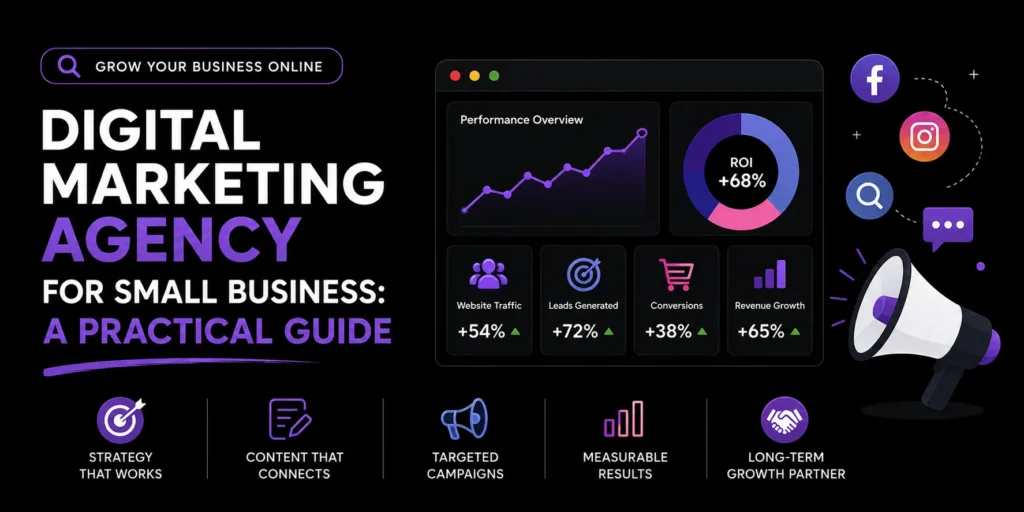
Digital marketing gives small businesses a practical way to reach customers, generate enquiries, and compete with larger brands. However, managing SEO, paid advertising, social media, content, and analytics without specialist support can quickly become overwhelming.
A digital marketing agency for small business brings these activities together under one strategy. Instead of chasing impressions or followers, the right agency focuses on measurable outcomes—qualified leads, bookings, store visits, online sales, and customer retention.
This guide explains what a small-business digital marketing agency does, which services are worth investing in, how much support you may need, and how to choose an agency that fits your goals and budget.
TL;DR: A digital marketing agency helps small businesses attract and convert customers through SEO, local search, paid ads, content, social media, and conversion optimization. Start with one clear goal, prioritize the channels closest to customer intent, and select an agency that provides transparent reporting tied to leads and revenue—not vanity metrics.
What Is a Digital Marketing Agency for Small Business?
A digital marketing agency for small business is a specialist team that plans, executes, and measures online marketing campaigns for smaller companies. Its strategies are usually designed around limited budgets, local or niche audiences, and the need to produce measurable returns.
Depending on the business, an agency may manage:
- Search engine optimization
- Google Business Profile optimization
- Google Ads and other paid campaigns
- Social media marketing
- Website and landing page improvements
- Content creation
- Email marketing
- Online reputation management
- Analytics and conversion tracking
Unlike an internal marketing hire who may have experience in only one or two areas, an agency can provide access to SEO specialists, advertising professionals, writers, designers, and data analysts.
If you are comparing service providers, this guide to selecting the best digital marketing agency in India explains the important factors to evaluate.
Why Do Small Businesses Need Digital Marketing?
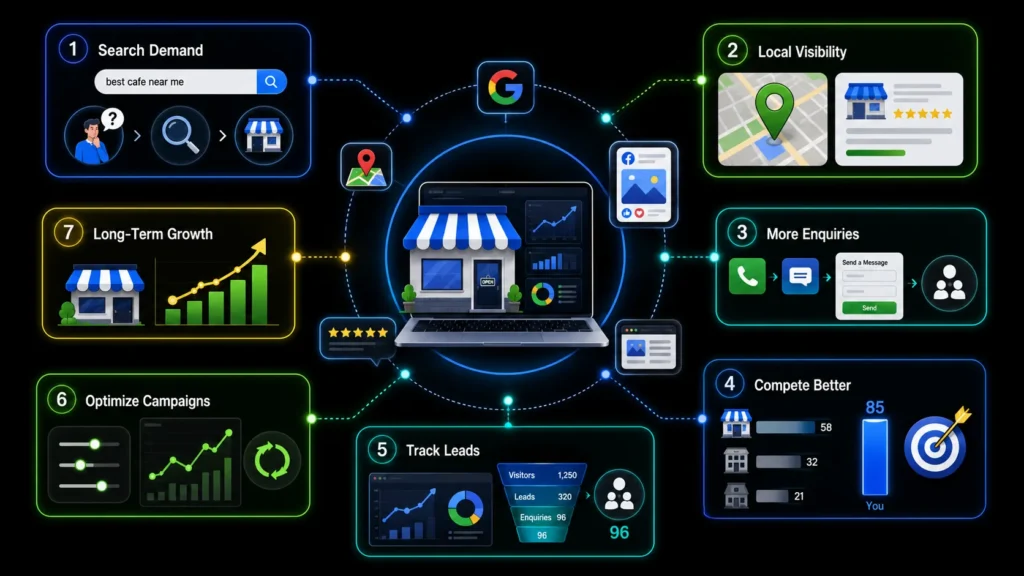
Customers increasingly use search engines, maps, social platforms, and online reviews before contacting a business. Even when a purchase happens offline, the decision often begins online.
Digital marketing helps a small business appear during this research process. It can also reach audiences more precisely than traditional advertising because campaigns can be targeted by location, interests, search intent, device, and previous website activity.
The main benefits include:
- Reaching people actively searching for a service
- Building visibility within a specific city or service area
- Generating enquiries beyond personal referrals
- Competing with established businesses in focused markets
- Measuring where leads and sales originate
- Adjusting campaigns based on performance
- Building a marketing channel that supports long-term growth
The goal is not to be active on every available platform. It is to identify where your customers search, compare, and make decisions—and then build a strong presence there.
What Services Does a Small-Business Digital Marketing Agency Provide?
Not every business needs every service. A reliable agency should recommend channels based on your audience, competition, sales process, and available resources.
Search Engine Optimization
SEO improves a website’s visibility when potential customers search for relevant products, services, or information.
A typical SEO campaign may include:
- Keyword and search-intent research
- Technical website auditing
- Title tag and meta description optimization
- Service and location page improvements
- Internal linking
- Content creation
- Link acquisition
- Performance monitoring
SEO is particularly valuable for businesses that offer services people search for regularly. It normally requires patience, but effective optimization can produce consistent traffic without paying for every website visit.
Local SEO
Local SEO helps businesses appear in location-based searches such as “plumber near me,” “dentist in Mumbai,” or “best bakery nearby.”
A local SEO strategy generally covers:
- Google Business Profile optimization
- Accurate business name, address, and phone details
- Local directory listings
- Customer review generation
- Location-focused website content
- Google Maps visibility
- Local backlink development
Businesses serving a defined location can explore professional local SEO services to improve their visibility across local search results and Google Maps.
Pay-Per-Click Advertising
Pay-per-click advertising allows a business to appear in front of potential customers more quickly than organic SEO. The advertiser usually pays when someone clicks the advertisement.
Google explains that Search ads can help businesses reach people who are actively searching for their products or services. Its official Google Ads resource also covers campaign formats for Search, YouTube, Display, and other Google channels.
Paid advertising can support:
- Immediate lead generation
- Product or service launches
- Seasonal offers
- Location-specific promotions
- Remarketing to previous visitors
- Testing offers before investing in long-term campaigns
Every campaign should have conversion tracking. Without it, a business may know how many clicks it received but not whether those clicks produced calls, enquiries, appointments, or sales.
Social Media Marketing
Social media can help a small business build familiarity, demonstrate expertise, answer customer questions, and maintain relationships with its audience.
An agency may help with:
- Platform selection
- Content calendars
- Post design and copywriting
- Short-form video content
- Community management
- Paid social campaigns
- Performance analysis
Businesses do not need to publish on every platform. A local restaurant may benefit from Instagram and Facebook, while a professional consultancy may find LinkedIn more valuable.
A focused social media marketing strategy for small business can help turn regular content into awareness, engagement, and qualified enquiries.
Content Marketing
Content marketing answers the questions customers ask before making a decision. It can improve organic visibility while helping people understand the value of a product or service.
Useful content formats include:
- Practical blog guides
- Service comparison pages
- Case studies
- Customer success stories
- Videos and demonstrations
- Checklists
- Frequently asked questions
- Email newsletters
Content should be based on real customer concerns rather than written only to include keywords. Helpful, accurate content can support both traditional search rankings and visibility in AI-generated search answers.
Website and Conversion Optimization
Generating traffic is only useful when the website can convert visitors into customers. An agency should therefore examine what happens after someone reaches the site.
Conversion improvements may include:
- Clear service explanations
- Faster page loading
- Mobile-friendly layouts
- Visible contact options
- Strong calls to action
- Shorter enquiry forms
- Trust signals and testimonials
- Dedicated campaign landing pages
A business may not always need more traffic. Sometimes it needs a clearer website that converts a larger percentage of its existing visitors.
Email Marketing
Email marketing helps businesses follow up with prospects and maintain relationships with current customers. It is particularly helpful when customers need time before purchasing or when repeat sales are important.
Common email campaigns include:
- Welcome sequences
- Lead-nurturing emails
- Appointment reminders
- Abandoned-cart emails
- Product updates
- Educational newsletters
- Re-engagement campaigns
The agency should segment audiences so that customers receive relevant messages rather than the same promotion being sent to everyone.
Which Digital Marketing Services Should a Small Business Choose First?
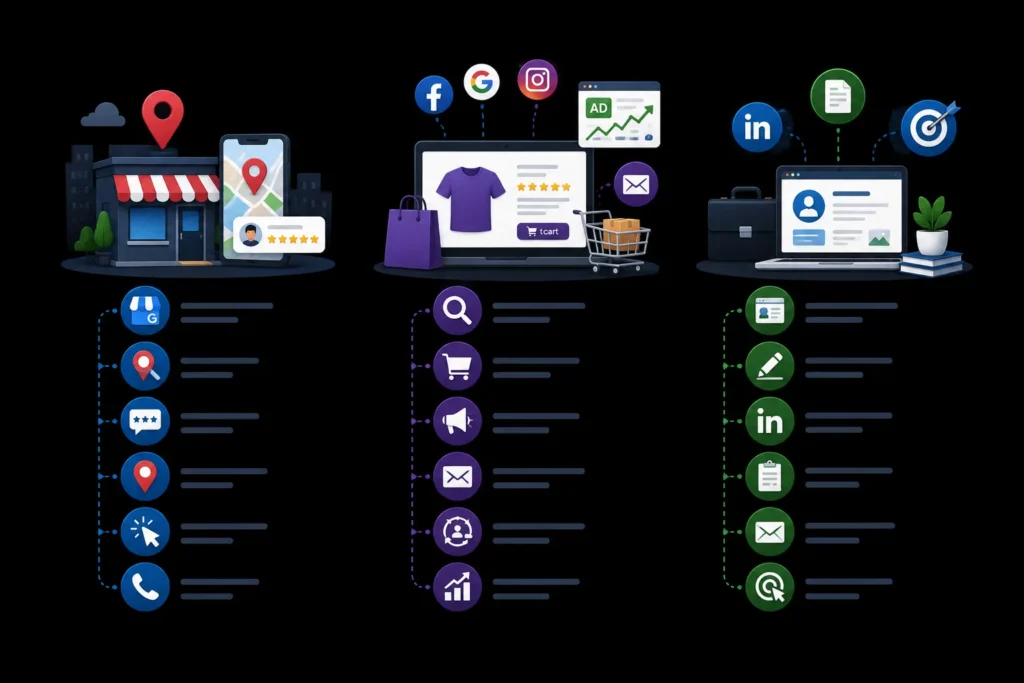
The best starting point depends on how customers normally find and purchase from the business.
For Local Service Businesses
Clinics, restaurants, salons, repair companies, schools, and home-service providers should generally prioritize:
- Google Business Profile
- Local SEO
- Customer reviews
- Location pages
- Search advertising
- Call and form tracking
If local visibility is weak, working with a local SEO consultant can help identify gaps in map rankings, listings, reviews, and location-based content.
For Ecommerce Businesses
Online stores may benefit most from:
- Product and category SEO
- Shopping advertisements
- Social media advertising
- Email automation
- Remarketing
- Conversion optimization
Product pages should provide original descriptions, useful images, clear delivery information, customer reviews, and a simple purchasing process.
For Professional Service Providers
Consultants, accountants, lawyers, agencies, and other professional service businesses can prioritize:
- Service-page SEO
- Educational content
- LinkedIn marketing
- Case studies
- Email nurturing
- Search advertising
Because these purchases usually involve trust and research, the website should demonstrate expertise while making the next step clear.
How to Create a Practical Small-Business Marketing Strategy
A practical strategy begins with the business objective—not with a list of marketing platforms.
Step 1: Define One Primary Goal
Choose a measurable objective, such as:
- Generate 30 qualified enquiries per month
- Increase appointment bookings
- Improve online sales
- Attract customers from a specific location
- Reduce the cost of acquiring a customer
- Increase repeat purchases
The goal should determine the channels, campaign structure, and reporting metrics.
Step 2: Understand Your Ideal Customer
Define who is most likely to buy, what problem they need to solve, and what information they require before making a decision.
Document:
- Customer location
- Main needs or pain points
- Typical budget
- Common objections
- Preferred online platforms
- Search terms they may use
- Factors that influence their decision
This prevents the marketing budget from being spread across audiences that are unlikely to convert.
Step 3: Fix the Digital Foundation
Before increasing traffic, confirm that the business has:
- A fast, mobile-friendly website
- Clear product or service pages
- Working forms and phone links
- Accurate business information
- Analytics and conversion tracking
- A clear privacy policy
- Simple navigation
- Strong calls to action
Sending paid traffic to a confusing or unreliable website wastes budget.
Step 4: Select the Right Channels
Choose a small number of channels based on customer behaviour. A service business may begin with local SEO and Google Ads, while a visual consumer brand may combine social media with paid social campaigns.
Avoid choosing a channel simply because it is currently popular.
Step 5: Measure Business Outcomes
Marketing reports should connect activity to commercial results.
Track metrics such as:
- Qualified leads
- Calls and form submissions
- Appointment bookings
- Ecommerce sales
- Conversion rate
- Cost per lead
- Customer acquisition cost
- Return on advertising spend
- Revenue attributed to each channel
Followers, impressions, and traffic can provide context, but they should not be treated as the final measure of success.
How Much Does a Digital Marketing Agency Cost?
The cost of hiring a digital marketing agency varies according to the services, competition, target locations, campaign scale, and amount of content required.
Common pricing structures include:
- Monthly retainers for ongoing services
- Fixed-price projects for audits or website work
- Hourly consulting
- Separate advertising management fees
- Performance-based arrangements in limited cases
Advertising spend is normally separate from the agency’s management fee.
Instead of selecting the lowest quote, compare what each proposal includes. A low-cost package may exclude essential work such as technical fixes, content production, landing pages, or conversion tracking.
Ask each agency to clarify:
- Which services are included
- Who will manage the account
- How often work will be completed
- Whether content and design are included
- Which tools will be used
- How results will be reported
- Whether the advertising budget is separate
- What happens when priorities change
How to Choose the Right Digital Marketing Agency
A good agency should understand the business model before recommending tactics. Be cautious if an agency promises specific rankings or immediate results without first reviewing the website, competition, and market.
Clear Understanding of Small-Business Priorities
The agency should know how to work within realistic budgets and focus on activities most likely to generate customers.
Relevant Experience
Experience in your industry can help, but it is not the only consideration. Look for evidence that the team understands similar audiences, locations, or sales cycles.
Transparent Strategy
The agency should explain:
- What it plans to do
- Why each activity matters
- When the work will happen
- How success will be measured
Business-Focused Reporting
Reports should connect marketing activity with enquiries, sales, and revenue. Rankings and website traffic alone do not provide a complete picture.
Realistic Expectations
SEO, brand development, and content marketing take time. Paid campaigns can generate data faster, but they still require testing and optimization.
Ownership and Access
The business should retain access to its:
- Website
- Domain
- Google Business Profile
- Advertising accounts
- Analytics platforms
- Search Console
- Creative assets
Avoid arrangements where all accounts remain under the agency’s ownership.
Questions to Ask Before Hiring an Agency
Use the first consultation to evaluate both expertise and communication.
Ask:
- Which channels should we prioritize, and why?
- How will you define a qualified lead?
- What results can reasonably be measured?
- How will you track calls, forms, and sales?
- Who will work directly on our account?
- How often will we receive updates?
- What is included in the quoted price?
- Do we retain ownership of all accounts and content?
- How will the strategy change if results are weak?
- Can you provide examples of similar campaigns?
The quality of the answers is often more revealing than the presentation or sales pitch.
Common Digital Marketing Mistakes Small Businesses Should Avoid
Trying Every Channel at Once
Dividing a limited budget across too many channels can prevent any campaign from gathering enough data or momentum.
Marketing Without Conversion Tracking
Without tracking, it is impossible to determine which campaigns produce genuine business results.
Focusing Only on Website Traffic
A smaller number of relevant visitors may generate more revenue than a large volume of low-intent traffic.
Expecting Immediate SEO Results
SEO is a long-term process. It requires technical improvements, useful content, authority development, and ongoing refinement.
Ignoring Existing Customers
Repeat purchases, referrals, reviews, and email campaigns may produce better returns than constantly acquiring new customers.
Choosing an Agency Only by Price
The cheapest option may become expensive if poor targeting, weak content, or missing tracking wastes time and advertising budget.
When Should a Small Business Hire a Digital Marketing Agency?
Hiring an agency may make sense when:
- Marketing is taking too much time away from operations
- Lead generation is inconsistent
- The website receives traffic but few enquiries
- Competitors dominate search and social platforms
- Paid advertising is spending money without clear returns
- Internal staff lack specialist knowledge
- The business is entering a new market
- Growth has stalled despite regular marketing activity
A small business does not need to wait until every marketing channel is failing. External support can also help create a clear foundation before the company scales.
Build a Marketing Strategy Around Business Growth
The right digital marketing agency should act as a strategic partner, not simply a supplier of posts, advertisements, or monthly reports. Its work should connect directly to the way your business attracts, converts, and retains customers.
Start with a clear objective, choose the channels that match customer intent, and measure the actions that contribute to revenue. This approach keeps the strategy practical while ensuring that every marketing investment has a defined purpose.
If you need help identifying the best opportunities for your business, get a free digital marketing quote based on your goals, market, and current online presence.
Already have specific challenges or campaign ideas? Schedule a consultation to discuss a focused growth strategy.
Frequently Asked Questions
What does a digital marketing agency do for a small business?
A digital marketing agency helps a small business attract and convert customers through services such as SEO, local search optimization, paid advertising, social media, content, email marketing, and website improvement. It also tracks which activities generate leads and sales.
Is a digital marketing agency worth it for a small business?
An agency can be worth the investment when it provides skills the business does not have internally and connects its work to measurable outcomes. Its value should be evaluated through qualified leads, customer acquisition cost, conversions, and revenue—not only traffic or followers.
Which digital marketing service is best for small businesses?
There is no single best service for every business. Local businesses often benefit from local SEO and Google Ads, ecommerce stores may prioritize product SEO and paid social, while professional service providers can focus on search optimization, content, and lead nurturing.
How much should a small business spend on digital marketing?
The appropriate budget depends on revenue, margins, competition, goals, and the channels being used. Start with an amount the business can sustain long enough to gather meaningful data, then increase investment in campaigns that consistently produce profitable customers.
How long does digital marketing take to produce results?
Paid advertising can begin generating traffic and campaign data shortly after launch, although optimization takes time. SEO and content marketing usually require several months to build meaningful visibility. The timeline depends on competition, website condition, budget, and campaign quality.
How can I measure the success of a digital marketing agency?
Measure success using qualified leads, sales, conversion rate, cost per lead, customer acquisition cost, and revenue attributed to marketing. Rankings, impressions, clicks, and engagement are useful supporting metrics but should not be the only measures reported.
Can a small business manage digital marketing without an agency?
Yes, a small business can manage digital marketing internally if it has enough time, skills, and tools. An agency becomes useful when campaigns require specialist knowledge, performance is difficult to measure, or marketing responsibilities prevent the owner from focusing on the business.

Yash Narayan is an SEO Associate at MoxSEO with 3 years of experience in keyword research, on-page SEO, content optimization, competitor analysis, and website performance monitoring. He focuses on improving organic visibility, identifying ranking opportunities, and creating search-friendly content that attracts relevant traffic. Through data-driven analysis and consistent optimization, Yash helps businesses strengthen their search presence and achieve sustainable digital growth.