





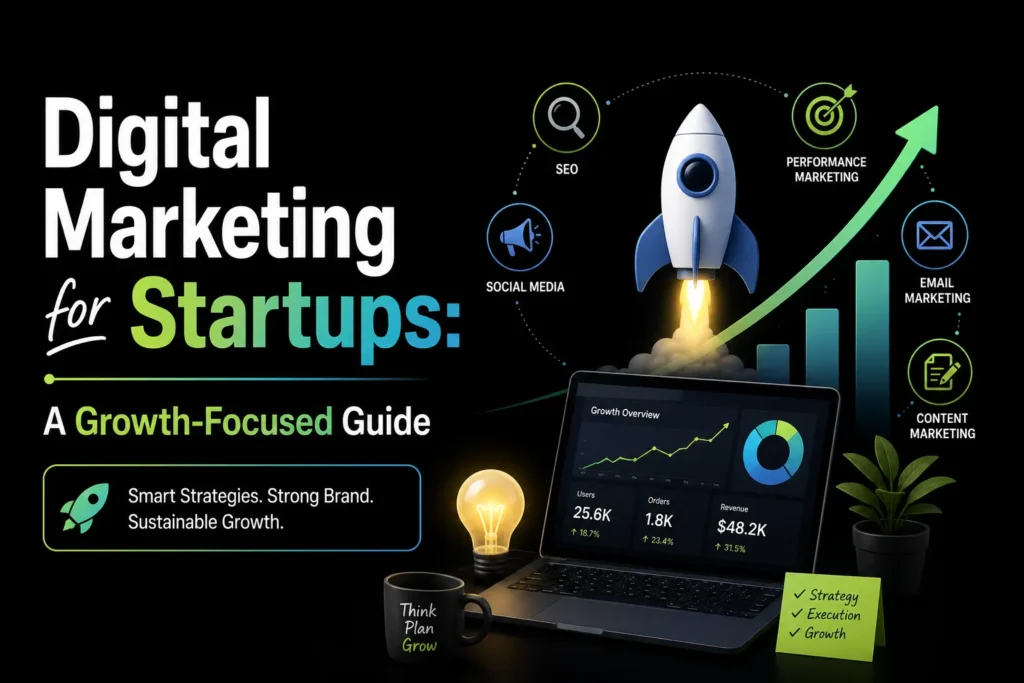
Startups face a unique marketing challenge. You need to build brand awareness, acquire customers, and prove traction to investors, all with limited budget and a small team. Traditional marketing playbooks do not work because startups do not have the time or money to wait 12 months for results. You need a digital marketing strategy that is fast, measurable, and cost-effective.
This guide covers the digital marketing channels that work best for startups, how to prioritize them with a limited budget, and how to build a growth system that scales as you grow. For agency guidance, see our guide to finding a digital marketing agency for small business.
TL;DR: Digital marketing for startups should focus on 2 to 3 channels initially: SEO for long-term organic growth, PPC for immediate traffic and leads, and social media for brand awareness. Start with a clear value proposition, define your target audience, set measurable goals, and choose channels based on where your audience spends time. Expect to invest ₹50,000 to ₹2,00,000 per month. MoxSEO offers digital marketing services for startups in India and globally.
What Is the Best Digital Marketing Strategy for a Startup?
Pick one fast channel (usually paid search) and one compounding channel (usually SEO with helpful content), tie both to a single conversion goal such as demo requests or sign-ups, track cost per acquisition from week one, and add channels only when the first two produce consistent results. Depth in two channels beats shallow effort in ten.
Why Startups Need a Different Marketing Approach
Startups operate under constraints that established businesses do not face: limited budget, no brand recognition, small teams, and pressure to show growth quickly. This means you cannot afford to spread your budget across every marketing channel. You need to focus on the channels that deliver the fastest results for your specific business and audience.
The key principles for startup marketing are:
- Focus over breadth: Do 2 to 3 channels well instead of 10 channels poorly.
- Measure everything: Track every rupee spent and tie it to a business outcome (signups, trials, sales).
- Iterate fast: Test, measure, and adjust weekly, not monthly. Startups that iterate quickly find what works faster.
- Build for scale: Choose channels and systems that can grow with you, not ones you will outgrow in 6 months.
The Best Digital Marketing Channels for Startups
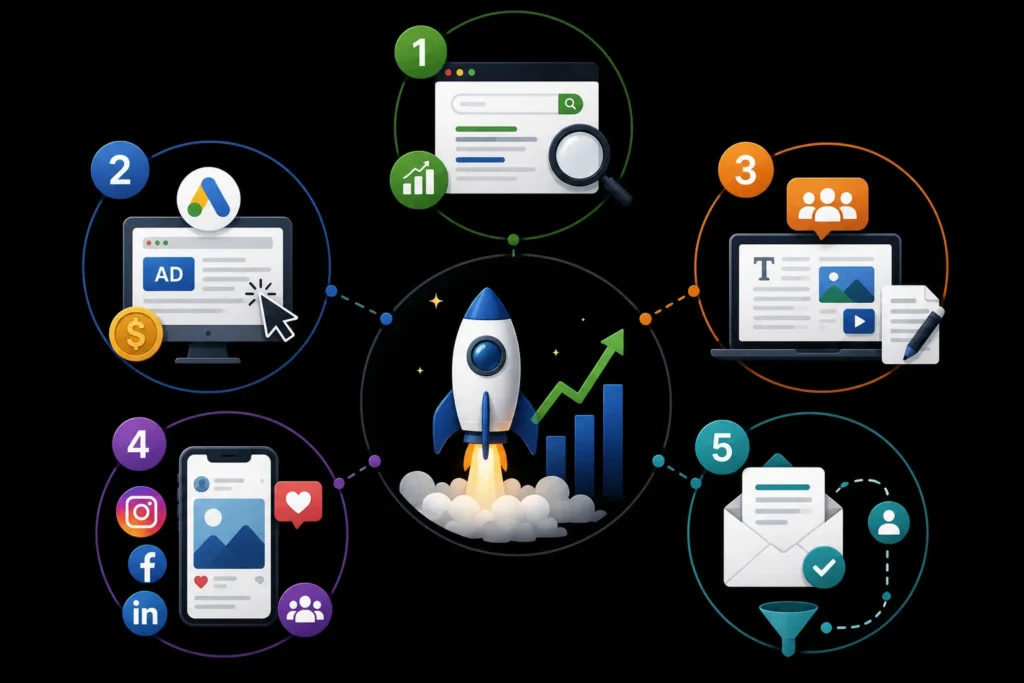
1. SEO (Long-Term Growth)
SEO is the foundation of long-term growth for startups. It takes 3 to 6 months to show results, but once your pages rank, they drive free traffic for months or years. Start with keyword research to find low-competition terms your target audience searches for, create content targeting those terms, and build your site’s authority over time. Google’s guidance on creating helpful, reliable, people-first content is the standard to follow. For startups on WordPress, see our WordPress SEO services.
2. PPC Advertising (Immediate Results)
PPC (Google Ads and Meta Ads) delivers immediate traffic and leads, which is critical for startups that need to show traction quickly. Start with Google Search ads targeting high-intent keywords (people searching for what you offer), then expand to Meta Ads for retargeting and awareness. Set a daily budget you can afford and track conversions from day one. For more on PPC, see our guide on PPC services in India.
3. Content Marketing (Authority and Trust)
Content marketing builds authority and trust, which startups need because nobody knows who you are yet. Create blog posts, guides, and videos that answer your target audience’s questions. This supports SEO (by targeting keywords), social media (by giving you content to share), and sales (by educating prospects). Start with 2 to 4 pieces of content per month. For professional help, see our guide to content marketing agencies in India.
4. Social Media Marketing (Brand Awareness)
Social media helps startups build brand awareness and engage with early customers. Choose 1 to 2 platforms where your audience spends time (LinkedIn for B2B, Instagram for B2C) and post consistently. Focus on value-driven content, not just promotional posts. For help choosing a partner, see our guide on social media marketing for small business.
5. Email Marketing (Retention and Nurturing)
Email marketing is one of the highest-ROI channels for startups. Use it to nurture leads, onboard new customers, and retain existing ones. Set up a welcome sequence for new signups, an abandoned cart flow for e-commerce, and a re-engagement sequence for inactive users. See our guide on email marketing companies in India for more.
How Do You Choose Channels by Startup Stage?
| Stage | Main goal | Start with | Add later |
|---|---|---|---|
| Pre-launch | Validate demand, collect a waitlist | A landing page, simple SEO foundations, founder-led social posts | Small paid tests |
| Launch to first customers | Find what converts | Google Search ads on high-intent terms, one content hub | Retargeting, email onboarding |
| Early traction | Lower acquisition cost, build repeatable growth | SEO and content around buyer questions, email nurture | Partnerships, expanded paid channels |
| Scaling | Grow without losing efficiency | All of the above with clear attribution | New markets, international SEO |
What Does a 90-Day Startup Marketing Plan Look Like?
- Weeks 1 to 2, foundations: Write a one-sentence value proposition, define your ideal customer, set up analytics and conversion tracking, and make sure the site is crawlable and fast enough to convert.
- Weeks 3 to 6, first campaigns: Launch a small Google Search campaign on high-intent terms and publish your first pieces of content aimed at questions buyers ask. The free keyword research tool is a good starting point.
- Weeks 7 to 10, learn and adjust: Review which keywords, ads and pages produce actual sign-ups, cut what does not, and put more behind what does.
- Weeks 11 to 13, add the next layer: Add email onboarding or retargeting, and plan the next quarter’s content based on what is ranking and converting.
Which Metrics Should a Startup Track?
- Conversions by channel: Sign-ups, demo requests or sales, split by source.
- Cost per acquisition (CPA): Spend on a channel divided by the customers or leads it produced.
- Payback period: How long it takes for a customer’s revenue to cover what it cost to win them.
- Organic visibility: Impressions and clicks for target queries in Google Search Console.
- Retention or activation: Whether acquired users actually use the product.
How to Build a Startup Marketing Budget
Most startups should allocate 10% to 20% of their revenue (or raised capital) to marketing. Here is a typical budget split for a startup spending ₹1,00,000 per month:
- PPC advertising: ₹40,000 (40%) for immediate traffic and leads
- SEO and content: ₹30,000 (30%) for long-term organic growth
- Social media: ₹20,000 (20%) for brand awareness
- Tools and software: ₹10,000 (10%) for analytics, email platform, SEO tools
Adjust this split based on your business model. B2B startups should invest more in SEO and LinkedIn. E-commerce startups should invest more in PPC and email. Consumer apps should invest more in social media.
If you want a published reference point for agency fees, MoxSEO lists digital marketing packages from $519 per month on its packages page (as of October 2026). The PPC package fee covers management only; ad spend is separate, so budget for both.
What Marketing Mistakes Do Startups Make?
- No tracking before spending: Without conversion tracking you cannot tell which spend works.
- Sending paid traffic to a weak page: A clear landing page with one action usually beats the homepage. See our landing page service.
- Waiting to start SEO: Since it compounds slowly, starting early matters. B2B software teams can see how we approach this in our B2B SaaS SEO work.
- Publishing for volume: Google’s people-first content guidance warns against mass-producing content across many topics. Fewer, better pages win.
- Judging SEO or content in week four: Set expectations of months, not weeks, and use paid channels to cover the gap.
Start Growing Your Startup With Digital Marketing
Digital marketing is how startups compete with established brands. You may not have their budget, but you can be faster, more focused, and more data-driven. The key is choosing the right channels, measuring everything, and iterating quickly.
MoxSEO offers digital marketing services for startups in India and globally. Get a free quote to see how we can help your startup grow. You can also explore our SEO services and PPC services, or contact us.
Frequently Asked Questions
How much should a startup spend on digital marketing?
Startups should typically allocate 10% to 20% of their revenue or raised capital to marketing. In India, a realistic starting budget is ₹50,000 to ₹2,00,000 per month. Split this across 2 to 3 channels: PPC for immediate results (40%), SEO and content for long-term growth (30%), and social media for brand awareness (20%), with 10% for tools and software.
Which digital marketing channel should a startup focus on first?
Start with PPC advertising for immediate traffic and leads, and SEO for long-term organic growth. PPC shows results within days, which is critical for startups that need to prove traction. SEO takes 3 to 6 months but compounds over time. Add content marketing and social media once your PPC and SEO foundations are running.
How long does it take for digital marketing to work for startups?
PPC advertising can drive traffic and leads within days. Social media marketing shows engagement growth in 1 to 3 months. SEO takes 3 to 6 months for meaningful organic traffic. Content marketing compounds over 6 to 12 months. A realistic timeline for a startup to see meaningful growth across channels is 3 to 6 months
Should a startup hire an agency or build an in-house marketing team?
For most early-stage startups, hiring an agency is more cost-effective than building an in-house team. An agency gives you a full team (strategist, content writer, ads manager, SEO specialist) for a single monthly fee, without the cost of hiring, training, and managing individual employees. As you grow and your marketing needs become more complex, you can transition to a hybrid model (in-house lead plus agency support).
What is the biggest marketing mistake startups make?
The biggest mistake is trying to do too many channels at once. Startups that spread their budget across 5 to 10 marketing channels get poor results everywhere because no channel gets enough budget or attention to perform. Focus on 2 to 3 channels, execute them well, measure results, and expand only after those channels are delivering consistent results.
Can a startup do digital marketing without a big budget?
Yes. Focus on one or two channels, start with content that answers real customer questions, use free tools such as Google Search Console and Analytics, and run small paid tests to learn what converts before scaling spend.
What is CAC and why does it matter to startups?
Customer acquisition cost (CAC) is the total marketing and sales spend needed to win one customer. It matters because growth that costs more than a customer is worth cannot last. Track it by channel and compare it with how quickly a customer’s revenue repays it.
Is SEO worth it for an early-stage startup?
Usually yes, if your customers search for what you offer. SEO is slow, but pages that rank keep bringing visitors without a per-click cost. Pair it with paid search so you have leads while organic results build.
When should a startup add email marketing?
As soon as you capture sign-ups or leads. A simple welcome sequence and a follow-up for people who did not convert cost little to run and make every other channel work harder.

Samruddhi Kadam is an SEO Associate at MoxSEO with 2 years of experience in keyword research, on-page SEO, content optimization, competitor analysis, and website performance tracking. She focuses on improving organic visibility, creating search-friendly content, and identifying practical opportunities to strengthen rankings. Through consistent analysis and data-driven execution, Samruddhi helps businesses attract relevant traffic and build a stronger presence in search results.