






Keyword research is the foundation of every successful SEO strategy. Before creating blog posts, service pages, landing pages, or content clusters, you need to understand what your audience is actually searching for.
Choosing the wrong keywords can waste time, budget, and content resources. You may end up targeting phrases with little business value, competing against websites you are not ready to challenge, or creating pages that do not match what searchers expect.
Effective keyword research helps you identify relevant topics, understand search intent, estimate demand, evaluate competition, and map the right keyword groups to the right pages.
For a broader SEO planning framework, see our SEO Checklist 2026.
TL;DR: Keyword research is the process of finding and evaluating the search terms people use to discover information, products, and services online. A strong keyword strategy considers search intent, business relevance, traffic potential, competition, conversion value, and the type of content already ranking.
Use sources such as Google Keyword Planner, Google Search Console, Google Trends, autocomplete suggestions, customer questions, competitor pages, and SEO tools. Group closely related keywords into topic clusters instead of creating a separate page for every variation.
The goal is not simply to target the highest-volume keywords. The goal is to find search opportunities your website can realistically rank for and convert into meaningful traffic, leads, or sales.
What Is Keyword Research?
Keyword research is the process of discovering, analysing, and prioritizing the words and phrases people use in search engines.
These search terms reveal what your audience wants to know, compare, solve, purchase, or locate.
For example, a digital marketing agency may find searches such as:
- SEO services
- SEO company for small businesses
- How much does SEO cost?
- Local SEO services in Mumbai
- Technical SEO audit
- Best keyword research tools
- How to improve Google rankings
Although these queries belong to the same broad topic, they have different meanings and require different types of pages.
“SEO services” may require a commercial service page, while “how much does SEO cost?” may be better suited to a detailed pricing guide.
Keyword research helps you understand these differences before you start creating content.
Why Keyword Research Matters
Keyword research supports almost every part of SEO.
It helps you:
- Understand how customers describe their problems
- Discover topics with meaningful demand
- Identify commercial and informational opportunities
- Create pages that match search intent
- Build a logical website structure
- Avoid publishing duplicate or competing pages
- Prioritize content with stronger business value
- Find gaps in competitor strategies
- Improve existing pages
- Create content clusters around important services
Without research, content creation becomes guesswork.
A blog may be well written, but it will struggle to perform if the topic has little demand, the format does not match the search results, or the page targets a keyword that is too competitive for the website.
Search Volume, Traffic Potential, and Business Value
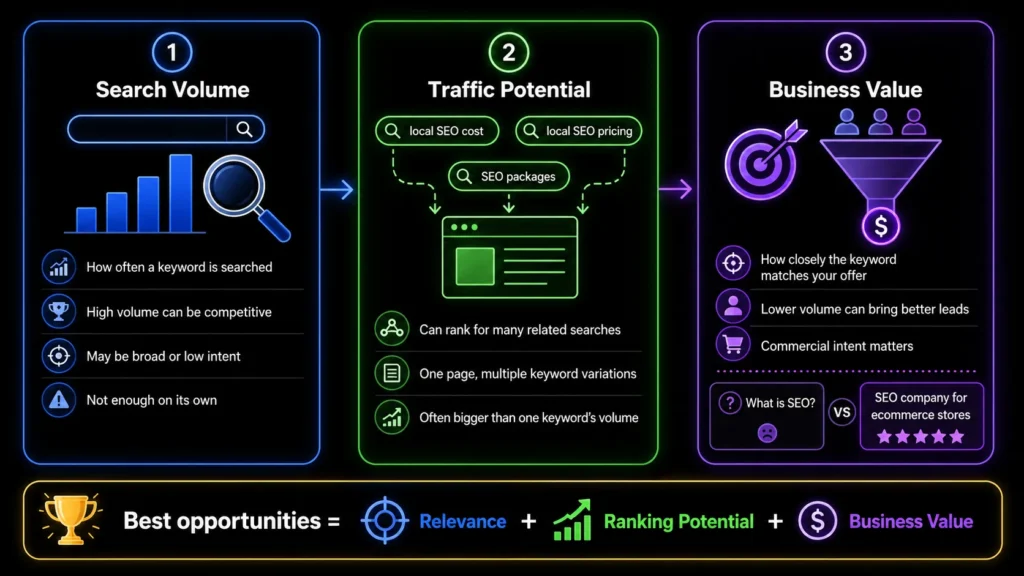
Search volume is one of the most commonly discussed keyword metrics, but it should never be used alone.
Search Volume
Search volume estimates how often a keyword is searched during a particular period.
A high-volume keyword may look attractive, but it may also be:
- Highly competitive
- Broad or unclear
- Dominated by established brands
- Informational rather than commercial
- Surrounded by search features that reduce clicks
- Poorly aligned with your services
Traffic Potential
Traffic potential considers whether a page could rank for many related searches, not just one exact keyword.
For example, a detailed page about local SEO pricing may rank for:
- Local SEO cost
- Local SEO pricing
- How much does local SEO cost?
- Local SEO packages
- Monthly local SEO fees
This means the topic may generate more traffic than the volume of one keyword suggests.
Business Value
Business value measures how closely the keyword connects to your offer.
A keyword with 100 highly relevant monthly searches may be more valuable than a broad keyword with 10,000 searches.
For example:
- “What is SEO?” may attract a large audience but low immediate buying intent.
- “SEO company for ecommerce stores” may have lower search volume but stronger commercial potential.
The strongest keyword opportunities usually combine relevance, realistic ranking potential, and clear business value.
How to Do Keyword Research Step by Step
Step 1: Define Your Audience and Business Goals
Before opening a keyword tool, clarify what your business wants to achieve.
Possible SEO goals include:
- Generate qualified leads
- Increase ecommerce sales
- Attract local customers
- Promote a new service
- Enter a new geographic market
- Build brand authority
- Support a sales team
- Reduce dependency on paid advertising
You should also define the audience.
Ask:
- Who is searching?
- What problem are they trying to solve?
- How much do they already know?
- Are they researching, comparing, or ready to buy?
- Which services or products are most valuable to the business?
- Which locations or industries matter most?
This context prevents you from choosing keywords based only on volume.
Step 2: Create Seed Topics
Seed topics are broad themes related to your services, products, customers, and industry.
For a digital marketing agency, seed topics may include:
- SEO
- Local SEO
- Technical SEO
- Content marketing
- PPC
- Social media marketing
- Website optimization
- Conversion rate optimization
For an ecommerce brand, seed topics may include:
- Product categories
- Customer problems
- Product features
- Materials
- Use cases
- Comparisons
- Buying guides
- Seasonal searches
Seed topics are not always final keywords. They are starting points for discovering more specific searches.
A useful way to generate seed topics is to review:
- Service pages
- Product categories
- Sales conversations
- Customer emails
- Support tickets
- Internal site searches
- Product reviews
- Competitor navigation menus
- Frequently asked questions
- Existing Google Search Console queries
Step 3: Use Google Autocomplete
Google Autocomplete can reveal how users phrase common searches.
Type a seed keyword into Google and review the suggestions.
For example, entering “keyword research” may produce variations around:
- Keyword research tools
- Keyword research for SEO
- Keyword research for YouTube
- Keyword research for ecommerce
- Keyword research step by step
Autocomplete predictions are influenced by real searches, language patterns, location, trends, and sometimes personal search activity.
Use them to discover wording, questions, and subtopics. Do not treat autocomplete position as proof of search volume or keyword importance.
You can also try:
- Adding different letters after the keyword
- Adding terms such as “how,” “best,” “cost,” “services,” or “near me”
- Searching questions
- Testing industry-specific variations
- Reviewing related searches at the bottom of the results page
Step 4: Use Google Keyword Planner
Google Keyword Planner is available through Google Ads and can help estimate search demand.
Enter your seed topics to find:
- Related keyword ideas
- Average monthly searches
- Seasonal trends
- Estimated advertising bids
- Geographic variations
- Advertiser competition
However, Keyword Planner was primarily designed for advertising.
Its “Competition” column refers to the number of advertisers bidding on a keyword. It does not measure how difficult the keyword is to rank for organically.
Use Keyword Planner for directional demand estimates, but combine it with live search-result analysis, Search Console data, Google Trends, and other SEO tools.
Search-volume figures should also be treated as estimates rather than exact numbers.
Step 5: Use Google Search Console
Google Search Console is one of the most valuable keyword research sources for an existing website.
It shows the actual queries that generate:
- Impressions
- Clicks
- Rankings
- Click-through rates
Search Console can help you find:
Striking-distance keywords
These are keywords where your page already ranks near the bottom of page one or on page two.
Improving the page may be more efficient than creating a completely new article.
High-impression, low-click keywords
These queries may indicate weak titles, poor intent alignment, or an unattractive search snippet.
Unexpected keyword opportunities
A page may receive impressions for topics you did not intentionally target. These can reveal missing sections or related content opportunities.
Keyword cannibalization
Several pages may appear for the same query, suggesting that Google is unsure which page is most relevant.
Country and device differences
Search behaviour and rankings may vary significantly by location and device.
Search Console is especially useful because it reflects your actual search visibility rather than estimated market data.
Step 6: Use Google Trends
Google Trends helps you understand how interest changes over time.
Use it to review:
- Seasonal demand
- Rising topics
- Regional differences
- Changing terminology
- Brand comparisons
- Topic growth or decline
For example, a keyword may have a reasonable average monthly search volume but receive most of its demand during one season.
Google Trends does not provide exact search volume. It shows relative interest, so use it to understand direction and timing.
Step 7: Study Customer Language
SEO tools do not always capture the exact language customers use when describing problems.
Review first-party sources such as:
- Sales call notes
- Consultation forms
- Customer support conversations
- Live chat transcripts
- Website search data
- Product reviews
- Survey responses
- Social media comments
- Community discussions
- Questions received by your team
These sources can reveal highly relevant topics that competitors may overlook.
For example, a customer may not search for “conversion funnel optimization.” They may search:
- Why are visitors not filling out my form?
- Why does my landing page get traffic but no leads?
- How can I increase website enquiries?
Customer language helps you create content that feels natural and specific.
Step 8: Analyse Search Intent
Search intent describes what the user wants to achieve.
The four common intent categories are:
Informational Intent
The user wants to learn something.
Examples:
- What is keyword research?
- How does local SEO work?
- Why is my website slow?
Suitable page types:
- Guides
- Tutorials
- Definitions
- Checklists
- Blog posts
Navigational Intent
The user wants to find a specific brand, tool, website, or page.
Examples:
- Google Search Console login
- MoxSEO services
- Ahrefs pricing
Commercial Intent
The user is comparing solutions before making a decision.
Examples:
- Best SEO tools
- Local SEO company comparison
- Ahrefs vs. Semrush
- Best keyword research services
Suitable page types:
- Comparison pages
- Review pages
- Service guides
- Alternatives pages
- Buying guides
Transactional Intent
The user is ready to complete an action.
Examples:
- Hire an SEO agency
- Buy running shoes online
- Book an SEO consultation
- Local SEO services near me
Suitable page types:
- Product pages
- Service pages
- Category pages
- Pricing pages
- Consultation pages
Do not determine intent from the keyword wording alone.
Search the keyword and inspect the results. Google may show guides, service pages, product listings, videos, forums, maps, or tools.
The dominant result type often shows what searchers expect.
Step 9: Review the Search Results
Before choosing a keyword, analyse the live search results.
Look at:
- Page types
- Content formats
- Headline angles
- Website authority
- Content depth
- Freshness
- Original data
- First-hand experience
- Backlinks
- SERP features
- Local results
- Video results
- Product results
- Featured snippets
- Discussion forums
Avoid analysing only article length.
A longer article is not automatically more useful. The goal is to understand why the current results satisfy the search query and whether you can create something meaningfully better.
Ask:
- Can we match the dominant intent?
- Can we provide stronger examples?
- Can we add real experience or original data?
- Can we create a better format?
- Is our website authoritative enough?
- Does the keyword produce meaningful clicks?
- Is the opportunity worth the required effort?
Step 10: Estimate Organic Competition
SEO tools may provide keyword difficulty scores, but these are estimates.
To evaluate organic competition properly, review:
- Authority of ranking domains
- Number and quality of backlinks
- Relevance of ranking pages
- Strength of brand recognition
- Quality of content
- Search-intent alignment
- Freshness requirements
- SERP features
- Website type
- Your own topical authority
A keyword may look easy in a tool but still be difficult if the search results are perfectly matched and dominated by trusted brands.
Likewise, a keyword with a high difficulty score may still be valuable if your site already has strong relevance and authority in that topic.
Step 11: Identify Long-Tail Keywords
Long-tail keywords are specific, relatively lower-frequency searches.
They are often longer phrases, but word count alone does not define them.
Examples may include:
- Keyword research for local service businesses
- How to find low-competition ecommerce keywords
- SEO keyword research for a new website
- Best free keyword research tools for beginners
Long-tail keywords can be valuable because they often reveal a more specific need.
However, they are not automatically easier to rank for or more likely to convert.
Evaluate each long-tail keyword based on:
- Search intent
- Relevance
- Competition
- Business value
- SERP quality
- Content requirements
Step 12: Group Keywords Into Topic Clusters
Do not create a separate page for every keyword variation.
Closely related keywords should often be grouped when they share:
- The same search intent
- Similar ranking pages
- The same audience
- The same page format
- The same customer problem
For example, these keywords may belong on one page:
- Keyword research
- How to do keyword research
- Keyword research process
- Keyword research steps
- SEO keyword research guide
These may require separate pages:
- Keyword research services
- Keyword research tools
- Ecommerce keyword research
- YouTube keyword research
- Local SEO keyword research
The first group shares a general learning intent. The second group represents different services, platforms, or use cases.
Keyword clustering helps prevent thin content and cannibalization.
Step 13: Prioritize Keyword Opportunities
Not every keyword deserves immediate attention.
Use a prioritization framework that considers:
Relevance
Does the keyword closely match your product, service, expertise, or audience?
Search Intent
Can you create the page type searchers expect?
Business Value
Can the keyword contribute to leads, sales, signups, or strategic authority?
Traffic Potential
Could the page rank for multiple related searches?
Organic Competition
Can your website realistically compete?
Existing Rankings
Do you already have a page within striking distance?
Content Effort
How much writing, design, research, development, or link acquisition will be required?
SERP Click Opportunity
Will users click websites, or does the results page answer most of the query directly?
Strategic Importance
Does the topic support an important service, market, or content cluster?
A simple scoring table can help:
| Keyword | Relevance | Business Value | Competition | Existing Position | Priority |
|---|---|---|---|---|---|
| SEO keyword research services | High | High | Medium | Not ranking | High |
| What is keyword research? | High | Medium | High | Position 18 | Medium |
| Free keyword tools | Medium | Low | High | Not ranking | Low |
| Local SEO keyword research | High | High | Medium | Position 11 | Highest |
Step 14: Map Keyword Clusters to Pages
After grouping and prioritizing the keywords, assign each cluster to a suitable page.
Possible page types include:
- Homepage
- Service pages
- Product pages
- Category pages
- Location pages
- Comparison pages
- Blog posts
- Guides
- Case studies
- FAQs
Each page should have one clear topic and primary intent.
It can naturally target several related phrases, questions, and secondary terms.
Avoid rigid rules such as “one keyword equals one page.” Create separate pages only when the keywords require meaningfully different content.
Before creating a new page, check whether an existing page already covers the topic.
You may need to:
- Improve the existing page
- Add missing sections
- Merge overlapping pages
- Redirect weak pages
- Change internal links
- Clarify the primary topic
For help optimizing mapped pages, see our on-page SEO guide. For broader planning and content execution, see our guide to content marketing services in India.
How to Prevent Keyword Cannibalization
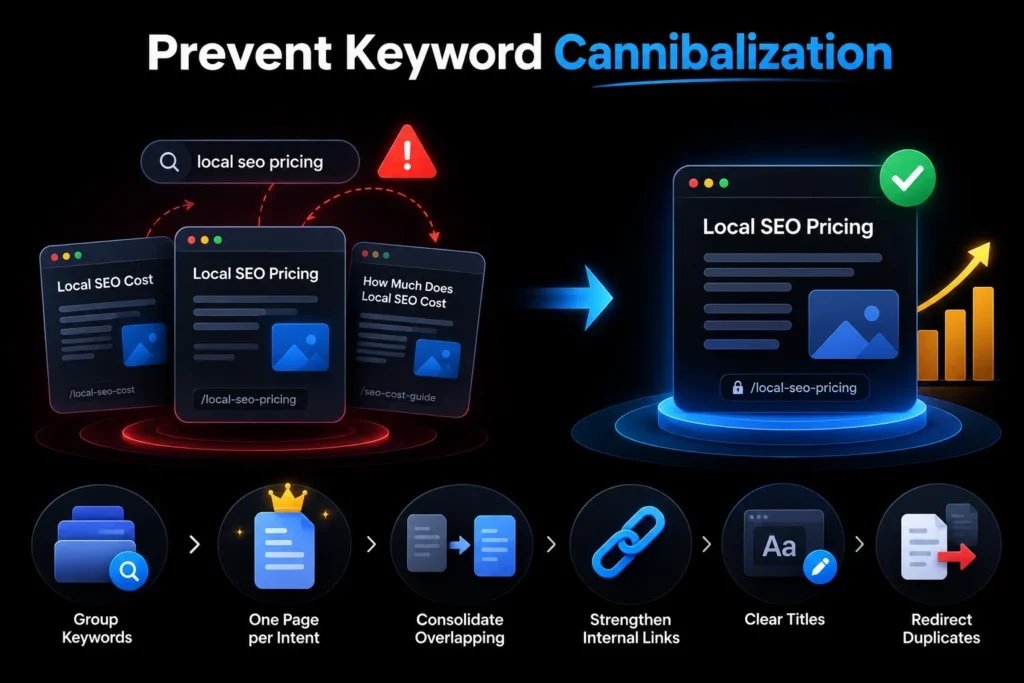
Keyword cannibalization happens when multiple pages compete for the same search intent.
Possible signs include:
- Different URLs replacing each other in rankings
- Several weak pages ranking for the same query
- Search Console showing multiple URLs for one keyword
- Similar pages with overlapping headings
- Internal links pointing to different pages using the same anchor
To reduce cannibalization:
- Group related keywords before creating pages
- Assign one main page to each intent
- Consolidate overlapping articles
- Strengthen internal linking
- Use clear page titles and headings
- Redirect outdated or duplicate content
- Avoid creating separate pages for minor keyword variations
Not every instance of multiple URLs appearing for a query is harmful. The issue becomes important when the pages compete for the same role and weaken each other.
Best Free Keyword Research Tools
Useful free and first-party tools include:
Google Search Console
Best for discovering actual queries, existing rankings, impressions, clicks, and optimization opportunities.
Google Keyword Planner
Useful for directional search-demand estimates, keyword ideas, location data, and paid-search information.
Google Trends
Best for seasonality, geographic differences, topic growth, and changes in terminology.
Google Autocomplete
Useful for discovering query phrasing, common modifiers, and related ideas.
People Also Ask
Helpful for identifying supporting questions and subtopics.
Related Searches
Useful for discovering associated themes and variations.
Bing Webmaster Tools
Can provide additional search-performance and keyword information.
Popular Paid Keyword Research Tools
Paid platforms may provide broader competitor research, keyword databases, clustering, backlink analysis, and rank tracking.
Common options include:
- Ahrefs
- Semrush
- Moz
- Ubersuggest
- SE Ranking
No tool is universally best.
Choose a platform based on whether you need:
- Competitor analysis
- Keyword expansion
- Search-volume estimates
- Content-gap research
- SERP tracking
- Backlink analysis
- Keyword clustering
- Local keyword data
Common Keyword Research Mistakes
Choosing Keywords Based Only on Volume
High search volume does not guarantee relevant traffic or revenue.
Confusing Paid Competition With SEO Difficulty
Google Keyword Planner’s competition metric reflects advertiser activity.
Ignoring Search Intent
A blog post will struggle if Google primarily shows product or service pages.
Creating One Page for Every Keyword
This can produce thin pages and keyword cannibalization.
Targeting Only Broad Keywords
Broad terms are often unclear, highly competitive, and less commercially focused.
Assuming Long-Tail Keywords Are Always Easy
Specific searches can still be competitive.
Copying Competitors Without Adding Value
Publishing a longer version of an existing article is not a strong strategy by itself.
Ignoring Existing Website Data
Search Console, sales data, and customer questions may reveal better opportunities than third-party tools.
Failing to Update Keyword Research
Search demand, terminology, competitors, and business priorities change.
Ignoring Conversion Potential
Traffic is not valuable if it does not support your business objectives.
What Is the Most Important Keyword Research Factor?
There is no single factor that works in isolation.
Search intent is the foundation because your content must satisfy what the user wants.
However, a keyword should also be evaluated for:
- Relevance
- Business value
- Traffic potential
- Competition
- Existing authority
- Required effort
- Conversion potential
A high-volume keyword with weak relevance may provide little value. A low-volume keyword with strong commercial intent may generate qualified leads.
The best opportunities are keywords that match your audience, business goals, content capabilities, and realistic ranking potential.
Build Your SEO Strategy Around the Right Keywords
Keyword research is not simply about finding popular search terms. It is about understanding what your audience needs, how they search, which results they expect, and where your business has a realistic opportunity to compete.
A strong keyword strategy connects search demand with business value. It helps you create the right pages, avoid content duplication, prioritize meaningful opportunities, and attract visitors who are more likely to engage or convert.
MoxSEO helps businesses analyse search demand, competitor visibility, existing rankings, customer intent, and commercial opportunities. Our team can create a prioritized keyword map for your services, products, locations, and content strategy.
Request a free keyword research consultation and start building an SEO strategy around searches that can support qualified traffic, leads, and long-term growth.
Frequently Asked Questions
What is keyword research in SEO?
Keyword research is the process of discovering and evaluating the search terms people use on Google and other search engines. It helps businesses understand search intent, estimate demand, identify content opportunities, and decide which pages to create or improve.
What is the best free keyword research tool?
There is no single best free tool for every situation. Google Search Console is best for analysing an existing website’s real queries. Google Keyword Planner is useful for estimated demand and keyword ideas. Google Trends helps identify seasonality and changes in interest, while autocomplete and related searches help discover phrasing and subtopics.
How many keywords should I target per page?
A page should target one clear topic and search intent rather than a fixed number of keywords. It can naturally cover multiple related phrases, questions, and variations. Create separate pages only when the keywords require different content types, audiences, services, locations, or intents.
What is the difference between short-tail and long-tail keywords?
Short-tail keywords are generally broad, high-frequency terms, while long-tail keywords are more specific and relatively lower-frequency. Long-tail keywords are often longer phrases, but word count alone does not define them. Some long-tail searches may be less competitive or more commercially focused, but each keyword should be reviewed individually.
How do I check keyword competition?
Review the live search results and analyse the authority, relevance, content quality, backlinks, brand strength, and format of ranking pages. Keyword difficulty scores from SEO tools can support your research, but they should not replace manual SERP analysis.
How often should I do keyword research?
Review your keyword strategy regularly and whenever your business, products, locations, audience, competitors, or search results change. Conduct research when planning a new page or content cluster, and use Search Console continuously to identify new opportunities and declining performance.
Should I target high-volume or low-volume keywords?
Target a balanced mix based on relevance, intent, competition, traffic potential, and business value. Lower-volume keywords may generate highly qualified visitors, while high-volume topics can support broader authority when your website is ready to compete.
Can one page rank for multiple keywords?
Yes. A well-structured page can rank for many related queries when they share the same intent and topic. You do not need to create a separate page for every wording variation.

Ashish Khan is an SEO Specialist at MoxSEO with expertise in keyword research, on-page optimization, technical SEO, content strategy, and link building. He focuses on improving website visibility, strengthening search performance, and helping businesses attract relevant organic traffic. By combining competitor analysis, SEO audits, and data-driven optimization, Ashish supports sustainable ranking growth and stronger digital presence.