
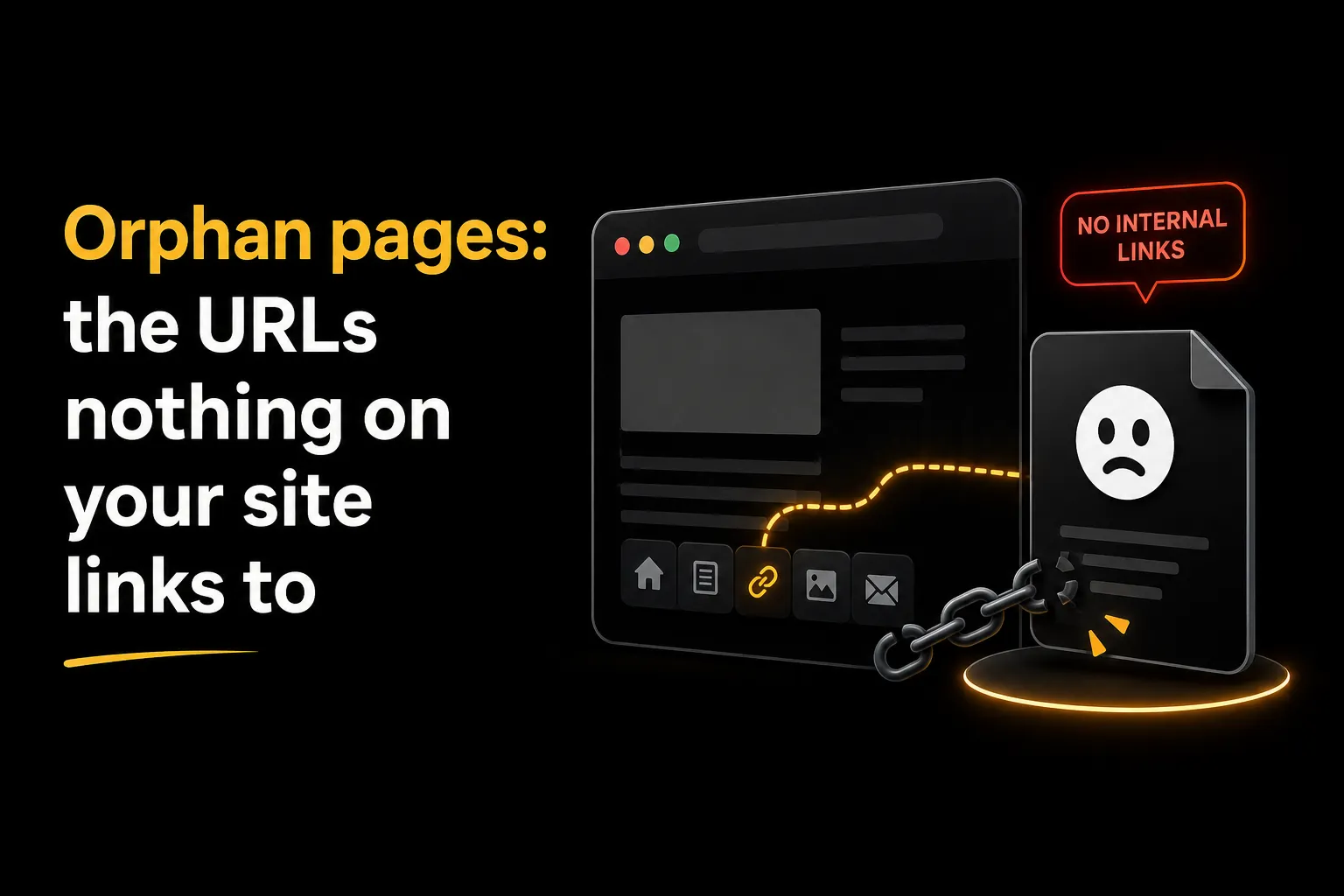
An orphan page can appear well connected during a standard internal link audit because most tools count every link, including navigation menus. A page linked only from the main menu may look adequately supported even though no relevant content on the site points to it. Once navigation links are excluded, the true internal linking structure becomes much clearer.
Why menu links tell you almost nothing
If your navigation appears on 500 pages, every page it links to shows 500 inbound links. That number is identical for your most important page and your least important one, which makes it useless for deciding anything.
Editorial links are different. Someone chose to place them, in a specific sentence, for a reason. That choice is the signal worth measuring.
The practical consequence: when you audit internal linking, remove nav, header and footer before you count. What remains is what your site is actually saying about which pages matter.
What an orphan page really costs
A page with no editorial inbound links is not merely unloved. It carries real costs.
- It is discovered late and recrawled rarely, so updates take longer to register
- It receives no internal authority, so nothing supports it in competitive results
- It still consumes crawl budget on every pass
- It is invisible to readers moving through your content naturally
The fix is usually one sentence. A single contextual link from a related page moves it from orphaned to supported, and costs nothing.
How to find them
Our internal link finder crawls outward from any URL with navigation, header and footer stripped, then lists pages by inbound editorial links with the lowest first. Anything showing zero is an orphan within the crawled set.
It also suggests where to add links by finding page pairs that share several distinctive terms with no link between them. Orphan targets sort to the top, because they are the most expensive problem to leave alone.
A sample of a dozen pages is usually enough to tell you whether the problem exists. A full-site map is a bigger exercise, but you rarely need one to know the answer.
When a suggestion means something else entirely
If two pages share a large number of distinctive terms and neither links to the other, that is sometimes a missing link. Sometimes it means the two pages are competing for the same query and should be one page.
We ran this against our own site and found 48 posts across 22 clusters doing exactly that. Eleven were merged rather than linked. The tool surfaces the pair; the judgement about which action to take is yours.
A useful test: if you could not explain to a reader why both pages exist, they should probably be one page.
How pages become orphaned in the first place

Nobody sets out to publish a page nothing links to. It happens through a handful of ordinary processes, each individually reasonable.
- A campaign page built for one purpose, linked from an email, never woven into the site
- An older post that was linked from a page later deleted or rewritten
- Bulk publishing, where the linking step is the one that gets skipped under time pressure
- A navigation change that quietly removed the only route to a section
- Pagination, where older archive pages fall off the end and take their posts with them
The last one is the most common on blogs. A post on page eight of an archive is reachable in theory and effectively invisible in practice.
Choosing where the link should come from
Not every link is equally useful, and adding one from the wrong page is close to worthless. The strongest internal links share three properties.
- Topically adjacent. A link from a page about the same subject carries more than one from an unrelated page.
- High in the body. A link in the second paragraph is worth more than one in a related-posts strip.
- Descriptive anchor. The anchor should describe the destination, not say “click here” or repeat your brand name.
The practical method: search your own site for the target page’s main topic, open the two or three most relevant results, and add a sentence that genuinely earns the link. If you cannot write that sentence naturally, the link probably does not belong there.
What to do when you find dozens
On a site of any age, a first audit often surfaces more orphans than anyone expects. Fixing them all at once is rarely the right move.
Sort by whether the page deserves to exist. Some orphans are orphaned because they should have been removed years ago, and linking to them spends authority on something you do not want ranking.
- Keep and link — the page has a job and nothing points at it
- Merge — the page overlaps something stronger; redirect it there
- Remove and redirect — the page has no purpose; send it somewhere that does
- Leave alone — thin utility pages that should not rank anyway
That triage matters more than the linking itself. An orphan audit that ends with every page linked has usually spent effort propping up pages that should have been retired.
Sources and further reading
Give Every Important Page a Clear Path
Navigation links can make a page appear well connected while hiding the fact that no relevant article, service page, or resource links to it contextually. Contact MoxSEO for an internal linking audit that separates editorial links from menus, headers, and footers, identifies orphaned pages, and highlights opportunities to strengthen discovery, crawlability, and internal authority. We will also help you decide whether each weakly supported page should be linked, improved, merged with a stronger page, redirected, or removed.
Schedule a consultation with MoxSEO to review your website’s internal link structure and build a practical action plan for your highest-value pages. Our team will help you place relevant contextual links, improve anchor text, resolve content overlap, and create a clearer route for both users and search engines.
Frequently asked questions
How many internal links should a page have?
There is no number worth quoting. The useful question is whether every page you care about has at least one editorial link from a related page.
Do footer links count for anything?
A little, but far less than a contextual link inside body copy. Treat them as navigation rather than as internal linking.
Is reciprocal linking between related pages a problem?
Not inherently. Dense reciprocal linking between near-identical pages usually signals cannibalisation rather than depth.
Will an orphan page ever get indexed?
Often yes, through the sitemap. It will simply be crawled less often and supported by nothing.

Sakshi Kumari is an SEO Specialist at MoxSEO with expertise in keyword research, on-page SEO, content optimization, technical SEO, and link-building strategies. She focuses on improving organic visibility, strengthening website performance, and creating search-focused content that attracts relevant traffic. Through data-driven analysis and practical SEO execution, Sakshi helps businesses build stronger search presence and achieve sustainable digital growth.