




We publish our mistakes, which means we will sometimes get it wrong. When that happens the fix goes on a public corrections log. This is why we keep one, what is currently on it, and why we think a methodology page without a corrections log is closer to marketing than to method.
What is a corrections log?
A corrections log is a public record of material changes to published work. Each entry says what changed and whether the change affected a study’s conclusion, a historical result or a recommendation. MoxSEO’s log lives at moxseo.com/corrections and sits alongside the methodology page, which explains how studies are designed, scored and reviewed.
What is on ours right now
As of October 2026 the public log lists two dated entries, both clarifications rather than changes to a result. One, dated 14 February 2026, clarifies wording about Long Animation Frames timing definitions in our Chromium INP measurement coverage, and states that historical ranking data was not changed. The other, dated 20 January 2026, clarifies the recommended Markdown link formatting in our llms.txt documentation.
Separately, three problems from our own research process are worth describing here. None of them reached a published figure, so they sit outside the public log, but they show the kind of failure the log and the methodology exist to catch.
- Concurrency corrupted a full scan. Fetching robots.txt at 175 parallel requests made google.com return as unreachable. Nothing errored; rows simply came back empty. The entire run was discarded and rerun at 25 to 40 concurrent.
- Raw scores reported as percentages. Our nine checks total 110 points, not 100. The first analysis pass treated the raw total as a percentage, inflating every score by roughly ten percent. Caught when a page scored above 100.
- The sample was not a list of websites. The top of the Tranco list is dominated by DNS roots and CDN endpoints that serve no site and no robots.txt. Unfiltered, it would have produced the headline that most top sites have no robots.txt, which is false.
How does our corrections process work?
The process described on our corrections page runs in five steps. Nothing here is a promise about turnaround time, because the page does not state one.
- Report. Anyone can report a possible error by emailing editorial@moxseo.com with the page URL, the exact statement, why it may be wrong, and the strongest supporting source.
- Review. The team checks the original evidence, the current page and the publication context, and decides whether the issue changes meaning or only presentation.
- Classify. The change is labelled as a correction, a clarification or an update (defined below).
- Publish. Material corrections identify what changed, when it changed, why, and whether the conclusion or measured result was affected.
- Propagate. Where a corrected claim appears in related research, resource, case or service pages, those references are reviewed as part of the same change.
Why publish them at all
The obvious objection is that admitting errors undermines confidence in the data. We think the opposite, for a specific reason.
Anyone can publish a number. What makes a number usable is knowing how it was produced and what could have gone wrong with it. A corrections log is evidence that somebody was looking for the failure modes rather than hoping there were none.
It also creates a useful internal constraint. Knowing that a mistake will be published in detail, with the mechanism named, changes how carefully the analysis gets checked before release. That effect is worth more than the reputational cost.
The failure mode worth dwelling on
The concurrency problem is the one we would most want another researcher to read, because it produces confident wrong answers rather than obvious failures.
Nothing crashed. No exception was raised. No timeout was logged. The scan completed, produced a clean-looking dataset, and a meaningful share of rows were silently empty. Had one implausible row not been questioned — google.com appearing to have no reachable robots.txt — the study would have published.
That is the shape of the dangerous error in any scanning work: the tool reports success while the data is wrong. It is why we now include known-good control domains in every run and check them before analysing anything else.
What counts as a correction
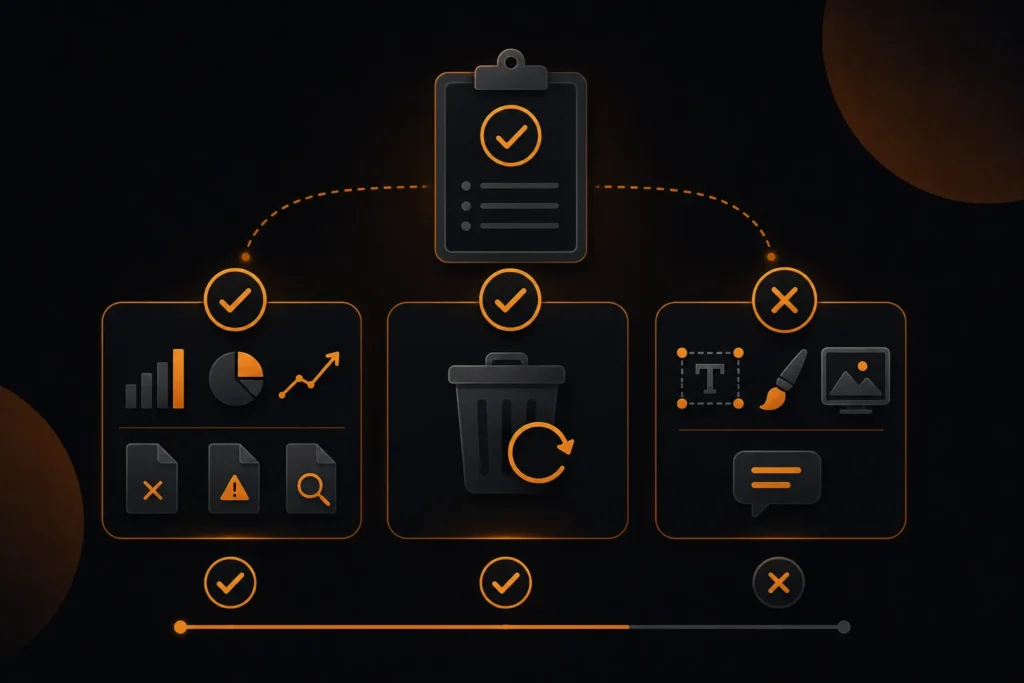
The line has to be drawn somewhere, or the log becomes a changelog nobody reads.
- Logged as a correction — an error that would have changed a published number, or did
- Logged as a clarification — wording or definitions changed so a statement is read correctly, without changing a result
- Handled as an update — newer information added without rewriting historical observations
- Not logged — typos, formatting and design changes
If it does not change what a number says or how a statement should be read, it is an edit rather than a correction. Conflating the two makes the log useless, because a reader can no longer tell which entries matter.
How does the log connect to our methodology?
The methodology page sets out five stages: define the question, collect observable data, score consistently, report limitations, and correct publicly. The last stage is the corrections log. The same page says that no study proves a universal rule from a limited sample, and that collection dates, tool behaviour, geography and later page changes can affect replication. Naming those limits up front is what makes a later correction easy to interpret: readers can see what the original claim covered. You can browse the studies this applies to on our research page, for example the AI crawler blocking study.
How this connects to trust as a ranking concept
Google’s guidance on helpful content asks whether a page demonstrates first-hand expertise and whether it is trustworthy enough to act on. Those are hard things to assert and relatively easy to evidence.
- Show the method — how the data was collected, at what scale, with what limits
- Show the failures — what went wrong and what you did about it
- Ship the data — per-row results so anyone can check your arithmetic
- Name the author — a real person, accountable for the claim
None of those are ranking factors in a mechanical sense. All of them are what a reasonable reader — or a quality rater working to published guidelines — would look for before treating a claim as reliable.
Google’s helpful content guidance frames this as three questions, “Who, How and Why”. Who created the content should be clear, with bylines that link to author background. How it was created should be explained where readers would reasonably wonder. And the main purpose should be to help visitors. Google also says trust is the most important of the E-E-A-T aspects. A corrections log speaks directly to that trust element.
What we would tell anyone publishing research
Three things, learned the expensive way.
- Include control cases. Known-good inputs whose expected result you can verify before trusting anything else in the run.
- Distrust clean data. A dataset with no anomalies is more often a broken collector than a tidy world.
- Publish the limits in the same document as the findings. Not in a footnote, and not later.
The full log is on our corrections page, and the method behind every study is documented on the methodology page, including sample construction and the weighting behind each check.
Sources and further reading
Build Greater Trust in Your Original Research
Publishing original research is not only about presenting strong findings. Readers, search engines, and AI systems also need to understand how the data was collected, which limitations affected the study, and how errors are handled when they are discovered.
A clear methodology page, public corrections log, named author, source documentation, and accessible per-row data can make research easier to verify and more credible to cite. These elements demonstrate that your conclusions come from a repeatable process rather than unsupported marketing claims.
MoxSEO helps businesses, agencies, publishers, and research-led brands strengthen the trust signals surrounding their original data. Our team can review your research methodology, sampling process, scoring model, control cases, source attribution, structured data, author information, and corrections policy to identify gaps that may weaken confidence in your findings.
Whether you are preparing a new industry study, publishing survey results, analysing website performance, or reviewing an existing research library, MoxSEO can help you create a clearer and more transparent framework. The goal is not to pretend that mistakes never happen. It is to show that errors are actively investigated, corrected, documented, and prevented from repeating.
A research consultation can also help you determine what should appear in a public corrections log, how to separate meaningful corrections from ordinary editorial updates, and how to present limitations without reducing the value of your findings.
Make your original research easier to inspect, understand, trust, and cite.
Contact MoxSEO for an Original Research and AI Visibility Audit
Frequently asked questions
Does publishing mistakes damage credibility?
It costs something short term and buys more back. A methodology page with no corrections log reads as either lucky or unexamined, and neither is reassuring.
What if someone finds an error in your data?
Email editorial@moxseo.com with the page URL, the exact statement, why it may be wrong and the strongest supporting source. The team reviews the original evidence and the current page, then classifies the change as a correction, clarification or update.
How do you decide what is significant enough to log?
Material changes are logged: errors that affect what a number or conclusion says, and clarifications that change how a statement should be read. Typos, formatting and design changes are not. Each entry records what changed, when, why and whether the conclusion or historical result was affected.
Do you republish corrected figures?
Where a corrected claim appears on related research, resource, case or service pages, those references are reviewed as part of the same change. The log entry records whether the conclusion or measured result changed, so readers can see the history.
Is a corrections log worth it for a normal business blog?
If you publish original data, yes. If you publish opinion and guidance, a clear last-updated date and a named author achieve most of the same thing.
What is the difference between a correction, a clarification and an update?
A correction fixes an error. A clarification improves how a statement should be interpreted. An update adds newer information without rewriting historical observations. Keeping the three apart lets readers see whether a published result was actually affected.
Where can I read the full log and the research method?
The corrections log is at moxseo.com/corrections and the method behind our studies is at moxseo.com/methodology. Published studies are listed on the research page.

Sakshi Kumari is an SEO Specialist at MoxSEO with expertise in keyword research, on-page SEO, content optimization, technical SEO, and link-building strategies. She focuses on improving organic visibility, strengthening website performance, and creating search-focused content that attracts relevant traffic. Through data-driven analysis and practical SEO execution, Sakshi helps businesses build stronger search presence and achieve sustainable digital growth.