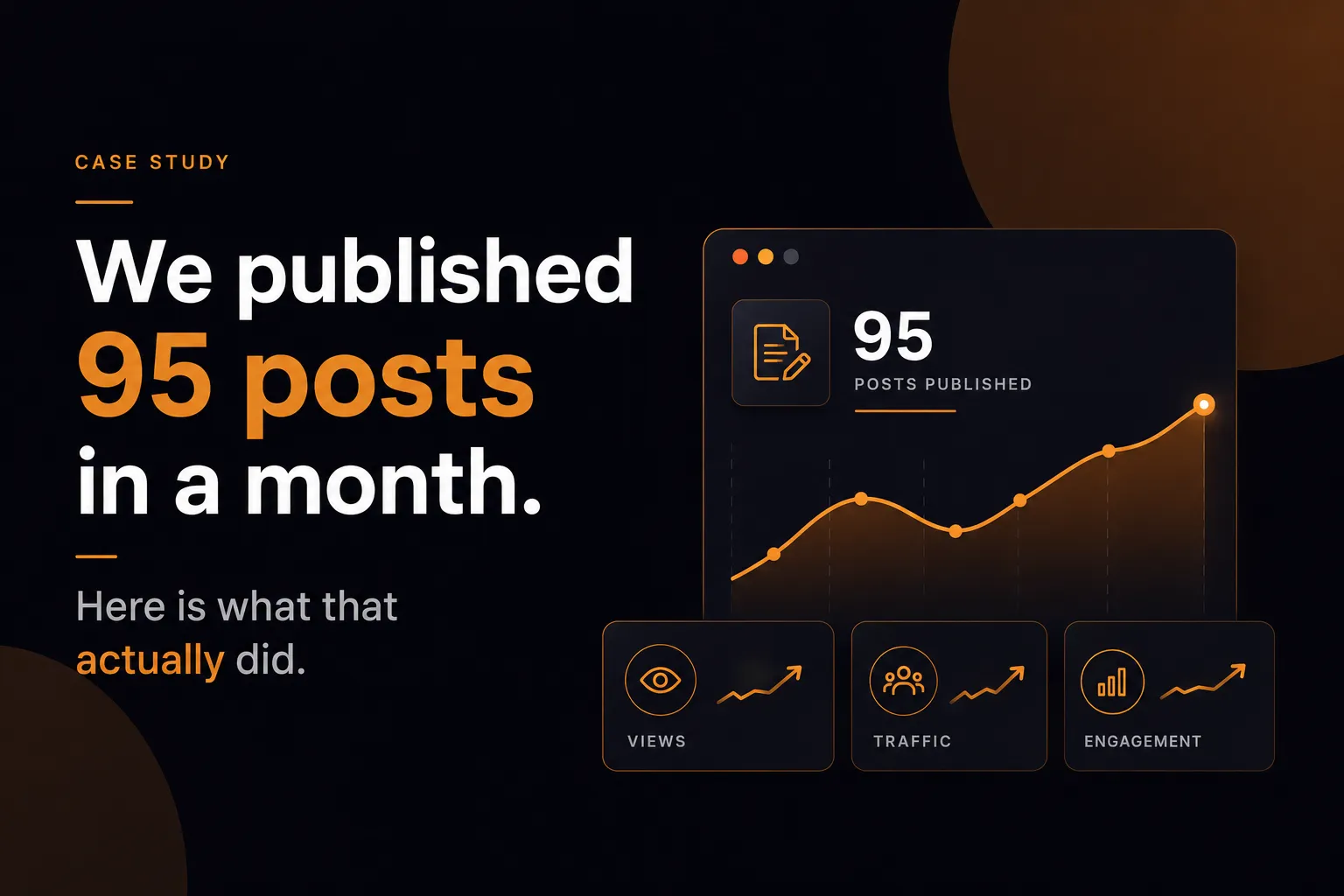
In July 2026 we publishing 95 posts in a month. This is an account of what that produced, what it cost, and what we would advise anyone considering the same thing. It is not a flattering story, which is rather the point of telling it.
What the volume actually was
Ninety-five posts in one month, with 35 published on a single day. For context, the five months before that produced five posts in total.
The reasoning was straightforward and, on the face of it, sound: more indexed pages means more entry points, and search rewards depth of coverage. Publish widely, then let the data tell you what worked.
The flaw is in the second half. You only learn what worked if the pages are distinguishable from each other.
What it produced
Auditing afterwards, 48 of those posts were competing with each other across 22 clusters. Six separate articles targeted variations of the same query. Two posts of over 3,200 words each covered the same term nine days apart.
Eleven were subsequently merged and redirected. That is roughly 12% of a monthu2019s output removed within weeks of publishing it.
The cost was not only the wasted writing. Every one of those pages had to be reviewed, compared, judged and consolidated — which took longer than commissioning them.
The pattern worth avoiding
The failure was structural rather than editorial. The posts were fine individually. The problem was that nobody held the full list, so overlap was invisible at the point of commissioning.
- Keyword lists produce overlap because keyword tools return variations, and variations look like separate topics
- Volume outruns review capacity long before it outruns writing capacity
- Cannibalisation is invisible until you look for it deliberately
- The cost arrives weeks later, when consolidating is much harder than not creating
What we would do instead
One page per intent, decided before commissioning. A running register of covered intents that any brief has to be checked against. Fewer pages, better supported.
Publish, wait for data, then decide what is genuinely missing. The instinct to decide everything upfront is what generates the overlap.
If you want to check your own site for this, our internal link finder surfaces page pairs sharing many distinctive terms with no link between them. That list is usually where the cannibalisation is.
The numbers, plainly
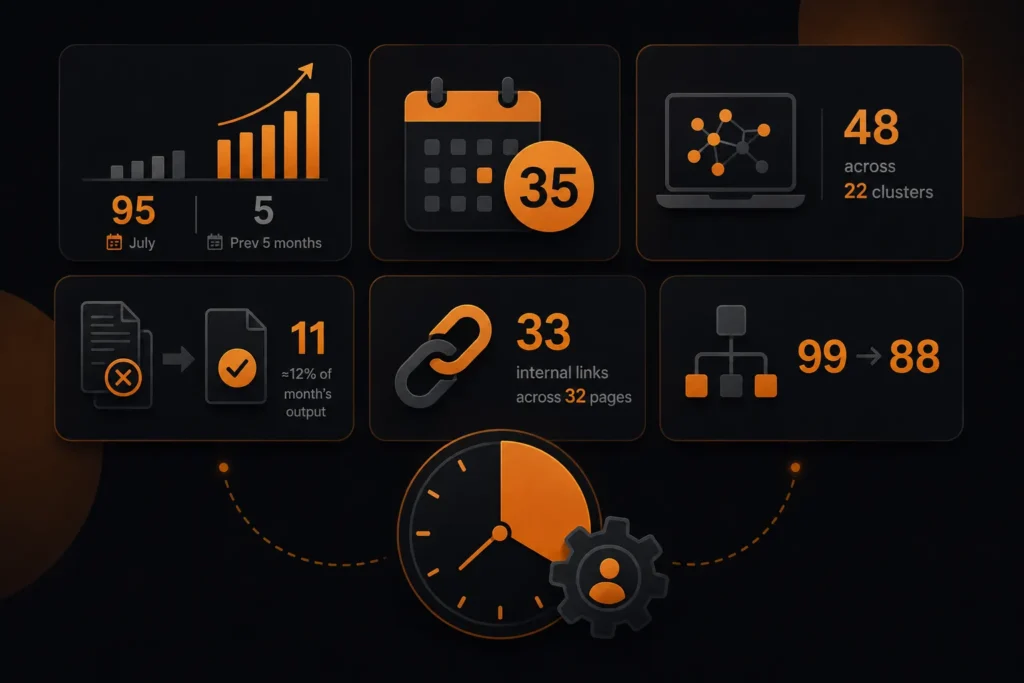
For anyone weighing a similar push, these are the figures rather than the narrative.
- 95 posts published in July 2026, against 5 in the preceding five months
- 35 published on a single day
- 48 posts found competing across 22 clusters on audit
- 11 merged and redirected, roughly 12% of the month’s output
- 33 internal links across 32 pages rewritten to avoid routing through redirects
- Sitemap reduced from 99 URLs to 88
The consolidation work took a meaningful fraction of the time the original writing did, which is the part rarely accounted for when volume is planned.
What we cannot yet tell you
Performance data for those posts was not available when we consolidated, so the merges were decided on internal signals: inbound links, depth and slug quality.
That is a genuine limitation. If the data later shows we kept the weaker page in a given cluster, the redirects can be reversed, because every merged post was archived in full rather than deleted.
We will publish the outcome either way, including the cases where we chose wrong. That is what the corrections log is for.
If you are planning a volume push anyway
Sometimes there is a reason to publish quickly. If so, these four things would have saved us most of the cleanup.
- Keep a register of covered intents that every brief is checked against before commissioning
- Search your own site first — if a page covers the intent, improve it instead of adding another
- Group keyword variations at planning stage, because keyword tools return synonyms that look like separate topics
- Publish in waves with a review between them, rather than everything at once
The register is the highest-value item and the least glamorous. Ours did not exist, which is the entire reason six posts ended up targeting one intent.
Sources and further reading
In July 2026 we published 95 blog posts. This is an account of what that produced, what it cost, and what we would advise anyone considering the same thing. It is not a flattering story, which is rather the point of telling it.
What the volume actually was
Ninety-five posts in one month, with 35 published on a single day. For context, the five months before that produced five posts in total.
The reasoning was straightforward and, on the face of it, sound: more indexed pages means more entry points, and search rewards depth of coverage. Publish widely, then let the data tell you what worked.
The flaw is in the second half. You only learn what worked if the pages are distinguishable from each other.
What it produced
Auditing afterwards, 48 of those posts were competing with each other across 22 clusters. Six separate articles targeted variations of the same query. Two posts of over 3,200 words each covered the same term nine days apart.
Eleven were subsequently merged and redirected. That is roughly 12% of a monthu2019s output removed within weeks of publishing it.
The cost was not only the wasted writing. Every one of those pages had to be reviewed, compared, judged and consolidated — which took longer than commissioning them.
The pattern worth avoiding
The failure was structural rather than editorial. The posts were fine individually. The problem was that nobody held the full list, so overlap was invisible at the point of commissioning.
- Keyword lists produce overlap because keyword tools return variations, and variations look like separate topics
- Volume outruns review capacity long before it outruns writing capacity
- Cannibalisation is invisible until you look for it deliberately
- The cost arrives weeks later, when consolidating is much harder than not creating
What we would do instead
One page per intent, decided before commissioning. A running register of covered intents that any brief has to be checked against. Fewer pages, better supported.
Publish, wait for data, then decide what is genuinely missing. The instinct to decide everything upfront is what generates the overlap.
If you want to check your own site for this, our internal link finder surfaces page pairs sharing many distinctive terms with no link between them. That list is usually where the cannibalisation is.
The numbers, plainly
For anyone weighing a similar push, these are the figures rather than the narrative.
- 95 posts published in July 2026, against 5 in the preceding five months
- 35 published on a single day
- 48 posts found competing across 22 clusters on audit
- 11 merged and redirected, roughly 12% of the month’s output
- 33 internal links across 32 pages rewritten to avoid routing through redirects
- Sitemap reduced from 99 URLs to 88
The consolidation work took a meaningful fraction of the time the original writing did, which is the part rarely accounted for when volume is planned.
What we cannot yet tell you
Performance data for those posts was not available when we consolidated, so the merges were decided on internal signals: inbound links, depth and slug quality.
That is a genuine limitation. If the data later shows we kept the weaker page in a given cluster, the redirects can be reversed, because every merged post was archived in full rather than deleted.
We will publish the outcome either way, including the cases where we chose wrong. That is what the corrections log is for.
If you are planning a volume push anyway
Sometimes there is a reason to publish quickly. If so, these four things would have saved us most of the cleanup.
- Keep a register of covered intents that every brief is checked against before commissioning
- Search your own site first — if a page covers the intent, improve it instead of adding another
- Group keyword variations at planning stage, because keyword tools return synonyms that look like separate topics
- Publish in waves with a review between them, rather than everything at once
The register is the highest-value item and the least glamorous. Ours did not exist, which is the entire reason six posts ended up targeting one intent.
Sources and further reading
In July 2026 we published 95 blog posts. This is an account of what that produced, what it cost, and what we would advise anyone considering the same thing. It is not a flattering story, which is rather the point of telling it.
What the volume actually was
Ninety-five posts in one month, with 35 published on a single day. For context, the five months before that produced five posts in total.
The reasoning was straightforward and, on the face of it, sound: more indexed pages means more entry points, and search rewards depth of coverage. Publish widely, then let the data tell you what worked.
The flaw is in the second half. You only learn what worked if the pages are distinguishable from each other.
What it produced
Auditing afterwards, 48 of those posts were competing with each other across 22 clusters. Six separate articles targeted variations of the same query. Two posts of over 3,200 words each covered the same term nine days apart.
Eleven were subsequently merged and redirected. That is roughly 12% of a monthu2019s output removed within weeks of publishing it.
The cost was not only the wasted writing. Every one of those pages had to be reviewed, compared, judged and consolidated — which took longer than commissioning them.
The pattern worth avoiding
The failure was structural rather than editorial. The posts were fine individually. The problem was that nobody held the full list, so overlap was invisible at the point of commissioning.
- Keyword lists produce overlap because keyword tools return variations, and variations look like separate topics
- Volume outruns review capacity long before it outruns writing capacity
- Cannibalisation is invisible until you look for it deliberately
- The cost arrives weeks later, when consolidating is much harder than not creating
What we would do instead
One page per intent, decided before commissioning. A running register of covered intents that any brief has to be checked against. Fewer pages, better supported.
Publish, wait for data, then decide what is genuinely missing. The instinct to decide everything upfront is what generates the overlap.
If you want to check your own site for this, our internal link finder surfaces page pairs sharing many distinctive terms with no link between them. That list is usually where the cannibalisation is.
The numbers, plainly
For anyone weighing a similar push, these are the figures rather than the narrative.
- 95 posts published in July 2026, against 5 in the preceding five months
- 35 published on a single day
- 48 posts found competing across 22 clusters on audit
- 11 merged and redirected, roughly 12% of the month’s output
- 33 internal links across 32 pages rewritten to avoid routing through redirects
- Sitemap reduced from 99 URLs to 88
The consolidation work took a meaningful fraction of the time the original writing did, which is the part rarely accounted for when volume is planned.
What we cannot yet tell you
Performance data for those posts was not available when we consolidated, so the merges were decided on internal signals: inbound links, depth and slug quality.
That is a genuine limitation. If the data later shows we kept the weaker page in a given cluster, the redirects can be reversed, because every merged post was archived in full rather than deleted.
We will publish the outcome either way, including the cases where we chose wrong. That is what the corrections log is for.
If you are planning a volume push anyway
Sometimes there is a reason to publish quickly. If so, these four things would have saved us most of the cleanup.
- Keep a register of covered intents that every brief is checked against before commissioning
- Search your own site first — if a page covers the intent, improve it instead of adding another
- Group keyword variations at planning stage, because keyword tools return synonyms that look like separate topics
- Publish in waves with a review between them, rather than everything at once
The register is the highest-value item and the least glamorous. Ours did not exist, which is the entire reason six posts ended up targeting one intent.
Sources and further reading
Your Next Content Win May Already Be Published
Before adding another article to your content calendar, check whether your website already has a page targeting the same search intent.
Content cannibalisation often begins quietly. Two posts appear slightly different in a keyword tool, but they answer the same question for the same audience. As more overlapping pages are published, internal links become divided, search engines receive mixed signals, and your strongest page becomes harder to identify.
MoxSEO can help schedule consultation you uncover those conflicts before you spend more time producing content that your website does not need. Our content review examines overlapping topics, similar page language, competing search intent, redirect chains, internal-link distribution, and gaps in your existing coverage.
The result is a practical action plan showing which pages should remain independent, which should be consolidated, which need stronger differentiation, and where genuinely new content is still required.
You do not always need more pages. Sometimes you need a clearer structure around the pages you already have.
Frequently asked questions
Is publishing frequently bad for SEO?
No. Publishing frequently without a register of what you already cover is what causes problems.
How many posts a month is right?
However many you can make genuinely distinct. That number is lower than most content plans assume.
Does removing posts hurt?
Merging and redirecting does not. Deleting without redirecting discards whatever links and history the page had.
How do I spot cannibalisation early?
Before commissioning, search your own site for the intent. If a page already covers it, improve that page instead.

Ashish Khan is an SEO Specialist at MoxSEO with expertise in keyword research, on-page optimization, technical SEO, content strategy, and link building. He focuses on improving website visibility, strengthening search performance, and helping businesses attract relevant organic traffic. By combining competitor analysis, SEO audits, and data-driven optimization, Ashish supports sustainable ranking growth and stronger digital presence.