





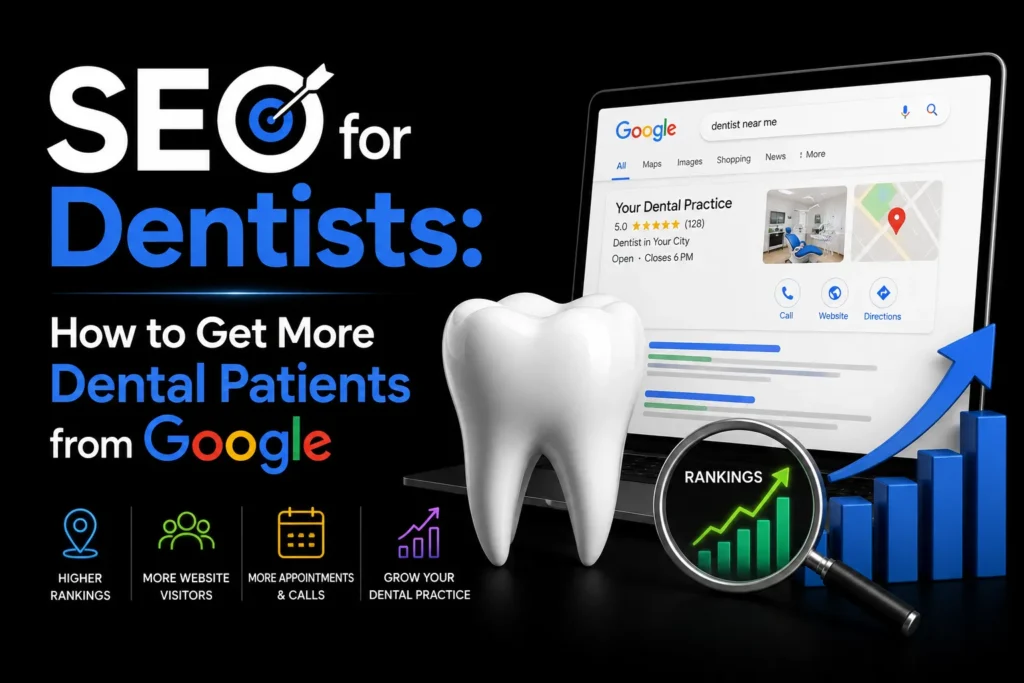
Most dental practices win or lose patients based on what shows up when someone in their area searches for a dentist. If your practice does not appear in those searches, you are invisible to the people actively looking for your services. SEO for dentists is not about ranking for broad terms like “dentist” alone, it is about showing up when someone searches “dentist near me,” “teeth whitening in [your city],” or “emergency dental clinic open today.” This guide walks through exactly how dental SEO works, what it takes to rank, and how to turn search visibility into booked appointments.
TL;DR: SEO for dentists combines local search optimization, service-specific pages for treatments like implants and Invisalign, Google Business Profile management, online reviews, and a mobile-friendly website. The practices that win are the ones that show up in the local pack, rank for treatment-specific keywords, and make it easy for searchers to call or book online. If you need professional help, MoxSEO offers local SEO services built for healthcare practices.
Why Dentists Need SEO
Dental patients are local. According to Google’s own business profile guidelines, nearly half of all Google searches are looking for local information. When someone needs a dentist, they search locally, look at the top results, read reviews, and call or book online within minutes. If your practice is not in those top results, your competitors are getting those patients instead.
Here is what makes dental SEO different from general SEO:
- Geographic specificity: You only need to rank in your local area, not nationally. This means you can compete even against large dental chains if your local SEO is stronger.
- Service-specific searches: Patients search for specific treatments like “dental implants,” “Invisalign,” “root canal,” or “teeth cleaning.” Each treatment deserves its own optimized page.
- Trust and reviews: Dental patients rely heavily on reviews. Your review profile directly impacts both rankings and conversion rates.
- Insurance and payment queries: Many patients search for dentists that accept specific insurance plans. Addressing this on your site captures high-intent traffic.
How SEO for Dentists Works: The Core Components
1. Local SEO and Google Business Profile
Your Google Business Profile is the single most important asset for dental SEO. It determines whether you show up in the local pack, the three listings that appear at the top of local search results. To optimize it:
- Claim and verify your profile if you have not already.
- Fill out every field completely: services, hours, parking, accessibility, insurance accepted.
- Use accurate NAP (name, address, phone) information that matches your website exactly.
- Upload high-quality photos of your office, team, and before-and-after treatment results.
- Post updates regularly: new services, seasonal offers, oral health tips.
For a complete walkthrough of local search optimization, see our local SEO guide and our local SEO strategy guide for 2026.
2. Service-Specific Pages
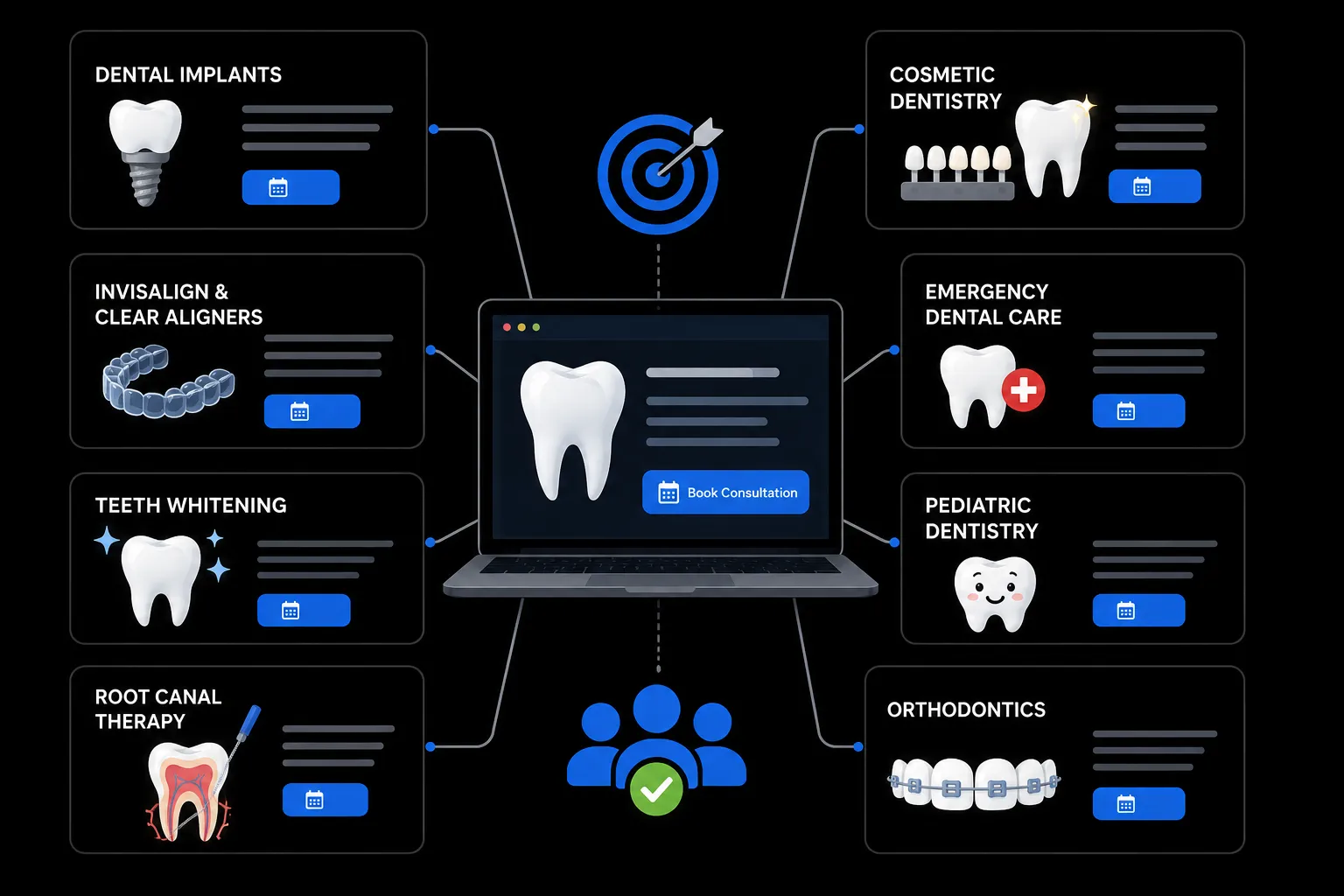
One of the biggest mistakes dental practices make is having a single “Services” page that lists everything. Google ranks pages, not websites. If you want to rank for “dental implants in [your city],” you need a dedicated page about dental implants. Create separate, detailed pages for each treatment:
- Dental implants
- Invisalign and clear aligners
- Teeth whitening
- Root canal therapy
- Cosmetic dentistry
- Emergency dental care
- Pediatric dentistry
- Orthodontics
Each page should explain the procedure, answer common patient questions, show before-and-after photos, and include a clear call to action to book a consultation.
3. On-Page SEO for Dental Websites
Every page on your dental website should follow on-page SEO best practices:
- Title tags: Include your primary keyword and your city. Example: “Dental Implants in Pune | [Practice Name]”
- Meta descriptions: Write a compelling description that includes your keyword and a call to action. Example: “Looking for dental implants in Pune? Our experienced team offers natural-looking, long-lasting results. Book a free consultation today.”
- Header tags: Use one H1 per page, then H2 and H3 subheadings to structure content logically.
- Internal linking: Link from your blog posts to your service pages, and from one service page to related services.
- Image optimization: Compress images for fast loading and add descriptive alt text to every image.
4. Online Reviews
Reviews are critical for dental practices. They influence both your local pack ranking and whether a searcher chooses you over a competitor. According to Google’s Search documentation, review count and review recency are local ranking factors. To build a strong review profile:
- Ask every satisfied patient for a review, ideally right after their appointment.
- Send a follow-up email or SMS with a direct link to your Google review page.
- Respond to every review, both positive and negative, professionally and promptly.
- Never buy reviews or incentivize patients with discounts in exchange for reviews, as this violates Google’s policies.
5. Website Speed and Mobile Experience
Most dental searches happen on mobile phones, often from someone experiencing pain and looking for an emergency dentist. If your website takes more than 3 seconds to load, a significant percentage of visitors will leave. Make sure your site:
- Loads in under 2 seconds on mobile devices.
- Has a click-to-call button visible at the top of every page.
- Has an online booking system that works on mobile.
- Uses a responsive design that adapts to any screen size.
Keyword Research for Dental Practices
Effective dental SEO starts with understanding what your patients actually search for. Here are the main keyword categories to target:
- Core service keywords: “dentist [city],” “dental clinic [city],” “dental office [city]”
- Treatment-specific keywords: “dental implants [city],” “Invisalign [city],” “teeth whitening [city],” “root canal [city]”
- Emergency keywords: “emergency dentist [city],” “dentist open Saturday [city],” “24 hour dental clinic [city]”
- Insurance keywords: “dentist that accepts [insurance name] [city]”
- Informational keywords: “how much do dental implants cost,” “Invisalign vs braces,” “what to expect during a root canal”
Informational keywords are perfect for blog content that builds trust and drives traffic, while service and emergency keywords are high-intent and should be targeted with dedicated landing pages.
Content Marketing for Dentists
A blog is one of the most effective ways to attract new dental patients. Patients research procedures before booking. If your practice answers their questions, you build trust and capture their search traffic. Content ideas include:
- “How Much Do Dental Implants Cost in [Your City]?”
- “Invisalign vs Traditional Braces: Which Is Right for You?”
- “What to Expect During Your First Dental Visit”
- “5 Signs You Might Need a Root Canal”
- “How to Choose the Right Dentist for Your Family”
Each blog post should link to the relevant service page and include a call to action to book an appointment. This creates a content funnel that turns researchers into patients.
How Long Does Dental SEO Take?
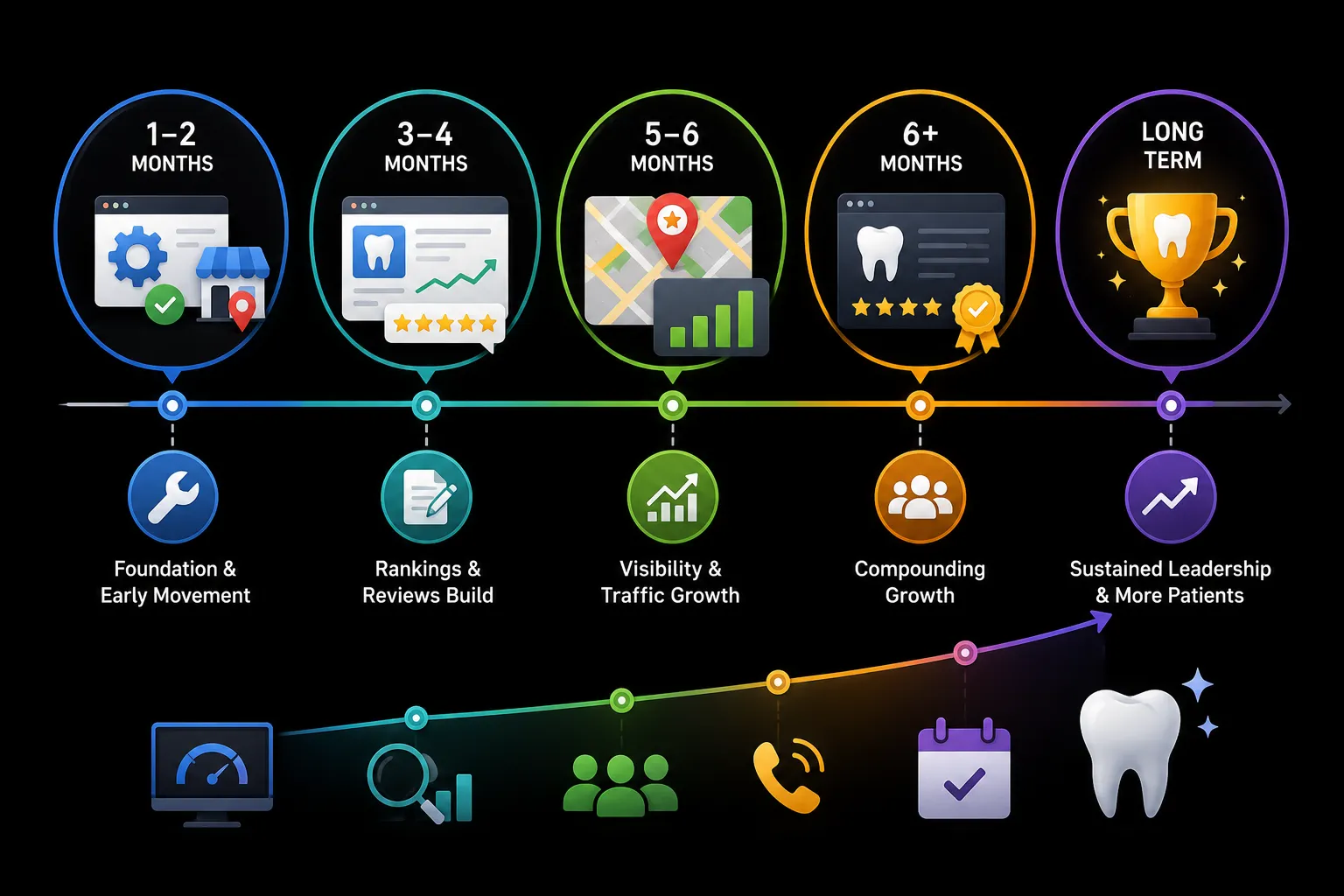
Dental SEO is not an overnight process. Here is a realistic timeline:
- Months 1 to 2: Technical fixes, Google Business Profile optimization, and on-page SEO improvements. You may see early movement in local pack rankings.
- Months 3 to 4: Service pages start ranking for treatment-specific keywords. Review building and content publishing begin showing results.
- Months 5 to 6: Significant improvement in local pack visibility and organic traffic. You should see a measurable increase in calls and appointment bookings.
- Months 6+: Compounding growth as content ranks for more keywords and your review profile strengthens.
Practices in smaller cities with less competition can see results faster, while those in competitive markets like Mumbai or Delhi may take longer.
Should You Do Dental SEO In-House or Hire an Agency?
Running a dental practice is a full-time job. Most dentists do not have the time to manage Google Business Profile, write blog content, build citations, and track rankings. If you are spending more than a few hours a week on SEO, that is time taken away from patients.
Hiring an agency that understands healthcare SEO lets you focus on patient care while experts handle your online visibility. Look for an agency with experience in dental or medical SEO, transparent reporting, and a clear strategy. For practices looking for affordable options, our SEO services for small businesses are designed for exactly this kind of local, service-based business.
Ready to attract more dental patients from Google search? Get a free quote from MoxSEO and find out how our dental SEO services can help your practice rank higher and book more appointments.
Frequently Asked Questions
What is SEO for dentists?
SEO for dentists is the process of optimizing your dental practice’s website and online presence to rank higher in Google search results when potential patients search for dental services in your area. It includes local SEO, service-specific pages, Google Business Profile optimization, review management, and content marketing.
How much does dental SEO cost?
Dental SEO typically costs between Rs 15,000 and Rs 75,000 per month in India, depending on the competitiveness of your local market and the scope of work. Practices in major cities like Mumbai or Delhi will need a higher budget than those in smaller towns. For a detailed breakdown, see our guide to SEO packages in India.
How long does it take to see results from dental SEO?
Most dental practices see initial improvements within 2 to 3 months and significant results within 4 to 6 months. Local pack rankings can improve faster than organic rankings, especially if your Google Business Profile was previously unoptimized.
Do I need a blog for my dental website?
Yes. A blog helps you rank for informational keywords that patients search before booking an appointment. It also builds trust, establishes your expertise, and creates internal linking opportunities to your service pages. One to two blog posts per month is a good starting point.
Can I do dental SEO myself?
You can handle basic tasks like updating your Google Business Profile and asking patients for reviews. However, technical SEO, content creation, citation building, and ranking tracking require specialized knowledge and consistent effort. Most practices see better results by hiring an agency.
Related guides in Industry SEO
- SEO for Doctors: How Healthcare Providers Can Attract More Patients
- SEO for Hotels: How to Increase Direct Bookings from Search
- SEO for Lawyers: A Complete Guide to Law Firm SEO
- SEO for Real Estate: How to Rank for Property Searches
- SEO for Restaurants: How to Get More Diners from Google Search
Need this handled for you? Explore our SEO Services service.

Samruddhi Kadam is an SEO Associate at MoxSEO with 2 years of experience in keyword research, on-page SEO, content optimization, competitor analysis, and website performance tracking. She focuses on improving organic visibility, creating search-friendly content, and identifying practical opportunities to strengthen rankings. Through consistent analysis and data-driven execution, Samruddhi helps businesses attract relevant traffic and build a stronger presence in search results.