





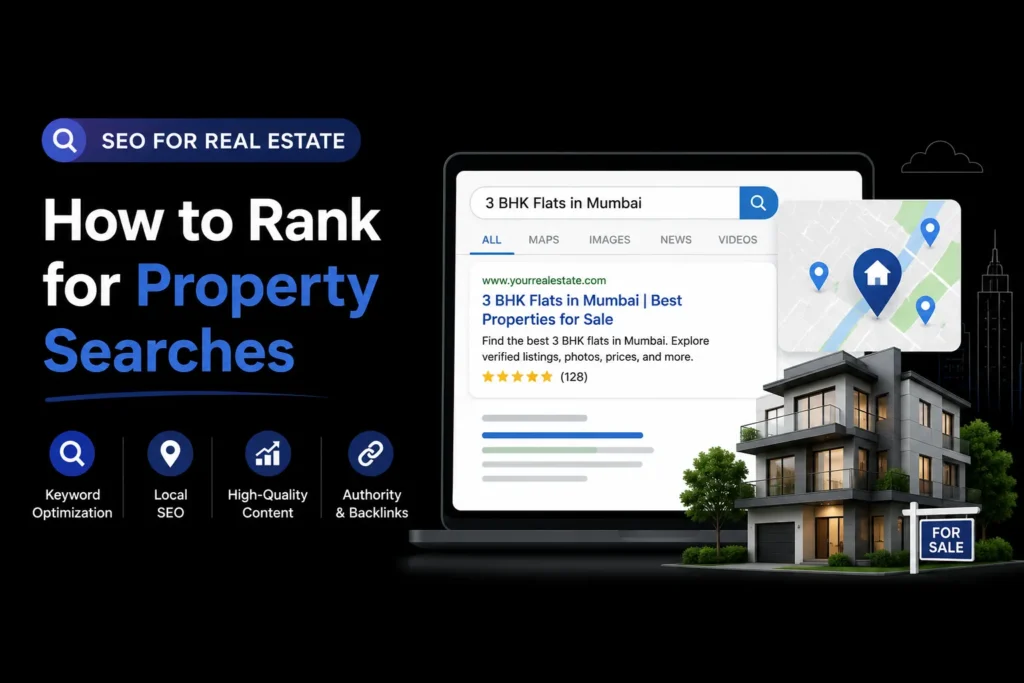
Real estate is a search-driven business. When someone is looking for a property, they start on Google. “2 BHK in [neighborhood],” “apartments for sale in [city],” “commercial property in [area].” The real estate agents and developers whose websites show up first get the leads. SEO for real estate is how you make sure that is you.
Real estate SEO is different from other industries because the search landscape is fragmented. Buyers search by location, property type, budget, and amenities. Sellers search for agents and valuation services. Each of these search patterns needs its own SEO strategy. This guide covers everything real estate businesses need to do to rank higher and generate more property leads from Google.
TL;DR: SEO for real estate means creating location-specific property listing pages, optimizing for local search with your Google Business Profile, publishing neighborhood guides and market reports, using schema markup for property listings, and building backlinks from real estate portals. The goal is to capture buyers and sellers at every stage of their property search journey.
Why SEO Matters for Real Estate Businesses
Over 90% of home buyers start their search online, and Google is the first stop for most of them. Real estate portals like MagicBricks, 99acres, and Housing.com dominate broad property searches, but they cannot cover every neighborhood, property type, or niche. That is where individual agents and developers can win with targeted SEO.
Unlike paid lead generation platforms that sell the same lead to multiple agents, SEO leads are exclusive. When a buyer finds your website through organic search, they contact you directly. No competition, no lead sharing fees.
Local SEO for Real Estate
Google Business Profile Optimization
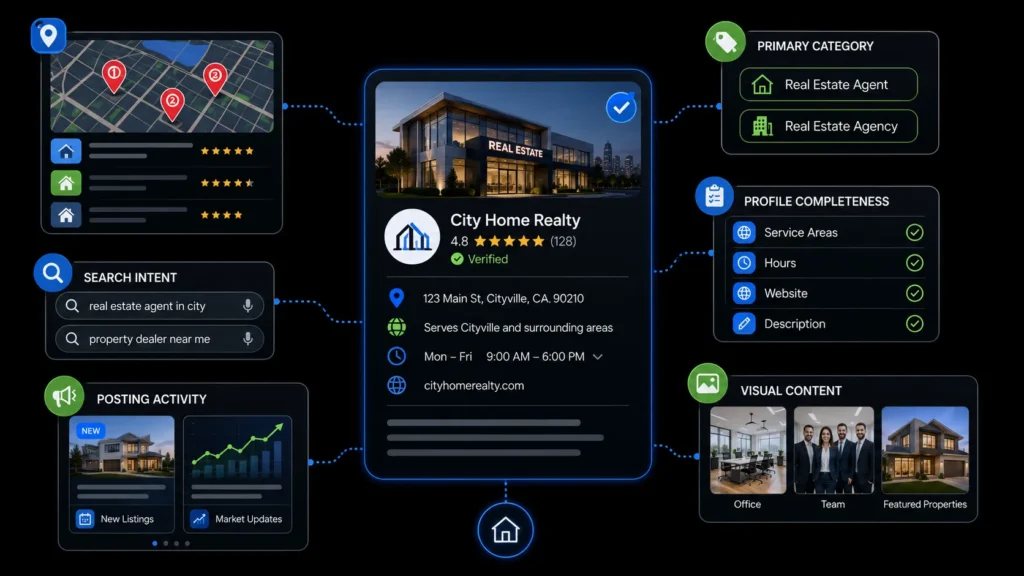
For real estate agents and brokers, local SEO starts with your Google Business Profile. When someone searches “real estate agent in [city]” or “property dealer near me,” Google’s local pack shows three businesses. Getting into that pack should be your first priority.
Choose “Real Estate Agent” or “Real Estate Agency” as your primary category. Fill out every field: your service areas, hours, website, and a description that includes your target keywords naturally. Upload photos of your office, team, and featured properties. Post new listings and market updates regularly.
For more on local search, read our local SEO guide and our guide to Google Business Profile optimization.
Location Pages for Each Area You Serve
Create a dedicated page for each neighborhood or city you serve. These pages should include:
- Current property listings in that area
- Average property prices and price trends
- Neighborhood information: schools, parks, shopping, transportation
- Nearby landmarks and amenities
- Customer testimonials from clients in that area
- An area map with pinned properties
Each location page should target keywords like “property in [neighborhood],” “apartments for sale in [area],” or “real estate agent in [city].” These hyper-local pages are where individual agents can outperform large portals.
On-Page SEO for Real Estate Websites
Property Listing Pages
Each property listing should be on its own URL with a descriptive title tag like “2 BHK Apartment for Sale in [Building Name], [Area] – [Price].” Include:
- High-quality photos with descriptive alt text
- Detailed property description with location, size, amenities, and price
- Floor plan images
- Nearby landmarks and distance to key locations
- A contact form or call button for inquiries
- Schema markup for the property listing
Property Type Pages
Create pages for each property type you handle: apartments, villas, plots, commercial offices, retail spaces, co-working spaces. Target keywords like “apartments for sale in [city],” “commercial property in [area],” or “villas in [region].”
Price Range Pages
Create pages for different budget ranges: “properties under 50 lakhs in [city],” “luxury apartments in [area],” “affordable housing in [region].” These capture budget-specific searches.
Schema Markup for Real Estate
Use schema markup to help Google understand your property listings. The Residence schema type or Product schema with RealEstateListing can enable rich results showing price, location, and availability in search results. Learn more in our schema markup guide.
Content Marketing for Real Estate
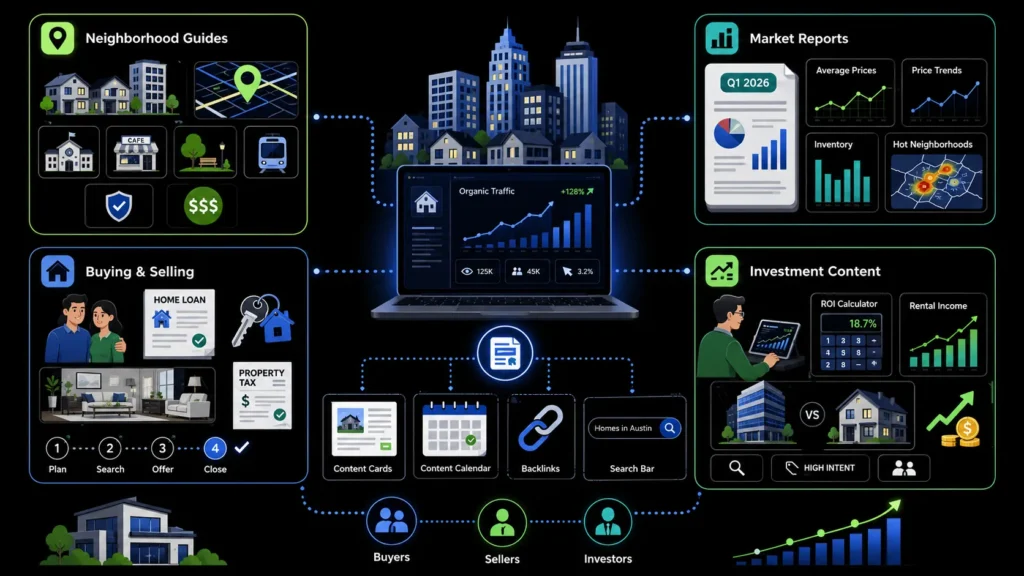
Content marketing is where real estate businesses can truly differentiate from property portals. Create content that buyers and sellers are searching for:
Neighborhood Guides
Write comprehensive guides for each area you serve: “Living in [neighborhood]: Complete Area Guide.” Cover schools, restaurants, parks, transportation, safety, property prices, and pros and cons. These guides capture research-stage buyers and position you as a local expert.
Market Reports
Publish quarterly market reports: “[City] Real Estate Market Report Q1 2026.” Include average prices, price trends, inventory levels, and hot neighborhoods. These reports attract serious buyers and investors and earn backlinks from news sites and blogs.
Buying and Selling Guides
Create evergreen guides: “How to buy your first apartment in [city],” “Step-by-step guide to getting a home loan in India,” “How to stage your home for sale,” “Property tax explained for [city] homeowners.” These capture top-of-funnel searchers and build trust.
Investment Content
For investor-focused content: “Best areas to invest in [city] real estate,” “ROI calculator for rental properties,” “Commercial vs residential real estate investment in India.” These attract high-intent investors.
For more on content strategy, read our on-page SEO guide.
Building Real Estate Backlinks
Backlinks from authoritative websites signal to Google that your real estate business is trusted and reputable. Earn links from:
- Real estate news websites (Moneycontrol, Economic Times Realty, MagicBricks blog)
- Local news sites and newspapers
- Architecture and interior design blogs
- Home loan and financial planning websites
- Local business directories and Chambers of Commerce
- Guest posts on real estate and investment blogs
- Partnerships with builders, developers, and interior designers
For link building strategies, read our guide to link building strategies.
Technical SEO for Real Estate Websites
Site Speed
Real estate websites are image-heavy, which can slow them down. Compress all property photos, use lazy loading for images below the fold, and use a content delivery network (CDN). Test your speed on PageSpeed Insights and aim for a mobile score above 80.
Mobile Optimization
Most property searches happen on mobile. Your listing pages, search filters, and contact forms must work perfectly on phones. If a buyer cannot browse listings on their phone, they will switch to a portal.
Search and Filter Functionality
Your website should have a robust search and filter system: by location, price, property type, number of bedrooms, and amenities. Ensure these filters generate indexable URLs so Google can crawl and rank them. For example, “/apartments/2-bhk/mumbai/under-1-crore/” should be a crawlable, indexable page.
XML Sitemap
Submit an XML sitemap to Google Search Console that includes all your property listings, location pages, and blog posts. This helps Google discover and index your pages faster. Learn more in our Core Web Vitals guide for technical optimization.
Tracking Real Estate SEO Performance
Track these metrics to measure your real estate SEO success:
- Lead inquiries: Form submissions and calls from organic search traffic
- Organic traffic: Visitors from organic search via Google Analytics
- Keyword rankings: Track your position for “property in [area],” “real estate agent in [city],” and neighborhood-specific keywords
- Google Business Profile insights: Calls, direction requests, and website clicks
- Property page views: Track which listings get the most organic traffic
- Conversion rate: Percentage of organic visitors who submit an inquiry
Ready to Generate More Property Leads with SEO?
Real estate SEO is one of the most effective lead generation channels for agents, brokers, and developers. Unlike paid lead platforms that share leads with multiple agents, SEO leads are exclusive and come directly to you. Every neighborhood guide, every market report, and every optimized listing page builds on the last.
If you want a real estate SEO strategy tailored to your business, get a free quote or learn more about our local SEO services. We help real estate businesses across India rank higher, generate more property leads, and grow their business through search.
FAQs About SEO for Real Estate
Can I compete with MagicBricks and 99acres?
Not for broad keywords like u0022property in Mumbai,u0022 but you can win for hyper-local and niche keywords. u00222 BHK in [specific building],u0022 u0022real estate agent in [specific neighborhood],u0022 and u0022property investment in [specific area]u0022 are all winnable with targeted SEO. Focus on what the big portals cannot cover: deep local expertise.
How long does real estate SEO take?
Most real estate businesses see ranking improvements within 3 to 6 months. New websites may need 6 to 12 months. The timeline depends on your competition, the age of your domain, and how consistently you implement SEO.
Should I use paid lead generation or SEO?
Both. Paid lead generation gives you immediate leads but stops when you stop paying. SEO takes longer but generates exclusive leads that compound over time. Use paid leads for short-term pipeline and SEO for long-term, sustainable lead generation.
How much does real estate SEO cost?
Real estate SEO typically costs between $500 and $2,500 per month depending on your market and competition. See our SEO packages for transparent pricing.
Do I need a blog for my real estate website?
Yes. A blog is essential for real estate SEO. Neighborhood guides, market reports, and buying guides capture research-stage buyers and build topical authority. Each blog post is an entry point for potential clients. Get a free quote to see how we can help.
Related guides in Industry SEO
- SEO for Restaurants: How to Get More Diners from Google Search
- SEO for SaaS Companies: A Complete Guide to SaaS SEO
- SaaS SEO Consultant: How to Choose the Right One
- SEO for Dentists: How to Get More Dental Patients from Google
- SEO for Doctors: How Healthcare Providers Can Attract More Patients
Need this handled for you? Explore our SEO Services service.

Yash Narayan is an SEO Associate at MoxSEO with 3 years of experience in keyword research, on-page SEO, content optimization, competitor analysis, and website performance monitoring. He focuses on improving organic visibility, identifying ranking opportunities, and creating search-friendly content that attracts relevant traffic. Through data-driven analysis and consistent optimization, Yash helps businesses strengthen their search presence and achieve sustainable digital growth.