


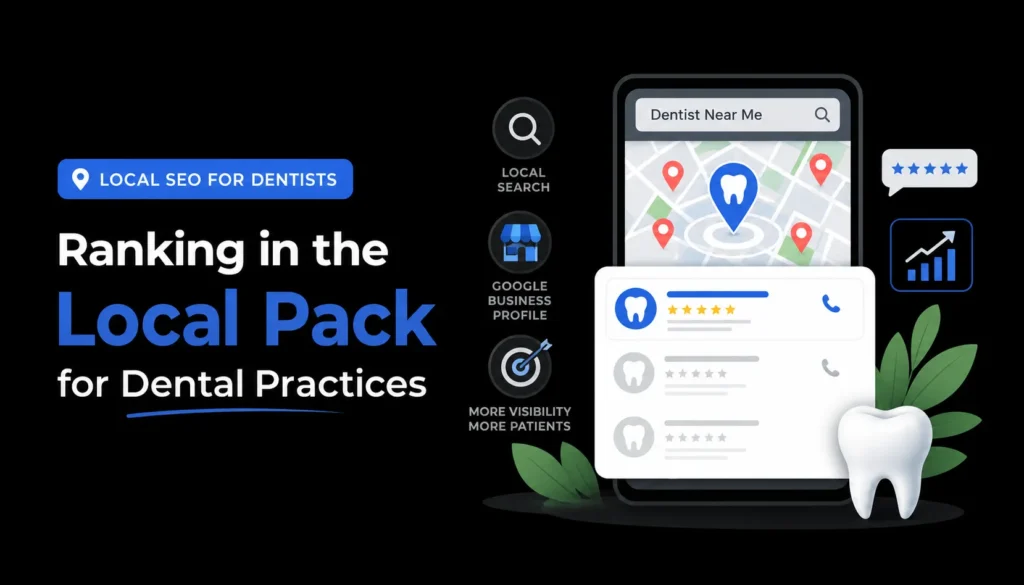
When patients need a dentist, they search locally. Queries like “dentist near me,” “dental clinic in [neighborhood],” and “emergency dentist open now” are some of the highest-intent searches in all of local SEO. Local SEO for dentists is the practice of making sure your dental clinic appears in the Google local pack, Google Maps, and local organic results when patients in your area search for dental care. While our broader SEO for dentists guide covers the full strategy, this guide focuses specifically on the local ranking factors that determine whether your practice shows up when it matters most.
TL;DR: Local SEO for dentists comes down to three pillars: a fully optimized Google Business Profile, consistent NAP citations across dental directories, and a steady stream of patient reviews. Practices that nail all three consistently rank in the local pack for their target dental keywords within 3 to 6 months.
How the Google Local Pack Works for Dentists
When someone searches “dentist near me” or “dental clinic Mumbai,” Google shows a map at the top of the results with three business listings underneath. This is the local pack, and it captures the majority of clicks for local dental searches. Below the local pack, you see the local organic results, which are regular web pages that rank based on content and links.
Ranking in the local pack is governed by three factors:
- Relevance: How well your Google Business Profile matches what the patient searched for. A dentist searching for “Invisalign provider” needs your profile to mention Invisalign.
- Distance: How close your practice is to the searcher’s location or the location they specified in their search. Google prioritizes nearby practices.
- Prominence: How well-known and reputable your practice is, based on reviews, citations, backlinks, and overall online presence.
Google determines local rankings mainly through relevance, distance, and prominence. You can learn more about these factors in Google’s official guide on improving local rankings. While you cannot control distance, you can improve your practice’s relevance and prominence through an optimized Google Business Profile, patient reviews, citations, and a strong local presence.
Step 1: Claim and Optimize Your Google Business Profile
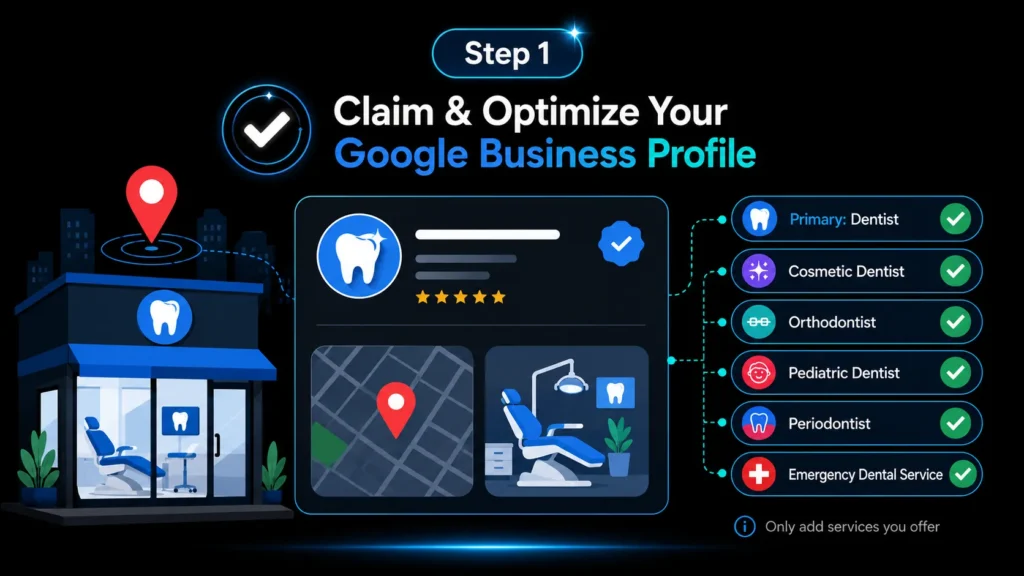
Your Google Business Profile is the single most important local SEO asset for a dental practice. If you do nothing else, do this. Here is how to optimize it for local dental searches:
Choose the Right Categories
Your primary category should be “Dentist.” This is the most important single field on your profile. If you offer specialized services, add secondary categories:
- Cosmetic Dentist
- Orthodontist
- Pediatric Dentist
- Periodontist
- Emergency Dental Service
Do not add categories for services you do not offer. Google penalizes misleading categories.
Write a Keyword-Rich Description
Your business description has 750 characters. Use them wisely. Naturally mention your key treatments and your location. For example: “MoxSEO Dental Clinic in Bandra West offers dental implants, Invisalign, teeth whitening, cosmetic dentistry, and emergency dental care. Serving patients across Mumbai since 2015.”
Follow Google’s Google Business Profile guidelines to avoid violations like keyword stuffing, promotional language, or listing services in the description that belong in the services section.
Complete Every Field
Google uses profile completeness as a ranking signal. Fill out:
- Business hours (including special hours for holidays)
- Phone number and website URL
- Service areas (neighborhoods and cities you serve)
- Services list with descriptions and pricing
- Attributes (wheelchair accessible, accepts new patients, offers online booking)
- Photos (office, team, treatment rooms, before-and-after results)
Use GBP Posts Regularly
Google Business Profile posts appear in your listing and signal that your practice is active. Post at least twice a month about:
- New treatments or technology
- Seasonal offers (e.g., teeth whitening before Diwali)
- Educational tips (e.g., “5 foods that damage enamel”)
- Practice updates and team news
Step 2: Build Consistent NAP Citations
NAP stands for Name, Address, Phone number. Google cross-references your NAP across the web to verify your practice information. If your phone number is different on Justdial than it is on Google, Google loses confidence in your listing and your rankings drop.
First, establish your canonical NAP. This is the exact practice name, address, and phone number you will use everywhere. Then, list your practice on these directories:
General Directories
- Google Business Profile
- Justdial
- Sulekha
- IndiaMART (if applicable)
- Bing Places for Business
- Apple Maps Connect
Healthcare-Specific Directories
- Practo
- Lybrate
- DocPrime
- Your state dental council directory
- Indian Dental Association member directory
Local Directories
- Your local chamber of commerce
- Local business associations
- Neighborhood community websites
- Local newspaper business directories
Check each listing to ensure your NAP matches your canonical version exactly. Same spelling, same phone number format, same address format. For a broader guide on local SEO citations, see our local SEO company guide.
Step 3: Generate Patient Reviews Consistently
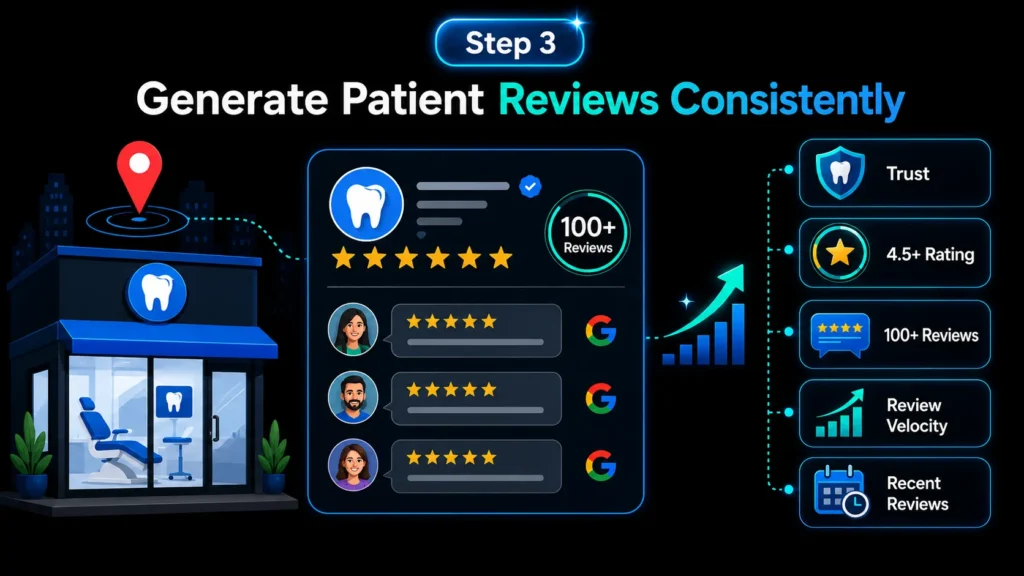
Reviews are the second most important local SEO factor after your Google Business Profile. For dental practices, reviews matter doubly because patients are choosing a healthcare provider and trust is paramount.
How Many Reviews Do You Need?
There is no magic number, but in competitive markets, practices in the local pack typically have 100+ reviews with a 4.5+ average rating. More important than total count is review velocity, the rate at which you get new reviews. Google values recent reviews more than old ones.
How to Get More Dental Reviews
- Ask in person: Train your front desk staff to ask every satisfied patient for a review before they leave. The in-person ask has the highest conversion rate.
- Send a follow-up SMS: Text a direct link to your Google review page 2 hours after the appointment. Include a brief thank-you message.
- Send an email follow-up: For patients who prefer email, send a review request with a direct link within 24 hours of their visit.
- Display QR codes: Place a QR code in your waiting room that links directly to your Google review page.
- Automate the process: Use dental practice management software that sends automated review requests after each appointment.
How to Respond to Reviews
Respond to every review, positive and negative. For positive reviews, thank the patient by name and mention their treatment. For negative reviews, apologize professionally, offer to resolve the issue, and invite the patient to contact the practice directly. Never share protected health information in a review response. Google’s review response guidelines apply to all businesses, but healthcare practices should be especially careful.
Step 4: Optimize Your Website for Local Dental Searches
Your website is the second half of local SEO. While your Google Business Profile controls the local pack, your website controls the local organic results. Here is what to optimize:
Add Location Pages
If you serve multiple neighborhoods or cities, create a dedicated landing page for each location. For example:
- /dentist-bandra-west/
- /dentist-andheri/
- /dentist-juhu/
Each page should include the neighborhood name in the title tag, H1, and content, along with directions, parking info, and location-specific details.
Add Local Business Schema
Structured data helps Google understand your practice information. Add LocalBusiness or Dentist schema to your website with your NAP, hours, services, and geo-coordinates. See our schema markup guide for implementation details.
Embed a Google Map
Embed a Google Map of your practice location on your contact page and location pages. This reinforces your geographic relevance.
Optimize Title Tags for Local Keywords
Your homepage title tag should include your practice name and location: “Dentist in Bandra West | MoxSEO Dental Clinic.” Each treatment page should follow the same pattern: “Dental Implants in Bandra West | MoxSEO Dental Clinic.”
Step 5: Build Local Backlinks
Backlinks from local websites signal to Google that your practice is an established part of the community. For dental practices, good local backlink sources include:
- Local news websites (offer to write a dental health column)
- Local schools and community organizations (sponsor events or offer free dental checkups)
- Nearby businesses (cross-promote with orthodontists, pharmacies, or gyms)
- Local dental associations and professional bodies
- Local business directories and chambers of commerce
For a complete link building strategy, see our link building strategies guide.
Tracking Your Local SEO Performance
Track these metrics to measure your local SEO progress:
- Local pack rankings: Track your position in the local pack for your target keywords using a local rank tracker
- Google Business Profile insights: Monitor search queries, calls, direction requests, and website clicks from your GBP dashboard
- Review count and rating: Track total reviews, average rating, and review velocity month over month
- Organic traffic to location pages: Use Google Search Console to track impressions and clicks for location-specific pages
Want to Improve Your Dental Clinic’s Local Visibility?
A strong dental local SEO strategy connects your Google Business Profile, patient reviews, directory listings, location pages, and local backlinks. The right improvements depend on your clinic’s location, competition, services, and current search presence.
Explore our local SEO services or request a review of your clinic’s local visibility to identify the areas that need attention.
Frequently Asked Questions
How long does local SEO take for dentists?
A newly optimized Google Business Profile can appear in local results within 2 to 4 weeks. Reaching the top 3 of the local pack in a competitive market typically takes 3 to 6 months of consistent optimization, review generation, and citation building. Established practices with existing profiles can see improvements faster.
What is the most important local SEO factor for dentists?
Your Google Business Profile is the most important factor, specifically your primary category, profile completeness, and review count. After that, consistent NAP across dental directories and location-optimized website content are the next most impactful factors.
How many reviews do I need to rank in the local pack?
There is no fixed threshold, but in most competitive markets, practices in the local pack have at least 100 reviews with a 4.5 or higher average rating. More important than the total is getting new reviews consistently. Five reviews per week every week is better than 50 reviews in one week and none for months.
Can I rank in the local pack for multiple locations?
You can rank in the local pack for any area where you have a verified Google Business Profile with a physical address. If you have multiple clinic locations, create a separate GBP for each. If you serve an area without a physical office, you can still rank in local organic results with a dedicated location landing page, but you will not appear in the local pack for that area.
Should I hire an agency for dental local SEO?
You can handle GBP optimization, review requests, and basic citations yourself. However, competitive local markets often require professional help with schema markup, backlink building, and ongoing rank tracking.
Related guides in Local SEO
- Local SEO for Lawyers: A Complete Guide to Ranking in Your City
- Local SEO for Plumbers: How to Get More Service Calls from Google
- Local SEO for Restaurants: A Complete Guide for Restaurant Owners
- Local SEO for Small Businesses: A Practical Guide to More Local Customers
- Local SEO Guide: How to Rank Your Business in the Local Pack (2026)
Need this handled for you? Explore our Local SEO service.

Yash Narayan is an SEO Associate at MoxSEO with 3 years of experience in keyword research, on-page SEO, content optimization, competitor analysis, and website performance monitoring. He focuses on improving organic visibility, identifying ranking opportunities, and creating search-friendly content that attracts relevant traffic. Through data-driven analysis and consistent optimization, Yash helps businesses strengthen their search presence and achieve sustainable digital growth.