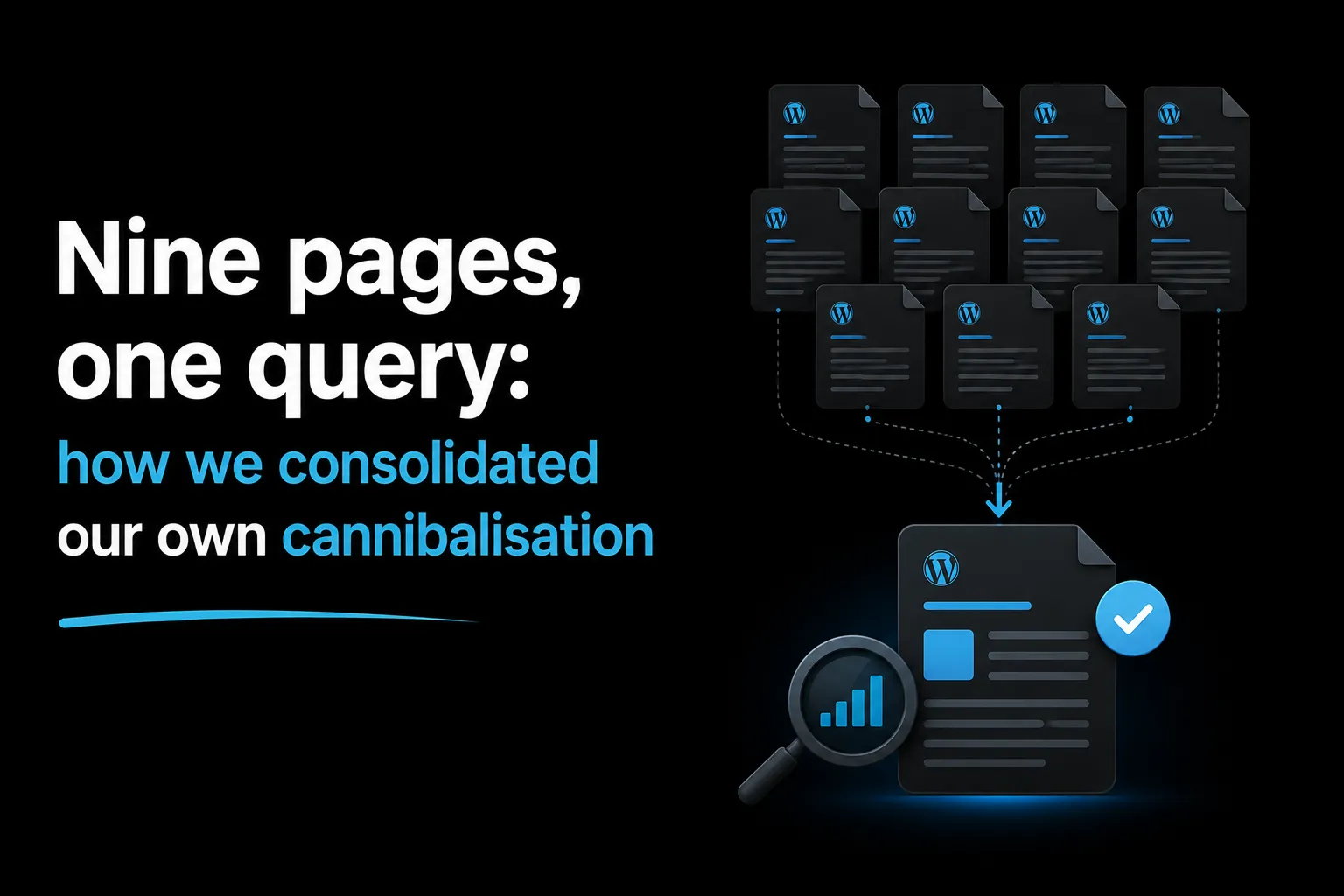
In July we published 95 posts. Auditing our own site afterwards, we found 48 of them competing with each other across 22 clusters. Eleven were merged. This is what that looked like from the inside, including the parts that do not reflect well on us.
How it happened
Not through carelessness exactly, but through volume outrunning oversight. Posts were commissioned by keyword. Nobody was holding the full list in their head, so SEO expert India, best SEO expert in India, top SEO experts in India, SEO consultant India, hire SEO experts India and SEO freelancer India all became separate articles.
Each was defensible in isolation. Together they were one intent split six ways, with our own pages as the only competition.
The clearest single example: two posts on best digital marketing agency in India, both over 3,200 words, published nine days apart.
How we decided what to merge
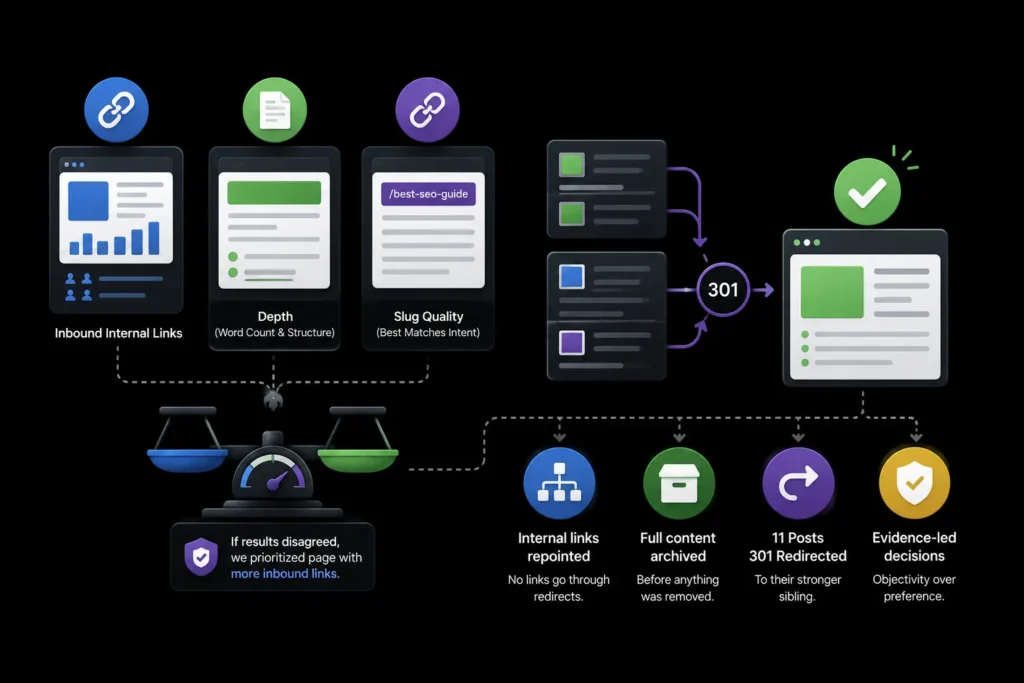
Not by which we liked. By evidence available at the time.
- Inbound internal links — which page the site already treated as primary
- Depth — word count and section structure
- Slug quality — which URL best matched the intent
Where those disagreed we kept the page with more inbound links, on the reasoning that internal linking reflects accumulated editorial judgement rather than a single decision.
Eleven posts were 301 redirected into their stronger sibling. Internal links were repointed so nothing routes through a redirect. Full content was archived before anything was removed.
What we would do differently
The honest answer is that the volume itself was the mistake, not the execution.
- One page per intent, decided before commissioning rather than after publishing
- A running list of covered intents that anyone briefing content has to check
- Publish, then measure, then decide what is missing — rather than deciding everything upfront
- Fewer, longer, better-supported pages
You can check your own site for this with our internal link finder. Page pairs sharing many distinctive terms with no link between them are usually either a missing link or a merge candidate.
What we still do not know
We consolidated on internal signals because performance data was not yet available for those posts. That is a real limitation and we would rather state it than imply more rigour than we had.
If the data later shows we kept the weaker page in some cluster, the redirects can be reversed — the sources were archived, not deleted.
We will publish the outcome either way. That is the point of keeping a corrections log.
How to tell cannibalisation from legitimate coverage
Not every pair of similar pages is a problem. Two pages can cover adjacent ground and both deserve to exist. The distinction is intent, not topic.
- Legitimate — a guide explaining how something works, and a service page for people ready to buy
- Legitimate — a broad overview and a deep dive on one component of it
- Cannibalisation — two pages answering the same question for the same reader
- Cannibalisation — the same intent split across synonyms: services, agency, company, consultant
The test we now apply before commissioning anything: could you explain to a reader, in one sentence, why both pages exist? If not, it is one page.
Confirming it in Search Console
Internal signals suggest cannibalisation. Search Console confirms it, and the confirmation is worth having before you merge anything irreversible.
- Filter by the query, then look at the Pages tab. Several of your URLs appearing is the signal.
- Look for position instability. A query where the ranking URL keeps changing is the classic symptom.
- Compare impressions. Two pages each getting a fraction of what one could get is the cost, made visible.
We consolidated on internal signals because performance data was not yet available for those posts. That was a limitation, not a preference, and we said so at the time rather than after.
Merging without losing what the pages earned
The mechanics matter, because a careless merge throws away the value you were trying to consolidate.
- Move the unique content across before redirecting. Anything the weaker page said better belongs in the survivor.
- 301, never delete. A deleted page discards its links and history entirely.
- Repoint internal links so nothing routes through the redirect.
- Update the sitemap so merged URLs are no longer listed.
- Archive the original so the decision is reversible if the data later disagrees.
That last point is the one people skip and later regret. We archived all eleven merged posts in full — content, metadata and categories — specifically so that a wrong call could be undone rather than argued about.
Fix Keyword Cannibalisation Without Losing Existing SEO Value
Merging overlapping pages requires more than selecting one URL and redirecting the others. The surviving page should preserve the strongest content, internal links, metadata, backlinks, and search intent covered across every competing URL. Without a clear consolidation plan, you may remove useful information, weaken topical relevance, or lose authority the original pages have already earned.
If several pages are ranking for the same queries, MoxSEO can review the competing URLs and identify which page should remain. You can get a free SEO audit to uncover keyword overlap, conflicting search intent, weak internal linking, and pages that may need to be merged.
Once the primary page is selected, the process may involve transferring valuable content, implementing 301 redirects, repointing internal links, updating the sitemap, and monitoring performance after consolidation. If you want to discuss your findings before making irreversible changes, schedule an SEO consultation for a practical consolidation plan based on your website’s current structure.
Frequently asked questions
How do I know if two pages are cannibalising?
If they target the same intent and you cannot explain to a reader why both exist, they are competing. Search Console showing both rotating for one query is confirmation.
Should I merge or just delete the weaker page?
Merge and redirect. Deleting discards any links and history the page accumulated.
Does merging always help?
Not always. If two pages genuinely serve different intents, merging makes one page that serves neither well.
How long before merging shows an effect?
Usually weeks. The redirect is honoured quickly; consolidation of signals takes longer.

Ashish Khan is an SEO Specialist at MoxSEO with expertise in keyword research, on-page optimization, technical SEO, content strategy, and link building. He focuses on improving website visibility, strengthening search performance, and helping businesses attract relevant organic traffic. By combining competitor analysis, SEO audits, and data-driven optimization, Ashish supports sustainable ranking growth and stronger digital presence.