





AI is changing how people discover information online. Google AI Overviews and AI Mode can summarize information from multiple sources, while platforms such as ChatGPT, Gemini, and Perplexity allow users to ask detailed questions without using traditional search queries.
This change does not mean traditional SEO is dead. Search engines still need to crawl, index, understand, evaluate, and retrieve website content. Technical SEO, helpful content, internal links, page experience, authority, and backlinks remain important.
What has changed is how information may be presented.
Instead of only competing for a blue-link ranking, businesses now need to consider whether their content can be understood, extracted, referenced, and recommended within an AI-generated answer. That requires a broader AI SEO optimization strategy.
This guide explains what AI SEO optimization means, how it relates to AEO and GEO, and what you can do to improve visibility across traditional and AI-powered search experiences.
TL;DR: AI SEO optimization means improving your website so search engines and answer engines can easily crawl, understand, evaluate, retrieve, and reference its content. The strongest strategy combines technical SEO, complete topic coverage, clear page structure, accurate structured data, original evidence, consistent brand information, strong E-E-A-T signals, and measurable business outcomes.
What Is AI SEO Optimization?
AI SEO optimization is the process of improving a website’s technical foundation, content, authority, and entity signals so it can perform across traditional search results and AI-generated search experiences.
The objective is not simply to insert more keywords or make every paragraph shorter. It is to help search systems understand:
- What the page is about
- Which question it answers
- Who created the information
- Why the source should be trusted
- Which claims are supported by evidence
- How the page relates to the rest of the website
- Whether the information is current and accurate
Google has clarified that its generative search features are connected to its existing Search index, ranking systems, and quality systems. A page must still be accessible, indexed, and eligible to appear in Search before it can be considered for generative search experiences.
AI SEO should therefore be treated as an extension of SEO rather than a replacement for it.
AI SEO vs Traditional SEO, AEO and GEO
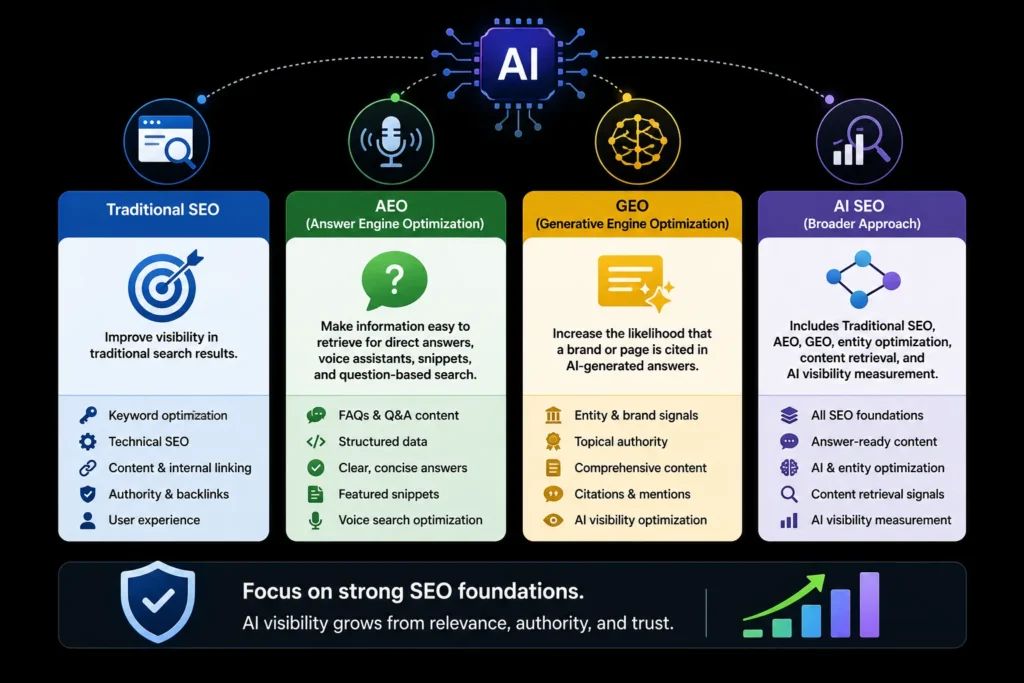
Image Source: AI-generated visual by MoxSEO
Several terms are now used to describe optimization for AI-driven discovery.
Traditional SEO focuses on improving visibility in conventional search results through technical optimization, content, internal linking, authority, and user experience.
Answer Engine Optimization, or AEO, focuses on making information easy to retrieve for direct answers, voice assistants, featured snippets, and question-based search experiences.
Generative Engine Optimization, or GEO, focuses on increasing the likelihood that a brand or page will be represented in AI-generated answers.
AI SEO is a broader term that can include traditional SEO, AEO, GEO, entity optimization, content retrieval, and AI visibility measurement.
These areas overlap. Google’s official position is that optimizing for generative AI features in Google Search remains part of SEO because those experiences rely on its core Search systems.
The practical lesson is simple: do not abandon proven SEO foundations to chase unsupported AI-search hacks.
How AI Is Changing Search Behaviour
Traditional search often starts with a short phrase such as “best accounting software.” AI-assisted search allows users to ask more detailed questions, such as:
What accounting software is suitable for a ten-person agency that needs recurring billing, expense management, and integration with a UK bank?
These conversational searches contain multiple needs, conditions, and comparison criteria.
AI-powered search experiences can break complex questions into subtopics, retrieve supporting information, and generate a combined response. This means a page may be valuable even when it does not provide the entire answer. A strong section, comparison table, definition, statistic, or original example may support one part of the response.
AI search is also changing how SEO success should be measured. Visibility may come through:
- A conventional organic result
- An AI Overview citation
- An AI Mode source link
- A product or local-business result
- A brand mention in an answer engine
- A citation in ChatGPT or Perplexity
- Increased branded searches after an AI mention
- An assisted conversion rather than a direct visit
Businesses therefore need to optimize both for rankings and for accurate representation across search experiences.
Read More About: WordPress SEO Checklist: 32 Steps to Improve Rankings in 2026
Step 1: Build a Crawlable and Indexable Technical Foundation
Content cannot perform in AI search if search engines cannot reliably access and index it.
Before changing headings or adding schema, check the technical foundation of the website.
Important areas include:
- Crawlable URLs
- Correct indexation directives
- Canonical tags
- Valid HTTP status codes
- XML sitemaps
- Mobile usability
- Internal links
- JavaScript rendering
- Duplicate content
- Page speed
- Core Web Vitals
- Accessible main content
- Image and video discoverability
Avoid accidentally blocking important pages through robots.txt, noindex directives, authentication requirements, or incorrect canonical tags.
You should also review snippet controls. Tags and attributes such as nosnippet, max-snippet, and data-nosnippet can affect how Google uses page content in search presentations.
Technical eligibility does not guarantee inclusion in AI-generated results, but it creates the foundation required for consideration.
Step 2: Match the Complete Search Intent
AI search systems do more than match an exact phrase. They evaluate the meaning, context, and likely objective behind a query.
Instead of building a page around one keyword, identify the different questions a searcher may need answered.
For example, a person researching AI SEO may want to know:
- What AI SEO means
- How it differs from traditional SEO
- Whether schema helps
- How to appear in AI Overviews
- Whether AI-written content can rank
- Which tools track AI citations
- How much an AI SEO service costs
- How long improvements take
- How results should be measured
Not every page must answer every possible question. However, the page should fully satisfy its primary intent and cover the most relevant supporting needs.
Avoid adding unrelated sections merely to increase word count. Comprehensive content is not content that says everything. It is content that provides the right depth for the target audience and query.
Step 3: Structure Content for Easy Understanding
Clear structure helps readers navigate the page and allows search systems to identify important passages.
Use one descriptive H1 that accurately summarizes the page. Organize major topics under meaningful H2 headings and use H3 headings for supporting details.
Each important section should ideally contain:
- A descriptive heading
- A direct opening answer
- A useful explanation
- Supporting evidence or an example
- Relevant limitations or conditions
When a heading asks a question, answer it immediately.
For example:
Does structured data improve AI visibility?
Structured data can help search engines understand specific page entities and attributes, but it does not guarantee rankings, rich results, or citations in AI-generated answers.
This format is more useful than delaying the answer with several introductory paragraphs.
Lists and tables can also improve clarity when presenting steps, features, comparisons, requirements, or data. However, they should be used because they suit the information—not because AI systems supposedly prefer every answer in bullet form.
Step 4: Cover Entities and Their Relationships
Semantic SEO is not simply adding synonyms or so-called LSI keywords.
Search systems need to understand the entities discussed on a page and how they relate to each other.
For example, an AI SEO article may establish relationships such as:
- AI Overviews are a Google Search feature.
- Search Console measures Google Search performance.
- Structured data describes page entities and attributes.
- The author created or reviewed the article.
- The organization publishes the website.
- A service page explains a commercial offering.
- A case study demonstrates first-hand experience.
Use consistent terminology throughout the website. Avoid referring to the same service by several conflicting names unless the terms genuinely have different meanings.
Clear entity relationships can be reinforced through page copy, internal links, author pages, organization details, breadcrumbs, and appropriate structured data.
Step 5: Use Accurate Structured Data
Structured data is standardized markup that gives search engines explicit information about a page and the entities represented on it. Google can use supported structured data to understand content and determine eligibility for certain search appearances.
Use schema that accurately matches the visible page.
Relevant types may include:
Articlefor blog and editorial contentOrganizationfor company informationPersonorProfilePagefor author informationBreadcrumbListfor page hierarchyProductfor eligible product pagesLocalBusinessfor relevant local businessesVideoObjectfor pages containing original videosServicewhere it accurately describes an offered service
For Article markup, useful properties may include the headline, author, publication date, modified date, image, and publisher. Article structured data can help Google understand article information, but it does not guarantee an enhanced appearance.
Be careful with FAQ schema. FAQPage markup does not regularly produce visible FAQ rich results for ordinary business websites. Google currently limits that search appearance mainly to authoritative government and health websites.
Structured data should clarify content that already exists on the page. Do not mark up invisible, misleading, irrelevant, or fabricated information.
After implementation, test the page with Google’s Rich Results Test and inspect the URL in Search Console.
Step 6: Strengthen E-E-A-T Signals
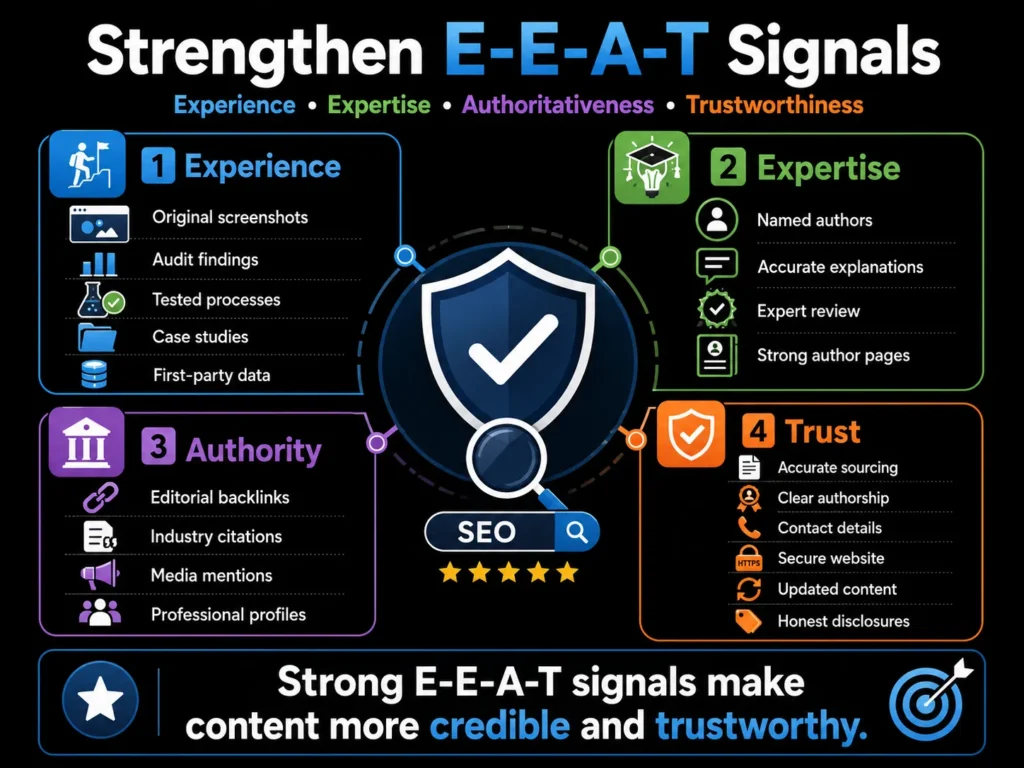
Image Source: AI-generated visual by MoxSEO
E-E-A-T stands for Experience, Expertise, Authoritativeness, and Trustworthiness.
It is not a single Google ranking factor or a score that can be increased by installing a plugin. It is a useful framework for evaluating whether content appears credible, useful, and trustworthy. Google says E-E-A-T itself is not a specific ranking factor, although its systems use multiple signals associated with strong E-E-A-T.
Demonstrate experience
Show evidence that the creator has actually used, tested, researched, or implemented what the page discusses.
This can include:
- Original screenshots
- Audit findings
- Tested processes
- Before-and-after examples
- Client case studies
- First-party data
- Practical lessons from failed approaches
Demonstrate expertise
Use named authors with relevant experience. Explain technical concepts accurately and add expert review where the subject requires specialist knowledge.
An author box containing only a name and image is weak evidence. A useful author page should explain the person’s role, expertise, experience, relevant work, and other publications.
Build authority
Authority is strengthened through recognition beyond your own website.
Relevant signals may include:
- Editorial backlinks
- Industry citations
- Expert contributions
- Conference participation
- Reputable directory listings
- Media mentions
- Branded search demand
- Consistent professional profiles
Prioritize trust
Trust is especially important for financial, health, legal, and safety-related topics.
Support trust through:
- Accurate sourcing
- Clear authorship
- Transparent business information
- Contact details
- Editorial standards
- Correction policies
- Secure website connections
- Updated content
- Honest commercial disclosures
Step 7: Create Evidence-Based, Citation-Friendly Content
AI systems do not need another rewritten version of information that already appears on hundreds of websites.
To create content worth referencing, add information that is specific, verifiable, and useful.
Strong evidence can include:
- Original research
- Internal data
- Surveys
- Experiments
- Screenshots
- Expert commentary
- Case studies
- Detailed comparisons
- Templates
- Checklists
- Tested recommendations
Place sources close to the claims they support. Prioritize primary sources, including official documentation, original studies, regulatory publications, first-party product information, and direct company disclosures.
Add dates and relevant context to time-sensitive information. A statistic without a study period, market, methodology, or source may be difficult to trust.
Be direct, but do not confuse confidence with accuracy. Many SEO answers depend on the website, competition, industry, audience, and query.
A better content pattern is:
Give the direct answer first, explain the evidence, and then state the limitations.
Step 8: Build Topic Clusters and Internal Links
AI SEO is not limited to optimizing individual articles.
A website is easier to understand when it contains a coherent set of pages covering a subject from different angles.
An AI SEO topic cluster could contain:
- AI SEO services
- AI SEO optimization guide
- AI SEO audit
- AI Overviews optimization
- GEO vs SEO
- Answer Engine Optimization
- AI citation tracking
- Structured data for AI search
- AI content quality
- ChatGPT brand visibility
- AI SEO case studies
Each supporting page should target a distinct intent and link naturally to the relevant pillar or service page.
Avoid creating several articles that answer the same question with minor wording changes. This can cause keyword cannibalization, create thin content, and weaken the website’s topical structure.
Use descriptive internal-link anchor text that tells readers what they will find after clicking. Avoid forcing the same exact-match keyword into every link.
Step 9: Strengthen Brand and Entity Consistency
AI visibility is also influenced by how clearly a company is represented across its own website and the wider web.
Make important business information consistent:
- Business name
- Service descriptions
- Website address
- Contact details
- Founder and team names
- Social profiles
- Location information
- Industry positioning
- Author biographies
Create a useful About page, service pages, team profiles, contact page, and relevant policy pages.
Organization and Person structured data can reinforce these relationships, but markup should support clear visible information rather than replace it.
Third-party mentions can also help systems understand what a business does. Focus on genuine editorial coverage, partnerships, industry contributions, reviews, case studies, and expert commentary. Google warns that chasing inauthentic mentions or unsupported AI-search shortcuts is not a useful substitute for high-quality content and real reputation.
Step 10: Optimize for AI Overviews and Answer Engines
There is no guaranteed formula for earning an AI Overview citation.
The strongest approach is to improve the overall usefulness, accessibility, accuracy, and differentiation of the page.
Focus on:
- Directly answering the target question
- Covering relevant sub-intents
- Using clear headings
- Publishing original evidence
- Supporting claims with reliable sources
- Maintaining technical accessibility
- Building relevant internal links
- Demonstrating genuine expertise
- Keeping time-sensitive information current
- Creating useful images and videos where appropriate
Do not create special AI markup, Markdown versions, or an llms.txt file solely to appear in Google’s generative search features. Google states that these additions are not required for inclusion in its AI search experiences.
Featured-snippet formatting can improve clarity, but an AI-generated answer may retrieve information from a wider range of sources. Optimize the complete page and supporting website structure rather than chasing only one paragraph or answer box.
Step 11: Use AI Responsibly in Your SEO Workflow
AI tools can improve the speed of SEO research and production, but they should not replace judgement, verification, or subject expertise.
AI can assist with:
- Generating keyword hypotheses
- Grouping related queries
- Summarizing recurring topics
- Creating initial content outlines
- Finding content gaps
- Suggesting internal links
- Drafting schema markup
- Identifying claims that need sources
- Reviewing readability
- Finding potentially outdated passages
Human review is still necessary to:
- Confirm search intent
- Inspect actual search results
- Verify facts
- Add original experience
- Check source quality
- Remove fabricated statements
- Refine brand positioning
- Approve strategic recommendations
Google does not prohibit AI-assisted content merely because AI was involved. The issue is whether the content is useful and created for people. Producing large volumes of unoriginal, low-value pages primarily to manipulate rankings may violate Google’s scaled content abuse policy, regardless of whether the pages were created by AI, humans, or both.
Step 12: Measure AI Search Performance
AI visibility should not be measured using rankings alone.
Use several measurement layers.
Google Search performance
Track:
- Organic clicks
- Impressions
- Click-through rate
- Average position
- Query groups
- Landing-page performance
- Indexed-page changes
Google introduced dedicated generative AI performance reporting in Search Console in June 2026. Eligible properties can use it to review impressions from features such as AI Overviews and AI Mode, including page, country, and device dimensions. Access may depend on the report’s rollout and whether the property has eligible data.
External answer-engine visibility
Monitor how your business appears in ChatGPT, Gemini, Perplexity, and other relevant platforms.
Review:
- Brand mentions
- Linked citations
- Unlinked mentions
- Competitor mentions
- Accuracy of business descriptions
- Sentiment
- Visibility across target prompt categories
Because outputs can vary by user, location, model, session, and wording, do not rely on one manually tested prompt.
Business outcomes
Connect search visibility to:
- Qualified leads
- Consultation requests
- Product enquiries
- Newsletter sign-ups
- Assisted conversions
- Branded searches
- Revenue
- Customer acquisition cost
An AI mention has limited value if it does not contribute to awareness, trust, engagement, or conversions.
Common AI SEO Mistakes to Avoid
Publishing unverified AI output
AI-generated drafts can contain factual errors, invented sources, repetitive language, and generic advice. Verify every important claim before publishing.
Treating schema as a ranking shortcut
Structured data can clarify information, but it does not guarantee rankings, rich results, or AI citations.
Ignoring technical SEO
Helpful content still needs to be crawled, rendered, indexed, and internally connected.
Creating multiple pages for the same intent
Thin variations of one topic can cause cannibalization and dilute authority.
Using vague author profiles
A name and stock image do not demonstrate expertise. Show genuine experience and relevant qualifications.
Adding unnecessary freshness updates
Do not change a date without making meaningful improvements. Update content when facts, tools, regulations, statistics, products, or recommendations have changed.
Tracking mentions without conversions
Visibility is useful, but SEO performance should ultimately support measurable business objectives.
Turn AI Search Visibility Into Sustainable Growth
AI search is no longer an experimental channel. It is becoming a core part of how people research services, compare providers, evaluate solutions, and make buying decisions.
Businesses that rely only on traditional keyword rankings may gradually lose visibility as search experiences become more conversational, selective, and answer-driven. The opportunity is to build content that performs across both environments.
That means making your website technically accessible, structuring content clearly, strengthening E-E-A-T signals, publishing original evidence, using accurate schema, improving internal links, and creating pages that directly answer the questions your audience is asking.
MoxSEO helps businesses prepare for this shift with a complete AI SEO strategy built around visibility, authority, and measurable growth. From technical AI-search audits and content optimization to entity improvement, citation-gap analysis, structured data, and performance tracking, every part of the strategy is designed to improve how your brand is discovered and represented.
Do not wait until competitors become the default sources cited across AI Overviews and answer engines.
Explore MoxSEO’s AI SEO services or request a consultation to build a stronger presence across Google Search, AI Overviews, AI Mode, ChatGPT, Gemini, Perplexity, and other emerging discovery platforms.
Frequently Asked Questions About AI SEO Optimization
Is AI SEO the same as GEO?
GEO is generally focused on visibility in generative answer engines, while AI SEO is a broader term that includes traditional search, generative search, technical SEO, entities, authority, and measurement. In practice, the strategies overlap significantly.
Does Google require special markup for AI Overviews?
No. Google says website owners do not need special AI files, new machine-readable formats, or dedicated AI markup to appear in its generative Search features. Standard technical SEO, useful content, and supported structured data remain the foundation.
Can AI-generated content rank in Google?
Yes, AI-assisted content can rank when it is helpful, accurate, original, and created for users. Using AI is not automatically a violation. Publishing low-value content at scale to manipulate rankings can violate spam policies.
Does structured data improve AI SEO?
Structured data can make page information more explicit and help search engines understand certain entities and attributes. It does not guarantee improved rankings or inclusion in AI answers.
Does FAQ schema still create rich results?
For most commercial and editorial websites, FAQ rich results are no longer displayed regularly. Google primarily limits them to authoritative government and health websites.
Related guides in AI SEO
Need this handled for you? Explore our AI SEO service.

Sakshi Kumari is an SEO Specialist at MoxSEO with expertise in keyword research, on-page SEO, content optimization, technical SEO, and link-building strategies. She focuses on improving organic visibility, strengthening website performance, and creating search-focused content that attracts relevant traffic. Through data-driven analysis and practical SEO execution, Sakshi helps businesses build stronger search presence and achieve sustainable digital growth.