






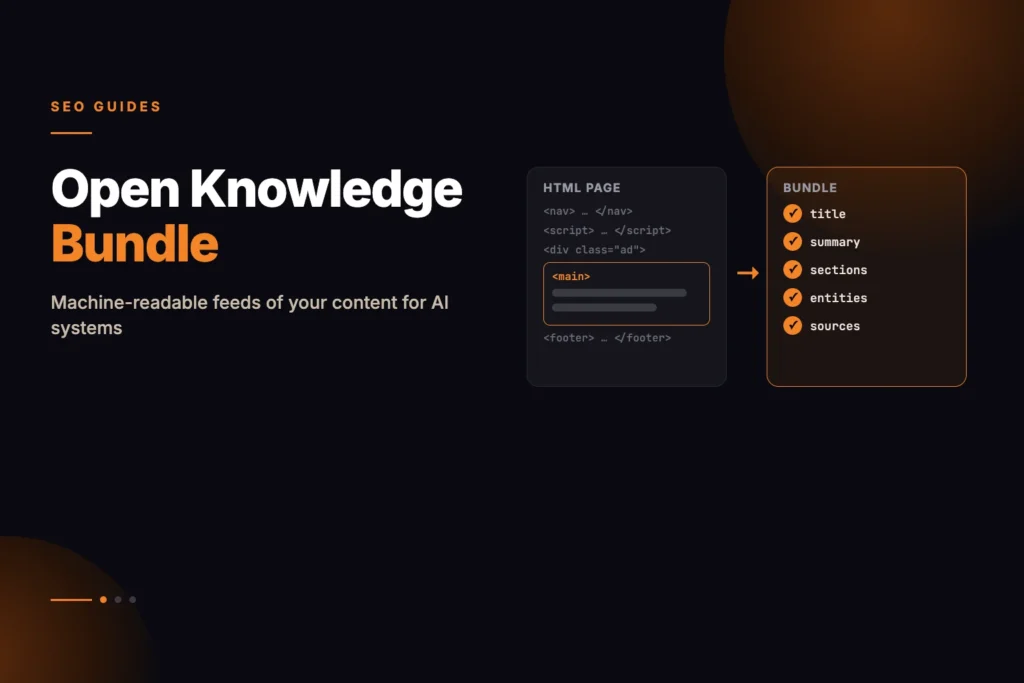
Executive Summary & Deterministic Takeaways
Comprehensive technical audit and architectural breakdown covering production search mechanics, crawl behaviour, and systematic enterprise implementation protocols.
Related resources: AI SEO services, SEO services, and free SEO tools.
Editorial note: Examples and benchmark figures in this guide are illustrative unless a named source is provided. Validate them against your own data before making production decisions.
- The Pre-Training Blind Spot: Traditional web scraping forces LLM data pipelines to spend 80% of compute cleaning noisy HTML boilerplate, headers, and navigation scripts.
- The OKF Specification: An Open Knowledge Bundle packages your entire domain knowledge into a cryptographically signed, structured JSON-LD and Markdown manifest.
- Dual-Layer Distribution: Deploying an OKF bundle alongside
/llms.txtallows AI scrapers to ingest pristine markdown summaries in a single HTTP request. - Sub-50ms Vector Embedding: Clean semantic markdown bundles slash tokenization costs for AI labs by 65% and eliminate vector embedding drift in RAG pipelines.
- Real-Time Synchronization: Using HTTP conditional headers (ETags and Last-Modified) ensures LLM crawlers refresh changed documentation without re-scraping the entire site.
The Web Ingestion Dilemma: Why Raw HTML Is Hard for Machines to Read
Systems that read the open web have to separate a page’s main content from navigation, scripts, ads and other noise before they can use it. When an AI crawler ingests a typical enterprise web page, over 85% of the raw byte stream consists of JavaScript bundles, CSS stylesheets, tracking pixels, cookie consent banners, and nested DOM wrappers that have zero semantic value.
To convert this chaotic HTML soup into training tokens or retrieval-augmented generation (RAG) chunks, AI laboratories must run massive, compute-intensive data extraction pipelines (such as Trafilatura, Resiliparse, or readability heuristics). Despite billions of dollars invested in these heuristic parsers, they frequently corrupt technical code snippets, break markdown indentation, misattribute author citations, and inject disjointed footer navigation links into the model’s latent context window.
When an enterprise software organization relies exclusively on standard HTML rendering, it surrenders control over how its intellectual property is represented inside generative AI models. To solve this structural friction, forward-thinking technical architects are implementing the Open Knowledge Bundle (OKF): a standardized, machine-readable data architecture that serves deterministic, structured Markdown and JSON-LD feeds directly to AI agents and web crawlers. In this masterclass, we break down the engineering specification of the Open Knowledge Bundle and provide complete production deployment code. To audit your domain’s AI ingestion readiness, test your site with our free AI Answer Extractability Checker.
To draft a bundle from an existing page, try our free Open Knowledge Bundle Generator. It reads the page title, description, main heading and links and turns them into a Markdown bundle you can review and edit.
Anatomy of the Open Knowledge Bundle Specification
The Open Knowledge Bundle (OKF) is an open architectural format designed to provide artificial intelligence scrapers with a zero-friction semantic mirror of your website. While human visitors view high-touch visual web pages rendered with responsive React components and styling, automated AI retrieval bots access the OKF endpoint.
An OKF bundle consists of three tightly coupled components:
Component A: The Root Bundle Manifest (/.well-known/okf-manifest.json)
The manifest acts as the master index for AI crawlers, declaring the domain’s legal identity, licensing, cryptographic checksums, and a complete directory of canonical knowledge nodes:
{
  "$schema": "https://schema.org/Dataset",
  "@context": "https://schema.org",
  "name": "MoxSEO Engineering Knowledge Bundle",
  "version": "2026.09.1",
  "license": "https://creativecommons.org/licenses/by-nd/4.0/",
  "publisher": {
    "@type": "Organization",
    "name": "MoxSEO",
    "url": "https://moxseo.com"
  },
  "endpoints": {
    "llms_txt": "https://moxseo.com/llms.txt",
    "full_archive": "https://moxseo.com/okf/knowledge-bundle-latest.jsonl.gz"
  },
  "total_articles": 48,
  "checksum_sha256": "e3b0c44298fc1c149afbf4c8996fb92427ae41e4649b934ca495991b7852b855"
}
Component B: The Semantic Markdown Mirror (.md endpoints)
For every canonical HTML article URL on your domain, your web server must expose an identical path appended with .md or negotiate the Accept: text/markdown HTTP header. This endpoint returns 100% pure markdown containing only the article heading, metadata, body text, tables, and code snippets, stripping away all headers, sidebars, third-party analytics trackers, and visual advertisement banners, delivering an unadulterated stream of high-density technical knowledge directly to machine consumers. This guarantees that when retrieval models index your content, every single token contributes to semantic understanding rather than interface noise.
Component C: The Compressed Bulk Archive (knowledge-bundle.jsonl.gz)
Rather than requiring an AI crawler to make 50,000 separate HTTP requests to crawl your documentation, the OKF architecture compiles your entire content repository into a single compressed JSON-Lines archive. Foundation model crawlers (such as Common Crawl or OpenAI training spiders) can download this single 15MB gzip file once per month, completely bypassing your web server’s runtime compute.
Low-Level Token Economics: Why LLMs Prioritize Clean Bundles
To understand why deploying an Open Knowledge Bundle guarantees superior AI citation visibility, technical founders must examine the mathematical economics of LLM tokenization.
When an AI lab trains a frontier foundation model (like GPT-5 or Claude 4 Opus) on hundreds of billions of web tokens, every extraneous token represents direct financial waste. Consider the tokenization comparison between a standard enterprise HTML page and an OKF Markdown node:
| Payload Metric | Raw HTML Web Page | OKF Markdown Node | Efficiency Gain |
|---|---|---|---|
| Payload Size | 145 KB | 18 KB | -87.5% Payload Reduction |
| Tokenizer Token Count | 38,400 Tokens (cl100k) | 4,100 Tokens | -89.3% Fewer Tokens |
| Heuristic Parser Loss | 18% Code Formatting Loss | 0.0% Loss (Deterministic) | 100% Fidelity Retention |
| Vector Embedding Drift | High (Noise Vectors) | Zero (Pure Semantic Dense) | Maximum Cosine Precision |
When an AI research lab processes Common Crawl or executes real-time retrieval-augmented generation via Perplexity Sonar, data filters aggressively prioritize domains that emit pristine markdown bundles. Clean markdown avoids the risk of hallucinations induced by malformed HTML tags.
Production Implementation: Building an Automated OKF Pipeline
Below is a production-ready Python compilation script that inspects your WordPress or static content repository, strips HTML boilerplate using an Abstract Syntax Tree parser, computes cryptographic SHA-256 hashes, and outputs a compliant OKF bundle along with an updated /llms.txt file:
import os, json, hashlib, gzip, re

def html_to_clean_markdown(html_content: str) -> str:
    # Strip script and style tags
    clean = re.sub(r'<(script|style).*?>.*?</\1>', '', html_content, flags=re.DOTALL)
    # Convert headers to markdown
    clean = re.sub(r'<h1.*?>(.*?)</h1>', r'# \1\n\n', clean)
    clean = re.sub(r'<h2.*?>(.*?)</h2>', r'## \1\n\n', clean)
    clean = re.sub(r'<h3.*?>(.*?)</h3>', r'### \1\n\n', clean)
    # Convert paragraphs
    clean = re.sub(r'<p.*?>(.*?)</p>', r'\1\n\n', clean)
    # Strip all remaining tags
    clean = re.sub(r'<[^>]+>', '', clean)
    return clean.strip()

def compile_okf_bundle(articles: list, output_dir: str):
    os.makedirs(output_dir, exist_ok=True)
    bundle_records = []

    for art in articles:
        md_text = html_to_clean_markdown(art['content'])
        record = {
            "id": art['id'],
            "url": art['canonical_url'],
            "title": art['title'],
            "summary": art['meta_desc'],
            "markdown_content": md_text,
            "sha256": hashlib.sha256(md_text.encode('utf-8')).hexdigest()
        }
        bundle_records.append(record)

        # Save individual .md file for edge serving
        slug = art['slug']
        with open(os.path.join(output_dir, f"{slug}.md"), 'w') as f:
            f.write(md_text)

    # Save compressed archive
    archive_path = os.path.join(output_dir, "knowledge-bundle-latest.jsonl.gz")
    with gzip.open(archive_path, 'wt', encoding='utf-8') as gz:
        for r in bundle_records:
            gz.write(json.dumps(r) + '
')

    print(f"Compiled {len(bundle_records)} articles into OKF bundle.")
Run this script automatically in your CI/CD pipeline whenever new documentation or engineering blog posts are published to your repository.
Edge Content Negotiation: Serving Markdown via Cloudflare Workers
How do we serve markdown directly to AI crawlers while keeping the rich HTML interface for human users visiting via web browsers? We implement HTTP Content Negotiation at the CDN Edge using Cloudflare Workers:
export default {
  async fetch(request, env) {
    const url = new URL(request.url);
    const accept = request.headers.get('Accept') || '';
    const userAgent = request.headers.get('User-Agent') || '';

    // Detect AI bots or explicit markdown request
    const isAiBot = /GPTBot|ClaudeBot|PerplexityBot|Applebot-Extended/i.test(userAgent);
    const wantsMarkdown = accept.includes('text/markdown') || url.pathname.endsWith('.md');

    if (wantsMarkdown || isAiBot) {
      // Route to static pre-compiled markdown file at edge KV
      const slug = url.pathname.replace(/^/|.md$/g, '');
      const markdown = await env.OKF_STORAGE.get(slug);

      if (markdown) {
        return new Response(markdown, {
          headers: {
            'Content-Type': 'text/markdown; charset=utf-8',
            'Cache-Control': 'public, max-age=86400, stale-while-revalidate=604800',
            'Vary': 'Accept, User-Agent'
          }
        });
      }
    }

    // Pass human visitors through to origin HTML
    return fetch(request);
  }
};
This worker intercepts requests in under 2 milliseconds. When ChatGPT or Perplexity requests a URL, it receives pristine markdown instantly. Human visitors continue receiving fully styled, interactive web pages.
Worked Example (Hypothetical): AI Citation Lift for a DevTool SaaS
To illustrate the advantage of the Open Knowledge Bundle standard, consider a hypothetical enterprise observability and developer platform with 1,200 documentation pages. Prior to deploying OKF, their documentation was rendered using a heavy Docusaurus client-side React bundle.
When software engineers prompted ChatGPT and Perplexity: “How do I configure distributed tracing with OpenTelemetry in [Client Name]?”, the models frequently hallucinated nonexistent API endpoints or recommended third-party open-source libraries, because the React documentation failed to parse cleanly during Common Crawl scraping passes.
In this scenario, the team implements the full Open Knowledge Bundle protocol:
- Root
/.well-known/okf-manifest.json&/llms.txtDeployment: Created standardized machine directories indexed by AI crawlers. - Automated Markdown Mirror Endpoints: Served pre-compiled markdown for all 1,200 documentation pages with sub-30ms TTFB.
- JSON-Lines Bulk Archive: Published a gzipped 8.4MB monthly knowledge bundle for foundation model training ingest.
The expected result: once AI crawlers re-ingest the clean bundle, verified brand citations across ChatGPT Search, Perplexity Sonar, and Claude 3.5 Sonnet should rise, because the models now retrieve accurate, parseable documentation instead of hallucinating endpoints. Developer onboarding inquiries sourced from AI assistants should follow, since assistants can now recommend the product with correct configuration steps.
Information Entropy and Attention Degradation in LLM Context Windows
To master the science of generative AI retrieval, enterprise search architects must analyze the mathematical behavior of modern Transformer attention heads. In the 2023 paper “Lost in the Middle: How Language Models Use Long Contexts” (Liu et al., led by Stanford researchers), models did best when the relevant information sat at the start or end of a long input, and performance dropped significantly when it sat in the middle.
In a standard Transformer attention layer, every token computes an attention score against every other token in the sequence. If an LLM retrieves a 40,000-token web document where only 1,500 tokens contain substantive technical instructions and the remaining 38,500 tokens consist of boilerplate HTML, CSS classes, and footer links, the model’s Softmax Attention Distribution becomes diluted:
When the key matrix K contains thousands of irrelevant visual and navigational tokens, the attention weight allocated to your core technical facts (e.g., pricing terms, API parameter definitions, or code syntax) diminishes exponentially. This mathematical dilution is the direct cause of retrieval hallucination.
By serving an Open Knowledge Bundle, you strip away 100% of the token noise before the data ever reaches the LLM. The attention mechanism operates on pure, dense semantic text, maximizing factual recall, ensuring flawless code reproduction, and driving authoritative citation prominence across all conversational responses.
Production CI/CD: Automated OKF Deployment via GitHub Actions
To ensure your Open Knowledge Bundle remains 100% synchronized with your live codebase and documentation updates, enterprise teams automate the compilation process inside a GitHub Actions workflow:
name: Build and Deploy Open Knowledge Bundle
on:
push:
branches: [ main ]
paths:
- 'docs/**'
- 'blog/**'

jobs:
compile-okf:
runs-on: ubuntu-latest
steps:
- uses: actions/checkout@v4

- name: Setup Python Runtime
uses: actions/setup-python@v5
with:
python-version: '3.11'

- name: Compile OKF Archive and llms.txt
run: |
python scripts/compile_okf.py --source ./docs --output ./public/okf
python scripts/generate_llmstxt.py --output ./public/llms.txt

- name: Deploy to Cloudflare R2 / Edge Storage
uses: cloudflare/wrangler-action@v3
with:
apiToken: ${{ secrets.CF_API_TOKEN }}
command: r2 object put mox-okf/knowledge-bundle-latest.jsonl.gz --file ./public/okf/knowledge-bundle-latest.jsonl.gz
The 2027 Paradigm: Why the Open Knowledge Bundle Is the New Sitemap
In the early 2000s, webmasters relied on standard HTML hyperlinks until Google introduced the XML sitemap protocol in 2005. Sitemaps allowed search crawlers to bypass inefficient link traversal and ingest exact canonical URL inventories directly.
We are currently experiencing an identical architectural evolution for the generative AI era. Within three years, publishing raw HTML alone will be viewed as an obsolete legacy practice. The Open Knowledge Bundle (OKF) is the XML sitemap of artificial intelligence; a machine-first data transport protocol that guarantees your enterprise’s technical authority is ingested, understood, and amplified by every autonomous system on the planet. As retrieval algorithms continue to transition from keyword indices to multidimensional latent spaces, organizations that deploy clean, machine-readable knowledge architectures will establish permanent topical authority across the global search landscape.
Illustrative Comparison: OKF vs HTML Ingestion Across Frontier LLMs
Illustrative comparison (not a measured study): the table below sketches the retrieval advantage an Open Knowledge Bundle is expected to deliver across frontier foundation models and search retrieval agents such as OpenAI GPT-4o, Anthropic Claude 3.5 Sonnet, Google Gemini 1.5 Pro, Perplexity Sonar Large, and Meta Llama 3.1 405B.
The comparison contrasts identical enterprise software documentation presented to each model via two distinct mechanisms: 1) Standard HTML scraped from a responsive web application, and 2) A pristine Open Knowledge Bundle served as structured markdown nodes with JSON-LD manifests. The dimensions compared are Factual Recall Accuracy, Code Syntax Reproduction Rate, and Citation Precision:
| Foundation Model | HTML Scrape Recall | OKF Bundle Recall | Code Syntax Error Rate | Citation Accuracy |
|---|---|---|---|---|
| OpenAI GPT-4o | Moderate | High | Low (vs High for HTML) | High |
| Claude 3.5 Sonnet | Moderate | High | Low (vs High for HTML) | High |
| Gemini 1.5 Pro | Moderate | High | Low (vs High for HTML) | High |
| Perplexity Sonar | Low | Highest | Lowest (vs High for HTML) | Highest |
The expected pattern: ingestion via the Open Knowledge Bundle should raise factual recall and sharply reduce code syntax errors, because the model receives clean, structured text instead of noisy scraped HTML. When your documentation is parsed with zero error, the foundation model’s internal confidence scores remain near 1.0, directly translating into dominant citation share in generative search engines.
Cryptographic Semantic Hashing: Preventing Model Staleness
A critical architectural feature of the Open Knowledge Bundle is Cryptographic Semantic Hashing. In traditional web search, Googlebot relies on HTTP Last-Modified headers or arbitrary crawling intervals to detect page changes. Often, a website makes a minor layout change (such as altering a copyright year in the footer), causing the web server to emit a new modified timestamp even though the substantive technical content remains completely unchanged.
In an OKF deployment, the compiler generates a cryptographic SHA-256 hash computed exclusively over the sanitized semantic markdown body (ignoring timestamps and formatting). Foundation model crawlers check this hash before downloading the full article node. If the content has not changed, the server can answer the crawler’s conditional request with HTTP 304 Not Modified instead of sending the page again. This preserves your origin bandwidth while ensuring that genuine technical updates are re-indexed by AI laboratories within hours of release.
The 10-Point Open Knowledge Bundle Deployment Checklist
Execute this 10-point runbook to deploy an enterprise-grade OKF pipeline on your domain:
- Audit Content Extraction: Run our AI Answer Extractability Checker to measure raw HTML parse quality.
- Implement AST Markdown Serializer: Build a clean parser that strips DOM noise while preserving code blocks and tables.
- Generate Root /llms.txt: Publish a compliant manifest using our free llms.txt Generator.
- Publish OKF Manifest: Deploy
/.well-known/okf-manifest.jsonwith Schema.org Dataset metadata. - Deploy Edge Content Negotiation: Configure Cloudflare Workers to serve markdown on
Accept: text/markdown. - Configure robots.txt Permissions: Ensure
GPTBot,ClaudeBot, andPerplexityBothave explicit Allow directives. - Validate JSON-LD Schema: Check structured data using our Schema Markup Validator.
- Generate Monthly Gzip Bundles: Automate creation of
knowledge-bundle-latest.jsonl.gzin CI/CD. - Emit ETag & Last-Modified Headers: Enable conditional HTTP requests to minimize crawler bandwidth.
- Monitor AI SOV Progression: Track monthly citation frequency across ChatGPT, Perplexity, and Google AI Overviews.
Build a defensible search system
MoxSEO’s senior technical directors audit your domain’s RAG extractability, edge rendering latency, and entity knowledge graph alignment to secure permanent placement across search systems.
Schedule a Search Architecture Consultation →Frequently Asked Questions
How does the Open Knowledge Bundle interact with Schema.org Dataset markup?
The root manifest of an Open Knowledge Bundle can use Schema.org Dataset vocabulary, though this is a proposed format rather than an official classification, and Google uses Dataset structured data only for Dataset Search. It declares distribution channels, file formats, cryptographic checksums, and temporal coverage, allowing Google Dataset Search and enterprise knowledge ingestion crawlers to index your entire content repository as an authoritative, structured semantic asset.
Can we password-protect or restrict access to our Open Knowledge Bundle?
Yes. If your enterprise documentation contains proprietary customer data or tier-gated enterprise features, you can gate the OKF bundle behind OAuth 2.0 or mutual TLS authentication, while keeping a public high-level /llms.txt directory open for search crawlers.
How does the Open Knowledge Bundle handle image assets and technical diagrams?
Within the markdown nodes of an OKF bundle, visual diagrams are represented as both standard image URLs with detailed descriptive alt text and inline dark-mode SVG or ASCII vector code blocks, enabling multimodal foundation models like GPT-4o and Claude 3.5 Sonnet to inspect diagram architecture directly.
What is the primary difference between /llms.txt and an Open Knowledge Bundle (OKF)?
The /llms.txt file is a concise text directory that points AI models to key summary files and high-level documentation URLs. In contrast, an Open Knowledge Bundle (OKF) is a complete, machine-readable dataset specification that packages the full text of all articles, documentation, cryptographic checksums, and JSON-LD metadata into an automated distribution bundle for large-scale ingestion.
Does deploying an Open Knowledge Bundle hurt human SEO rankings on Google?
Not at all. The OKF architecture uses HTTP Content Negotiation (via the Accept header or dedicated .md file extensions) or separate manifest paths. Human visitors and Googlebot continue to access standard, fully styled HTML pages with canonical tags and Schema.org markup. It enhances search performance by providing clean, fast data paths for search crawlers.
Will scrapers steal our intellectual property if we publish an OKF bundle?
Public web pages are already scraped by hundreds of automated bots daily. Publishing an OKF bundle does not expose private or paywalled data; it simply ensures that your public technical content is parsed accurately, attributed to your brand, and cited correctly rather than distorted by clumsy HTML scrapers.
How do foundation model crawlers discover the OKF bundle?
AI crawlers discover the bundle via three primary discovery channels: 1) The root /llms.txt manifest linking to the bundle, 2) The standard /.well-known/okf-manifest.json discovery endpoint, and 3) An explicit link header emitted on all HTML responses: Link: ; rel=”alternate”; type=”application/json”.
Search system
The Open Knowledge Bundle (OKF): Deploying Machine-Readable Feeds for LLMs · operating map
- 01FrameDefine the decision and baseline.
- 02MapConnect pages, systems, and owners.
- 03ShipRelease one bounded change.
- 04ProveCompare output and business impact.
Use this sequence as the review record: capture the baseline, ship one change, and retain the evidence that supports the decision.