





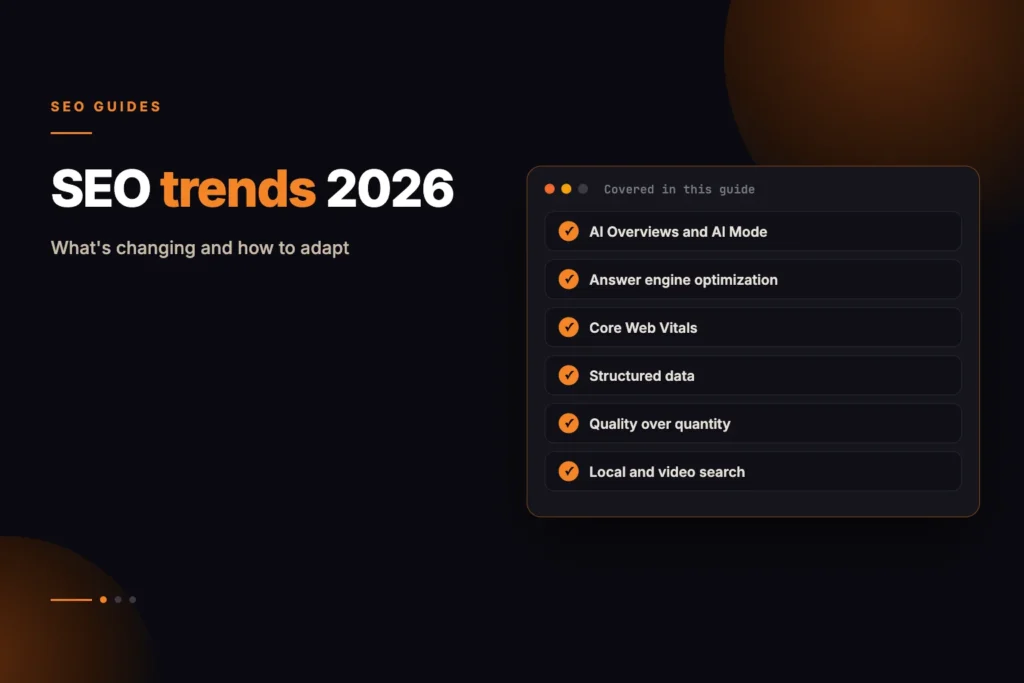
SEO changes constantly. Google changes Search many times a year, new technologies reshape how people search, and strategies that worked last year can stop working this year. Staying ahead of SEO trends is the difference between growing your traffic and watching it decline. This guide covers the top SEO trends for 2026 and what they mean for your business.
TL;DR: The top SEO trends for 2026 are AI-powered search (Google AI Overviews), Answer Engine Optimization (AEO), voice search growth, Core Web Vitals and page experience, structured data importance, and content quality over quantity. Businesses that adapt to these trends will maintain and grow their search visibility. Those that do not will lose ground. MoxSEO offers SEO services that keep your business ahead of algorithm changes.
What Has Actually Changed in Google Search in 2026?
Most trend lists mix confirmed changes with guesses. As of October 2026, these are the developments we can point to in Google’s own documentation, and what each one means in practice:
| Development | What Google’s documentation says | What to do |
|---|---|---|
| AI Overviews and AI Mode | A page must be indexed and eligible to show with a snippet. Google lists no additional requirements and says you do not need new machine-readable files, AI text files or markup. | Keep pages crawlable, indexable and genuinely useful; fix technical blockers first. |
| Query fan-out | These features may run several related searches across subtopics while building a response, so they can surface a wider set of supporting links. | Cover the sub-questions around a topic, not only the head term. |
| FAQ rich results | Google says the FAQ rich result stopped appearing in Search from May 7, 2026. | Keep helpful FAQ content on the page, but do not expect FAQ markup to create a rich result. |
| Core Web Vitals | Targets are LCP within 2.5 seconds, INP under 200 milliseconds and CLS under 0.1. Google says page experience aligns with what its core ranking systems seek to reward. | Measure with field data and fix the slowest templates first. |
| AI traffic reporting | Traffic from AI features is included in the Search Console Performance report under the Web search type. | Watch impressions, clicks and conversions for informational pages over time. |
Sources: Google Search Central pages on AI features and your website, FAQ structured data and Core Web Vitals. The rest of this guide goes through each trend in turn.
1. AI-Powered Search and Google AI Overviews
Google AI Overviews are now appearing at the top of search results for a large share of queries. These AI-generated summaries answer questions directly, reducing the need for users to click through to websites. This means traditional SEO is no longer just about ranking in the top 10. It is about being the source that AI engines cite in their answers. Google’s AI Overviews documentation explains how these results work.
To optimize for AI Overviews, create content that is factually clear, well-structured, and citation-worthy. Use schema markup, answer questions directly, and build your brand’s authority so AI systems recognize you as a trusted source.
One point of clarity: Google’s documentation says there is no special schema or file required to appear in AI Overviews or AI Mode. The page must be indexed and eligible to appear with a snippet, and standard SEO practices still apply. Schema markup remains useful for helping Google understand a page, but it is not an AI Overview switch. You can check whether AI crawlers can reach your pages with our AI crawler access checker, and see how answer-ready a page is with the AI answer extractability checker. Our AI SEO service covers this work for businesses that want help.
2. Answer Engine Optimization (AEO)
AEO is the evolution of SEO for the AI search era. Instead of optimizing for clicks from search results, AEO optimizes for being the answer that AI engines (Google AI Overviews, ChatGPT, Perplexity) reference. This means structuring content in clear question-and-answer formats, using concise summaries, and building entity authority.
In practice this is the same craft as good SEO writing: open each section with a direct answer, then explain. Name your business, authors and services consistently across your site and profiles so that systems can tie them to one entity. Our entity schema generator helps with the markup side.
3. Voice Search Continues to Grow
As smart speakers and voice assistants become more common, voice search is growing. Voice searches are conversational, question-based, and often local. Optimize for voice by targeting question keywords, winning featured snippets, and ensuring your Google Business Profile is fully optimized. See our voice search SEO guide for a complete strategy.
4. Core Web Vitals Remain Critical
Google’s Core Web Vitals (LCP, CLS, INP) are part of the page experience signals that Google strongly recommends getting right, and Google says page experience aligns with what its core ranking systems seek to reward. Sites that load slowly, shift layout, or feel unresponsive give visitors a worse experience and are less likely to perform well. Test your site with Google PageSpeed Insights and fix any issues. Google’s page experience guidance explains how these metrics are used.
The good thresholds are LCP within 2.5 seconds, INP below 200 milliseconds and CLS below 0.1. Google does not say how much weight these metrics carry, so treat them as a floor for quality rather than a shortcut to rankings. INP replaced the older FID metric in Core Web Vitals, so reports that still mention FID are out of date.

5. Structured Data and Schema Markup
Schema markup helps Google understand your content and can make pages eligible for some rich results. In 2026, schema still matters for clarity about entities and relationships, but it does not guarantee a rich result, and not every type still produces one. Ensure your site has Organization, LocalBusiness, Service, Article, and Product schema where applicable. Google’s introduction to structured data covers the types you should implement.
FAQPage is the notable exception: Google’s documentation says FAQ rich results no longer appear in Search from May 7, 2026, so FAQ markup will not add a rich result in Google. FAQ content is still worth writing because readers and AI assistants use direct questions and answers. Validate your markup with our schema markup validator and read Google’s structured data introduction for supported types.
6. Content Quality Over Quantity
Google’s helpful content updates have made it clear that thin, generic content will not rank. In 2026, the focus is on creating fewer, higher-quality pieces of content that genuinely help users. Each page should have a clear purpose, target a specific keyword, and provide more value than the competing pages ranking for the same term. Google’s guidance on creating helpful, reliable, people-first content is the standard to follow.
That guidance lists warning signs worth checking against your own site: producing lots of content on unrelated topics in the hope some will rank, using automation to generate content on many topics, mostly summarising other sources without adding value, and changing dates to look fresh when nothing substantial changed. It also notes that E-E-A-T is not a direct ranking factor, but Google’s systems use signals that identify content showing experience, expertise, authoritativeness and trust, with trust the most important. Clear authorship helps.
7. Local SEO and Google Business Profile
Local SEO continues to be one of the highest-ROI strategies for businesses serving specific geographic areas. Google Business Profile optimization, local citations, and review generation remain the top local ranking factors. See our guide to local SEO consulting for a complete strategy.
Google describes local ranking as based mainly on relevance, distance and prominence, so a complete profile, consistent business details and genuine reviews remain the practical levers. Our local SEO service and the NAP consistency checker are good starting points.
8. Video SEO and YouTube
Video content is growing in search importance. Google increasingly shows video carousels in search results, and YouTube is widely used as a search engine. Optimizing your videos for both YouTube and Google search can widen your visibility. See our YouTube SEO services guide for optimization tips.
What Should You Do First? A Practical Order
- Confirm your important pages are indexable. Check robots rules, noindex directives and canonical tags. Pages that cannot be indexed cannot appear in AI features either.
- Fix field-data Core Web Vitals problems on your highest-traffic templates.
- Rewrite thin pages so each one answers a specific question completely, with a direct answer at the top.
- Add accurate structured data for your organisation, services, articles and products, and validate it.
- Track results in Search Console and analytics by page type, and review monthly rather than reacting to every update.
What Are the Common Mistakes When Reacting to SEO Trends?
- Chasing tactics instead of fundamentals. A page that is not indexed or not useful will not be helped by new markup or files.
- Believing unsourced claims. Check whether a claim about ranking factors is backed by Google’s documentation or by a clearly described test.
- Mass-producing AI content. Google lists scaled, low-effort content as a warning sign of search-engine-first content.
- Ignoring measurement. Without a baseline in Search Console you cannot tell if a change helped.
For how we test these questions ourselves, see our research and methodology pages.
Ready to Adapt Your SEO Strategy for 2026?
Search is evolving through AI Overviews, AEO, voice search, structured data, and stronger quality standards. Updating your strategy now can help protect your rankings and uncover new growth opportunities.
Want to stay ahead of search changes? Get a free SEO consultation from MoxSEO.
Frequently Asked Questions
What are the top SEO trends for 2026?
The top SEO trends for 2026 are AI-powered search (Google AI Overviews), Answer Engine Optimization (AEO), voice search growth, Core Web Vitals and page experience, structured data importance, content quality over quantity, local SEO, and video SEO. Businesses that adapt to these trends will maintain and grow their search visibility.
How is AI changing SEO in 2026?
AI is changing SEO by generating answers directly in search results through Google AI Overviews, ChatGPT, and Perplexity. This reduces click-through rates for some queries but creates new opportunities for brands to be cited as the source. To adapt, create content that is factually clear, well-structured, and citation-worthy, and use schema markup to help AI systems understand your content.
Is SEO still relevant in 2026?
Yes, SEO is still highly relevant. While AI is changing how search results appear, organic search remains one of the largest sources of website traffic. The strategies have evolved (more focus on AEO, structured data, and content quality), but the fundamental goal is the same: make your website the best result for what your customers are searching for.
What is Answer Engine Optimization (AEO)?
Answer Engine Optimization (AEO) is the practice of optimizing your content to be referenced by AI-powered search engines like Google AI Overviews, ChatGPT, and Perplexity. AEO involves structuring content in clear question-and-answer formats, using schema markup, building entity authority, and creating content that is factually clear and citation-worthy.
How do I prepare my website for SEO in 2026?
To prepare for SEO in 2026, focus on: creating high-quality content that answers user questions, implementing schema markup, optimizing for AI search (AEO), improving Core Web Vitals, optimizing for voice search, maintaining your Google Business Profile, and creating video content. Audit your site regularly and adapt your strategy as search evolves.
Do I need special markup or an llms.txt file to appear in Google AI Overviews?
No. Google’s documentation says there are no additional requirements to appear in AI Overviews or AI Mode beyond being indexed and eligible to show with a snippet, and that you do not need new machine-readable files, AI text files or markup. Other AI assistants may behave differently, so test the ones that matter to your audience.
Does FAQ schema still give rich results in 2026?
Not in Google. Google’s documentation says the FAQ rich result stopped appearing in Search from May 7, 2026. FAQ content is still useful to readers, so keep clear questions and answers on the page.
Are Core Web Vitals still worth fixing?
Yes. Google strongly recommends good Core Web Vitals and says page experience aligns with what its core ranking systems seek to reward, though it does not state their weight. The good thresholds are LCP within 2.5 seconds, INP under 200 milliseconds and CLS under 0.1.
Where can I see traffic from AI features in Google?
Google says traffic from AI features is included in the Search Console Performance report under the Web search type. It is not reported as a separate AI category, so track conversions and engagement for your informational pages alongside it.