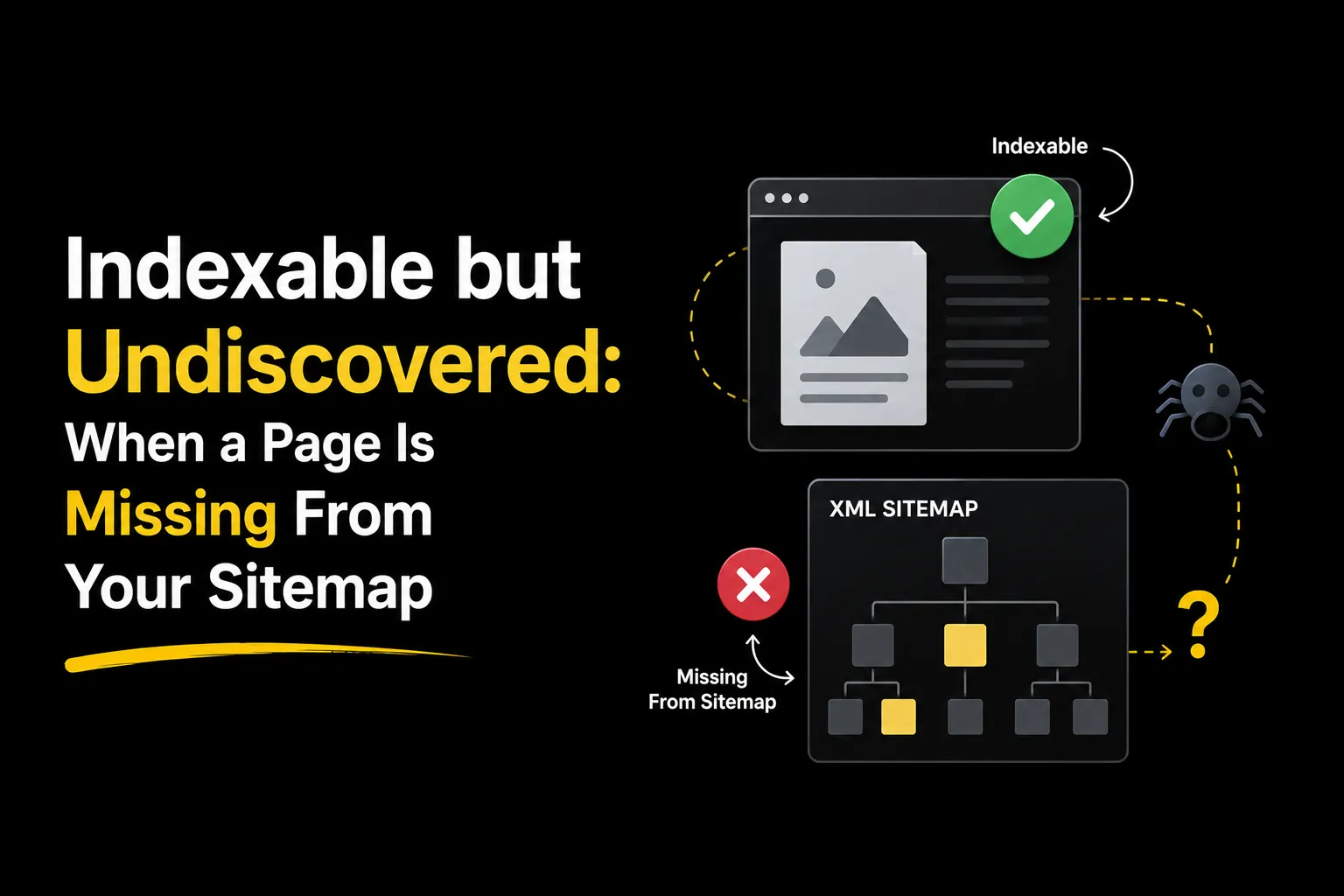
A page missing from sitemap files can be technically sound and fully indexable yet remain absent from search results because Google has not discovered it. Discovery and indexing are separate stages: if search engines cannot find the URL through a sitemap or internal link, they cannot crawl, evaluate, or index the page.
How pages are actually found
Google discovers URLs in three main ways: links from pages it already crawls, entries in your XML sitemap, and external links from other sites. Nothing else reliably introduces a URL.
For a well-linked page on an established site, the sitemap adds little. For a new page, a deep page, or one with few internal links, it may be the only route in.
This is why sitemap membership matters most precisely where it is most often overlooked — on the pages least likely to be found any other way.
Our own sitemap dropped from 99 URLs to 88 after consolidation. The eleven removed were redirected, so their URLs still resolve, but leaving them listed would have been telling Google to crawl pages we had deliberately merged away.
The gap worth checking
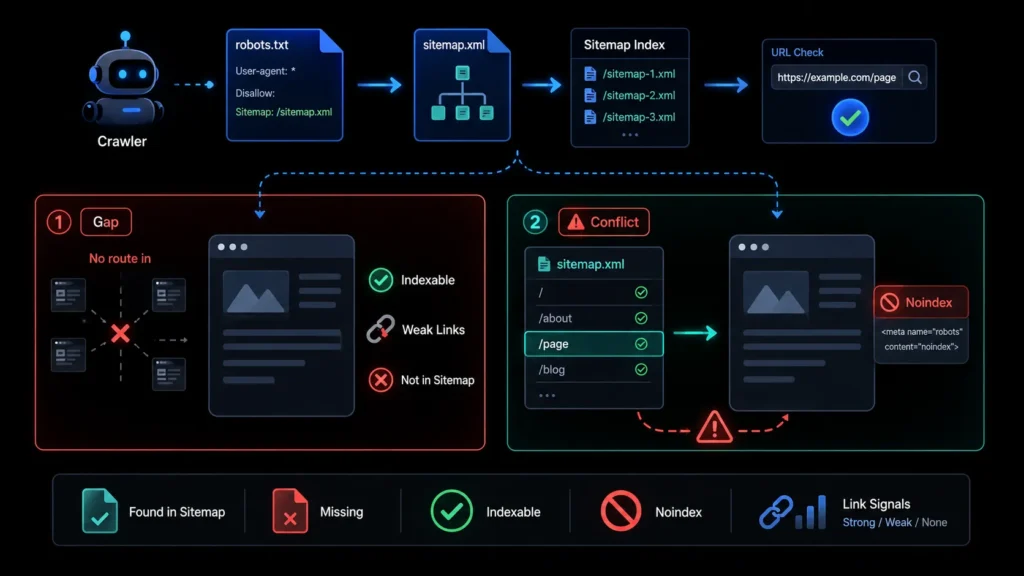
The problematic combination is a page that is indexable, linked from nowhere useful, and missing from the sitemap. It has no route in at all.
Our on-page audit tool checks this directly. It locates your sitemap through robots.txt or the conventional paths, follows sitemap-index children, and reports whether the specific URL you entered is listed.
The reverse case is also worth knowing: a URL in your sitemap that carries a noindex is a contradiction. You are asking for it to be crawled and telling it not to be indexed.
What belongs in a sitemap
Only URLs you want indexed. That sounds obvious and is routinely ignored.
- Include canonical, indexable, 200-status pages
- Exclude noindexed pages, redirects, paginated duplicates and parameter variants
- Exclude anything canonicalising elsewhere — you are asking for the wrong URL
- Keep
lastmodaccurate, or omit it rather than lie
A sitemap full of URLs that should not be indexed teaches Google to trust it less.
What a sitemap will not do
Being listed does not guarantee indexing. It is an invitation, not an instruction, and Google routinely declines.
It also does not compensate for a page nothing links to. A page reachable only from the sitemap is telling Google that your own site does not consider it important.
Use the sitemap for discovery and internal links for importance. They answer different questions and neither substitutes for the other.
Discovery, crawling and indexing are three separate things
They are routinely discussed as one process, which is why diagnosis so often goes wrong. A page can fail at any of the three, and the symptom looks identical from outside.
- Discovery — Google learns the URL exists, from a link or a sitemap
- Crawling — Google requests the URL and receives a response
- Indexing — Google decides the content is worth storing and serving
Search Console distinguishes these clearly. “Discovered, currently not indexed” means discovery worked and crawling has not happened. “Crawled, currently not indexed” means Google fetched it and declined. Those two states need completely different responses.
What each state actually tells you
The second is the one people misread most often, because it feels like a technical fault and usually is not.
- Discovered, not indexed — usually crawl budget or low perceived importance. More internal links help.
- Crawled, not indexed — Google looked and was unconvinced. This is a content quality signal, not a technical one.
- Duplicate, Google chose a different canonical — you have a consolidation problem, not a discovery one.
- Excluded by noindex — deliberate or accidental; check which.
Adding sitemap entries fixes the first. It does nothing for the second, and treating a quality problem as a technical one is where a lot of effort gets wasted.
Making a new page discoverable properly
When you publish something you want indexed quickly, do these four things rather than only submitting it.
- Link to it from a related page that already gets crawled regularly
- Confirm it appears in the sitemap and that the sitemap has updated
- Request indexing in Search Console for genuinely important pages
- Check it is not orphaned — a page reachable only from the sitemap is telling Google your own site does not rate it
The first matters most and is skipped most often. An internal link from a well-crawled page does more for discovery than any submission, because it also carries a signal about importance that a sitemap entry does not.
Help Google Discover and Index Your Important Pages
A page missing from your sitemap may remain undiscovered, especially when it also lacks useful internal links. MoxSEO can review your sitemap, internal-link structure, indexability signals, canonicals, redirects, and Search Console coverage to identify important URLs that search engines may be overlooking.
You can request a free technical SEO audit to uncover missing sitemap entries, orphan pages, and conflicting indexing signals. For a structured plan to improve crawling and indexation across your website, schedule an SEO consultation based on your current site structure.
Sources and further reading
Frequently asked questions
How often should the sitemap update?
Automatically, whenever content changes. Most SEO plugins handle this. A stale sitemap is worse than a small one.
Should I submit the sitemap in Search Console?
Yes, once. It confirms the location and gives you a report on what was read and what was skipped.
Is there a size limit?
50,000 URLs or 50MB uncompressed per file. Beyond that use a sitemap index, which most plugins generate automatically.
Do images and videos need their own sitemaps?
Only for large media libraries where discovery is a genuine problem. For most sites the standard sitemap is enough.

Sakshi Kumari is an SEO Specialist at MoxSEO with expertise in keyword research, on-page SEO, content optimization, technical SEO, and link-building strategies. She focuses on improving organic visibility, strengthening website performance, and creating search-focused content that attracts relevant traffic. Through data-driven analysis and practical SEO execution, Sakshi helps businesses build stronger search presence and achieve sustainable digital growth.