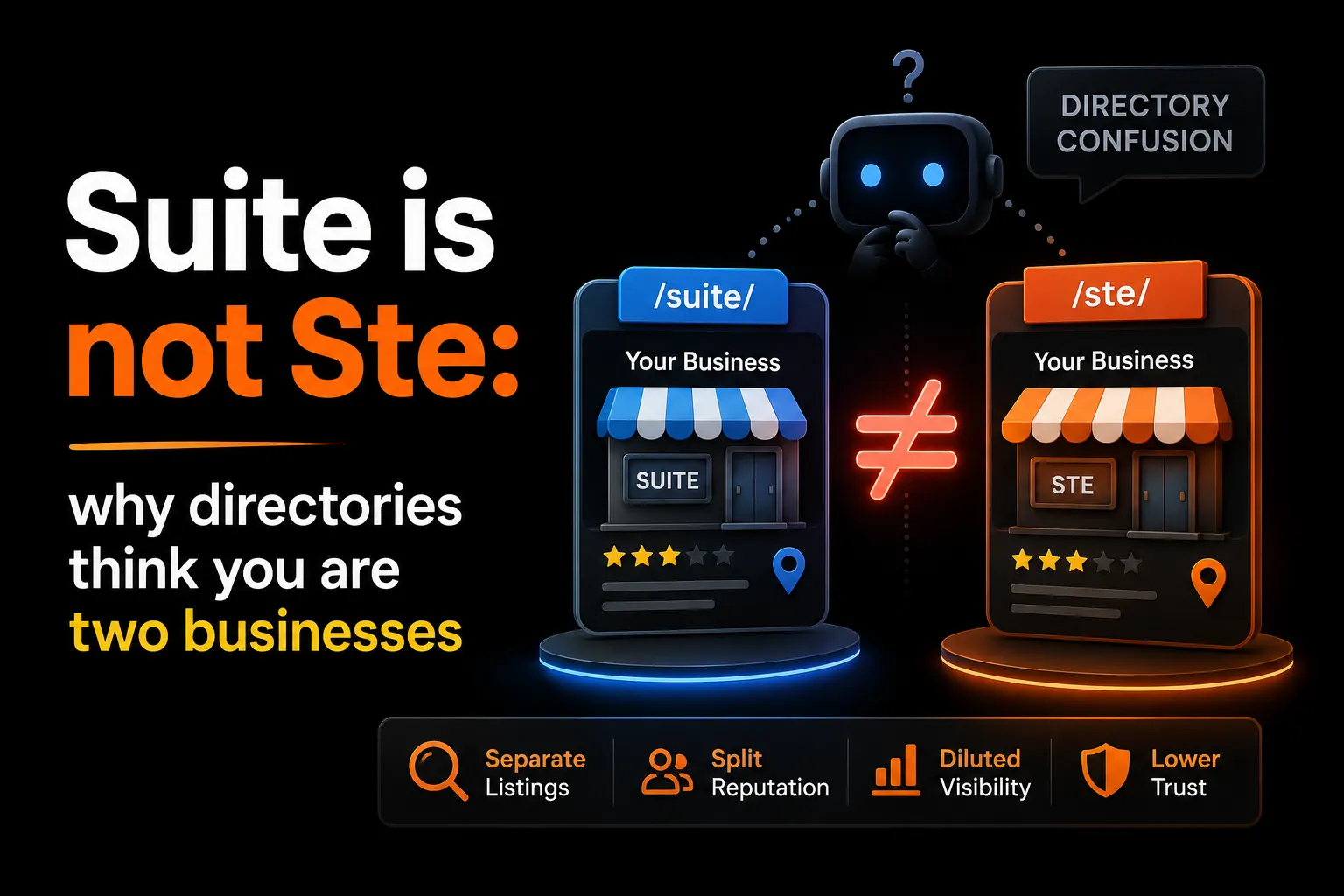
A human reading “Suite 4” and “Ste 4” sees one address. A matching algorithm assembling your business identity from dozens of sources sees two records that disagree. When records disagree the entity fragments, and a fragmented entity performs worse than a single consistent one.
Machines match on strings, not on meaning
Local search relies on reconciling your details across many sources: your own site, your Business Profile, directories, review platforms and data aggregators. Each holds a record, and something has to decide which records describe the same business.
That decision is made on string similarity rather than comprehension. Abbreviations, punctuation in phone numbers, a missing unit number and inconsistent formatting all reduce confidence that two records are the same entity.
It usually starts on your own website
The consistent finding when we test this is how often the inconsistency begins at home, where the structured data says one thing and the visible page says another.
- Schema says Suite 3, the page says Ste 3
- Schema carries a call-tracking number while the page shows the real line
- Schema omits the postcode that appears in the footer
- Two different numbers on the same page with no indication which is primary
If your own two sources disagree, every downstream record inherits that ambiguity.
Testing our own checker against a fixture where the markup said Suite 3 and the page said Ste 3, the first version reported a 100% match, because it normalised the abbreviation before comparing. Technically defensible, practically useless — it was hiding exactly the difference a directory would treat as significant. It now reports both figures separately.
What to standardise, and how
Pick one canonical form of your name, address and phone. Write it down. Use it everywhere without variation.
- Name — exactly as registered, with no added keywords
- Address — one spelling of every element, including whether you abbreviate
- Phone — one primary number, consistently formatted
Then check that your markup agrees with your page. Our NAP consistency checker compares the two directly, matching phone numbers on digits alone and reporting both how well the address matches after normalising abbreviations and how much of it is written identically.
What markup alone will not fix
Consistency stops you losing ground. It does not by itself win the map pack. Proximity, review velocity, profile completeness and category selection all do more.
What consistency does is remove a handicap. It is cheap, entirely within your control, and there is no sensible argument for leaving it broken.
Add sameAs links to your Business Profile and main directory entries while you are in there. It is the clearest way to state which records are yours, and most local sites omit it entirely.
Where to check, in the order that matters
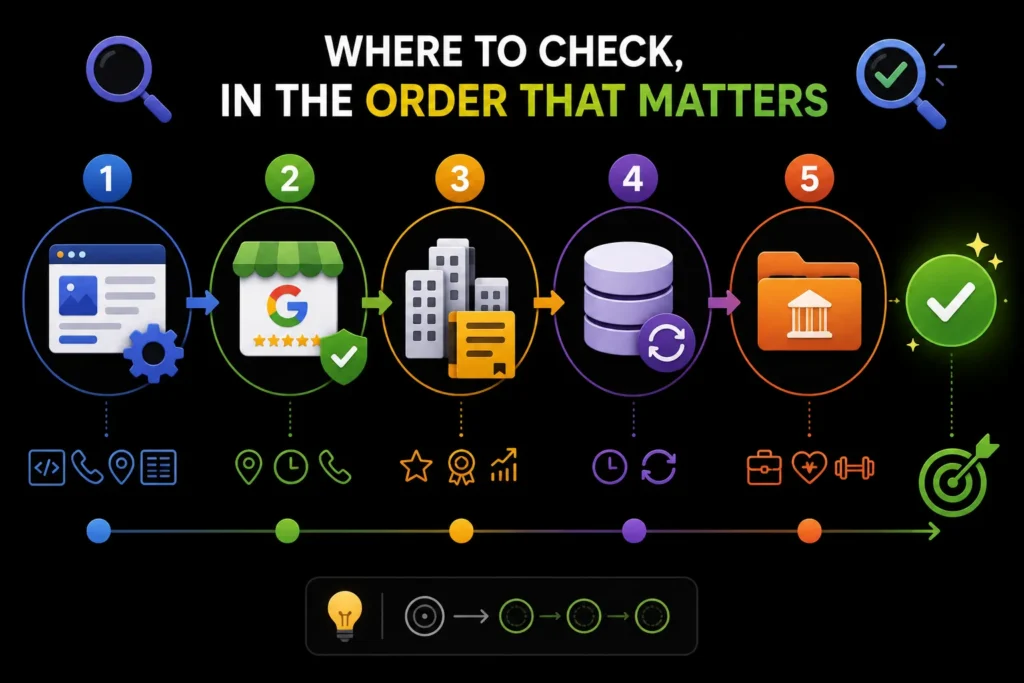
Start with the sources you control completely, then work outward. Fixing directories before fixing your own site means doing the work twice.
- Your own site — structured data, contact page, footer, and any location pages
- Your Business Profile — the single most consequential external record
- Major directories — the handful that actually carry weight in your market
- Data aggregators — slower to update and often the source of stale records
- Industry directories — sector-specific listings, which vary enormously in value
The order matters because downstream records are frequently rebuilt from upstream ones. Correct the source and some corrections propagate on their own.
The formatting decisions worth making once
Most inconsistency comes from decisions never explicitly made. Make them, write them down, and apply them everywhere.
- Do you abbreviate Street, Suite, Road? Pick one and never mix.
- Do you include the unit or floor number? If yes, always. If no, never.
- Is the phone written with spaces, hyphens or brackets? One format only.
- Do you use the country code? On an international-facing site, yes, consistently.
- Is your business name exactly as registered, with no appended keywords?
That last one deserves emphasis. Adding a service or city to your business name in listings is a well-known violation of platform guidelines and a common cause of suspension, quite apart from the inconsistency it creates.
When your details genuinely change
A move or a number change is where most fragmentation begins, because the update happens in some places and not others.
Update in this order, and finish it in one sitting rather than over weeks: your own site and schema first, then your Business Profile, then the major directories, then everything else.
Keep the old number redirecting to the new one for as long as you reasonably can. A dead number on a stale listing is worse than an old one that still reaches you.
Then re-run the check. Our NAP consistency checker compares your markup against your visible page, which is the pair most likely to drift apart after a change, because the two are usually edited by different people at different times.
Sources and further reading
Frequently asked questions
Does an old address on a directory still hurt me?
It can, particularly if the listing is live and indexed. Claim and correct it rather than only updating your own site.
Should I use a call tracking number?
On the page, if you want. In your structured data use the real primary line, and keep tracking numbers out of your citations.
What if I have several locations?
Each location needs its own page and its own LocalBusiness node with its own address. One node listing several addresses is ambiguous.
Is NAP consistency still a ranking factor?
It is better understood as an entity-resolution requirement than a ranking factor. Inconsistency creates doubt, and doubt costs visibility.

Sakshi Kumari is an SEO Specialist at MoxSEO with expertise in keyword research, on-page SEO, content optimization, technical SEO, and link-building strategies. She focuses on improving organic visibility, strengthening website performance, and creating search-focused content that attracts relevant traffic. Through data-driven analysis and practical SEO execution, Sakshi helps businesses build stronger search presence and achieve sustainable digital growth.