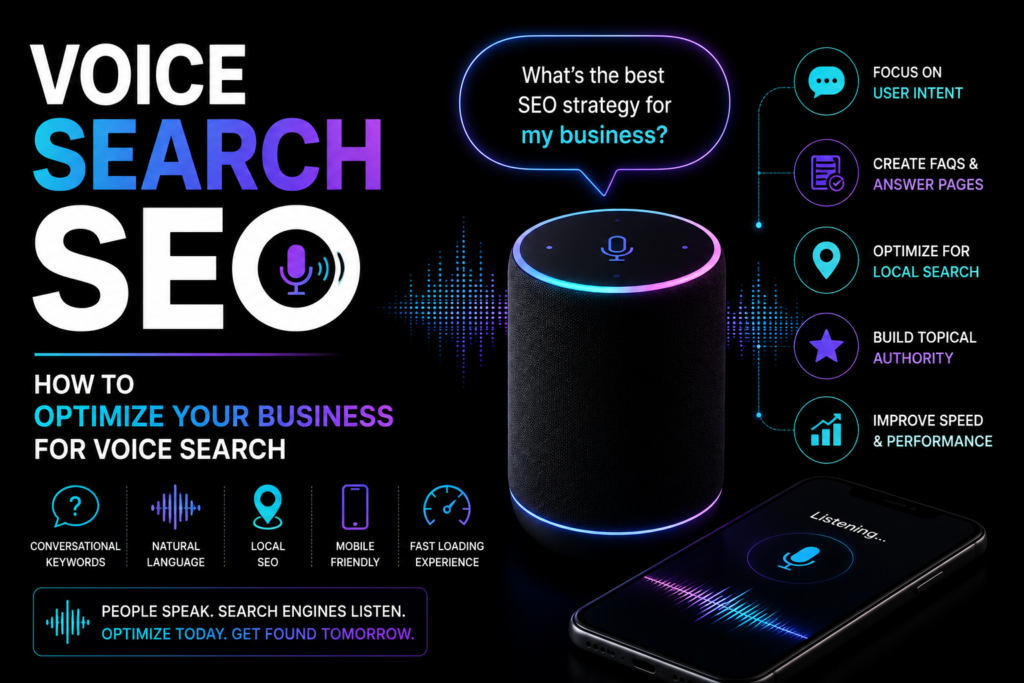
Voice search is changing how people find businesses online. Instead of typing keywords into a search bar, more and more people are asking their phones, smart speakers, and virtual assistants questions out loud. “Hey Google, find a digital marketing agency near me.” “Alexa, what’s the best restaurant in Mumbai?” If your business is not optimized for voice search, you are invisible to this growing audience.
Voice search SEO is the process of optimizing your online presence so your business appears in voice search results. This guide explains how voice search SEO works, what to optimize, and how to prepare your business for the voice search revolution. For a broader local SEO framework, see our Local SEO Strategy 2026 guide, or for hands-on help, see our guide to local SEO consulting.
TL;DR: Voice search SEO involves optimizing for conversational, question-based queries, targeting featured snippets, improving local SEO, and ensuring your website loads fast and is mobile-friendly. Voice searches are longer, more natural, and more local than text searches. Focus on answering common questions clearly, optimizing your Google Business Profile, and targeting long-tail conversational keywords. MoxSEO offers SEO services that include voice search optimization.
What Is Voice Search SEO?
Voice search SEO is the practice of optimizing your website and online presence to appear in results when people search using voice commands through Siri, Google Assistant, Alexa, or other virtual assistants. Voice searches differ from text searches in several important ways:
- They are conversational: People speak in full sentences, not keyword fragments. “Where is the nearest coffee shop” instead of “coffee shop near me.”
- They are longer: Voice queries average 4 to 6 words, compared to 2 to 3 words for text searches.
- They are question-based: Voice searches often start with who, what, where, when, why, and how.
- They are local: A large percentage of voice searches have local intent, like “near me” or “in [city].”
- They expect a single answer: Voice assistants typically read one result, not a list of 10. Ranking #1 is even more critical for voice than for text search.
How to Optimize for Voice Search
1. Target Question-Based Keywords
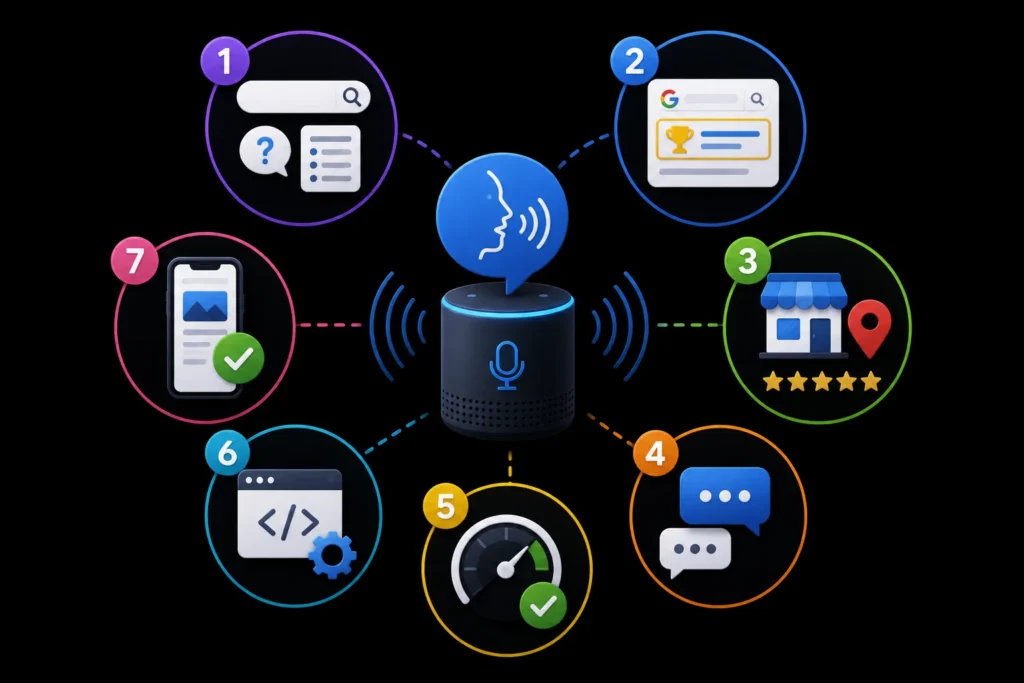
Voice searches are questions. Optimize your content to answer common questions in your industry. Use tools like Answer the Public or Google’s “People Also Ask” feature to find the questions your customers are asking. Create FAQ pages and blog posts that answer these questions clearly and concisely.
2. Aim for Featured Snippets
Google often reads featured snippets (position zero) as the answer to voice searches. To win featured snippets, structure your content with clear question headings followed by concise, direct answers (40 to 50 words). Use lists, tables, and step-by-step formats where appropriate. Google’s featured snippets documentation explains how to optimize for these results.
3. Optimize for Local Search
A large share of voice searches are local. Ensure your Google Business Profile is fully optimized with accurate NAP (name, address, phone), business hours, categories, and photos. Build local citations and generate reviews. Follow Google’s official Google Business Profile guidelines to ensure compliance. For Google Maps ranking, see our guide to Google Maps SEO.
4. Use Conversational Language
Voice searches use natural, conversational language. Your content should match. Write the way people speak, not the way they type. Instead of optimizing for “plumber Mumbai,” optimize for “how do I find a reliable plumber in Mumbai.”
5. Improve Page Speed
Voice assistants prioritize fast-loading pages. Google’s voice search, in particular, tends to pull answers from pages that load quickly. Use a caching plugin, compress images, minimize JavaScript, and use a CDN to improve load times. Google’s page experience guidance explains why speed matters for both SEO and voice search.
6. Use Schema Markup
Schema markup helps search engines understand your content’s context, which is especially important for voice search. Add FAQ schema, LocalBusiness schema, and Article schema to help Google identify your content as a potential voice search answer.
7. Optimize for Mobile
Most voice searches happen on mobile devices. Your website must be mobile-friendly, with responsive design, large tap targets, and fast load times. Google uses mobile-first indexing, so your mobile site is the version Google evaluates for rankings.
What Is the Most Important Voice Search SEO Factor?
There is no single factor, but answering conversational search intent is the foundation. If your content does not provide clear, direct answers to spoken questions, page speed, schema, and mobile optimization will have limited impact. Start with question-based content, then strengthen local SEO and technical performance.
Looking for voice search SEO that improves your visibility? Get a free consultation from MoxSEO and prepare your business for conversational search.
Frequently Asked Questions
What is voice search SEO?
Voice search SEO is the process of optimizing your website and online presence to appear in results when people search using voice commands through Siri, Google Assistant, Alexa, or other virtual assistants. Voice searches are conversational, question-based, longer than text searches, and often have local intent. Optimizing for voice search involves targeting question keywords, winning featured snippets, improving local SEO, and using schema markup.
How is voice search different from text search?
Voice searches are conversational and use natural language, while text searches use keyword fragments. Voice searches are longer (4 to 6 words vs. 2 to 3 words), more likely to be question-based (who, what, where, how), and more likely to have local intent. Voice assistants typically read a single answer, so ranking #1 is even more critical for voice search than for text search.
How do I optimize for voice search?
To optimize for voice search, target question-based keywords, aim for featured snippets by answering questions concisely (40 to 50 words), optimize your Google Business Profile for local search, use conversational language in your content, improve page speed, add schema markup (FAQ, LocalBusiness), and ensure your website is mobile-friendly.
Does voice search matter for small businesses?
Yes. A large percentage of voice searches have local intent, like u0022near meu0022 or u0022in [city].u0022 Small businesses that optimize for local voice search can capture customers who are searching for nearby services using voice commands. Optimizing your Google Business Profile and building local citations are the most important steps for local voice search visibility.
How long does it take to rank for voice search?
Voice search SEO follows the same timeline as general SEO. You may see improvements in 3 to 6 months. Local voice search (Google Business Profile optimization) can show results faster, sometimes within weeks. Featured snippet optimization for question-based queries can take 2 to 4 months depending on competition.

Ashish Khan is an SEO Specialist at MoxSEO with expertise in keyword research, on-page optimization, technical SEO, content strategy, and link building. He focuses on improving website visibility, strengthening search performance, and helping businesses attract relevant organic traffic. By combining competitor analysis, SEO audits, and data-driven optimization, Ashish supports sustainable ranking growth and stronger digital presence.