Ecommerce conversion rate optimization is the process of improving your online store so that more visitors complete a purchase. Most ecommerce stores convert at just 2 to 3 percent, meaning 97 to 98 percent of visitors leave without buying. Fixing even a fraction of those lost conversions can dramatically increase revenue without spending more on ads or SEO. This guide covers the specific CRO strategies that work for ecommerce stores. For general CRO services, see our guide to conversion rate optimization services.
TL;DR: Ecommerce conversion rate optimization focuses on improving product pages, checkout flow, site speed, mobile experience, and trust signals. The biggest wins usually come from simplifying checkout, improving product images and descriptions, and reducing page load times. Start with a data driven audit, then test changes systematically.
What Is Ecommerce Conversion Rate Optimization?
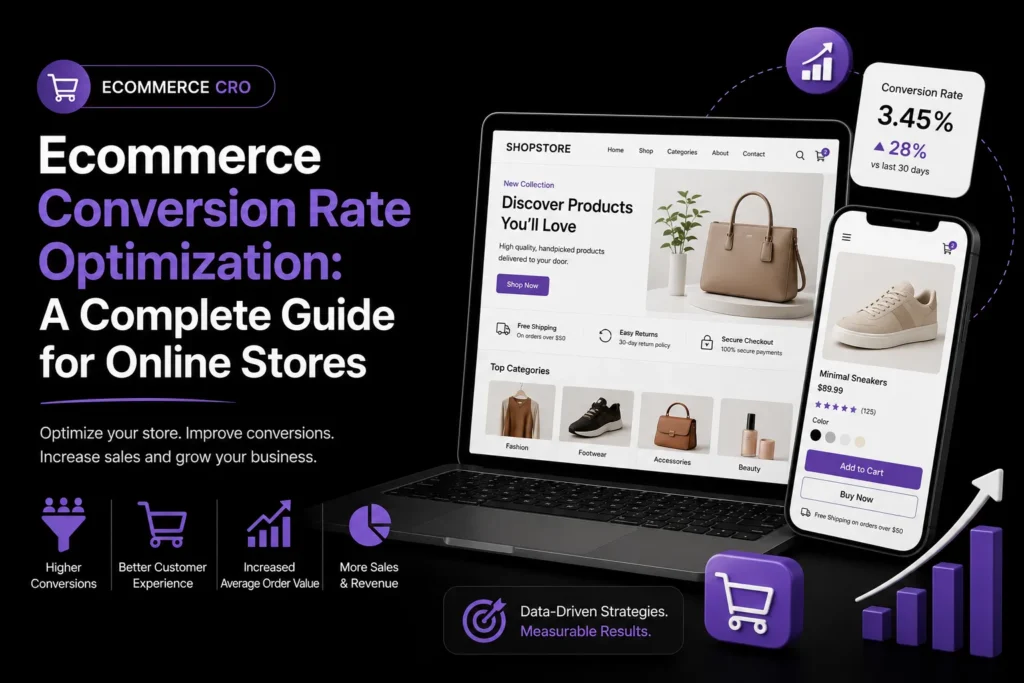
Ecommerce conversion rate optimization (CRO) is the systematic process of improving your online store to increase the percentage of visitors who make a purchase. Unlike general CRO, ecommerce CRO focuses on the unique elements of online shopping: product pages, category navigation, cart, checkout, and post purchase experience.
Your ecommerce conversion rate is calculated as: (Number of Orders / Total Visitors) x 100. If you get 10,000 visitors and 200 orders, your conversion rate is 2 percent.
Key Areas to Optimize for Ecommerce CRO
1. Product Pages
Product pages are where the buying decision happens. Optimize them with:
- High quality images: Multiple angles, zoom functionality, and lifestyle photos showing the product in use.
- Detailed descriptions: Clear, benefit focused descriptions with specifications, materials, and sizing information.
- Social proof: Star ratings, customer reviews, and user generated photos. Products with reviews convert up to 270 percent better than those without.
- Clear pricing: Show the price clearly, including any discounts. Avoid hiding shipping costs until checkout.
- Strong CTA: Use a prominent, contrasting “Add to Cart” or “Buy Now” button.
- Urgency and scarcity: “Only 3 left in stock” or “Sale ends in 2 hours” can increase conversion, but use them honestly.
2. Checkout Flow
Checkout is where most ecommerce conversions are lost. The average cart abandonment rate is 70 percent. To reduce it:
- Offer guest checkout: Forcing account creation can reduce conversion by 20 to 30 percent. Let people buy first, then create an account.
- Simplify forms: Remove unnecessary fields. Use autofill for address and payment information.
- Show trust signals: Display security badges, payment options, and return policy during checkout.
- Offer multiple payment options: Include UPI, credit cards, debit cards, net banking, wallets, and COD for Indian customers.
- Be transparent about costs: Show shipping costs and taxes upfront, not at the final step. Surprise costs are the number one reason for cart abandonment.
3. Site Speed
A 1 second delay in page load time can reduce conversions by 7 percent. For ecommerce:
- Compress and lazy load images
- Use a content delivery network (CDN)
- Minimize JavaScript and CSS
- Choose fast hosting
- Use accelerated mobile pages (AMP) where appropriate
Google’s page experience guidance explains why speed matters for both SEO and conversions.
4. Mobile Optimization
Over 60 percent of ecommerce traffic comes from mobile devices. If your mobile experience is poor, you are losing the majority of your potential customers. Ensure:
- Your store is fully responsive, not just mobile friendly
- Buttons and links are large enough to tap easily
- Forms are easy to fill out on mobile with minimal typing
- Mobile checkout is as fast and simple as desktop checkout
5. Search and Navigation
If visitors cannot find what they are looking for, they leave. Improve search and navigation with:
- An on site search bar with autocomplete
- Clear category structure with breadcrumbs
- Filters for price, size, color, brand, and other attributes
- Synonym matching in search (so “sneakers” returns “sports shoes”)
Ecommerce CRO Tools
- Google Analytics: Track conversion funnels, identify drop off points, and segment by device and traffic source.
- Hotjar or Crazy Egg: Heatmaps and session recordings to see how visitors interact with your store.
- VWO or Optimizely: A/B testing platform for testing product page variations, checkout flows, and CTAs.
- Google PageSpeed Insights: Check your store’s load time and get specific optimization recommendations.
How Much Does Ecommerce CRO Cost?
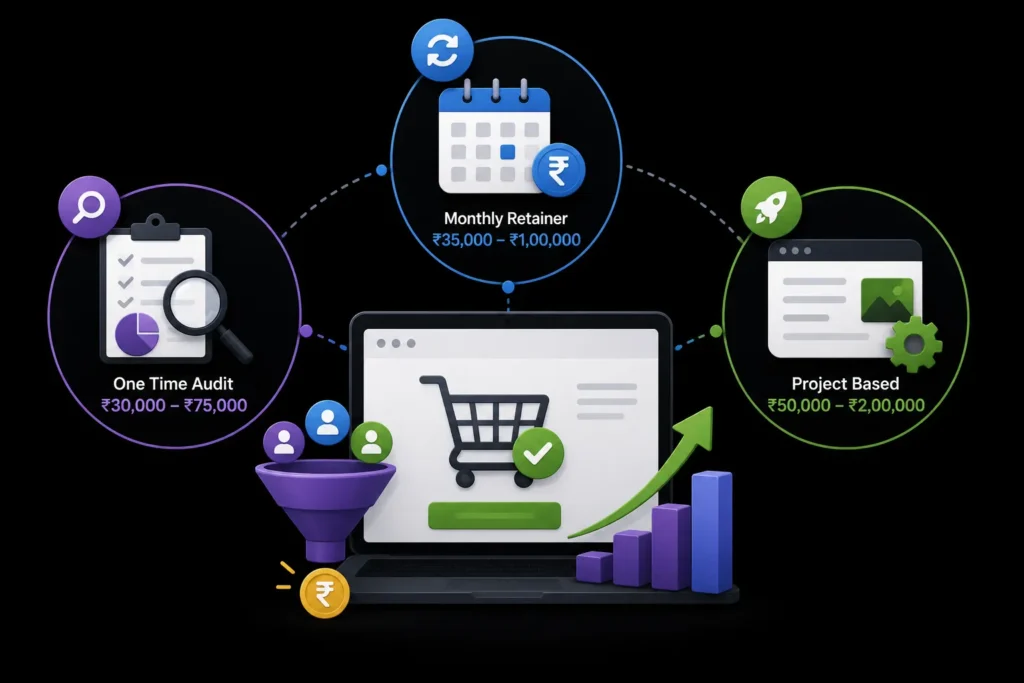
- One time audit: Rs 30,000 to Rs 75,000 for a comprehensive ecommerce CRO audit with prioritized recommendations.
- Monthly retainer: Rs 35,000 to Rs 1,00,000 per month for ongoing testing and optimization.
- Project based: Rs 50,000 to Rs 2,00,000 for a specific project like checkout redesign or product page optimization.
For Shopify stores specifically, see our guide to Shopify conversion rate optimization. For ecommerce SEO, see our ecommerce SEO services.
What Is the Most Important Ecommerce CRO Factor?
There is no single factor, but a simple checkout experience is the foundation. Strong product pages may attract interest, but unnecessary form fields, hidden costs, and limited payment options can stop customers from completing their orders. Start with checkout improvements, then optimize product pages, speed, mobile usability, and trust signals.
Looking for ecommerce CRO services that turn more visitors into buyers? Get a free consultation from MoxSEO and start increasing your online store’s revenue.
Frequently Asked Questions
What is a good ecommerce conversion rate?
The average ecommerce conversion rate is 2 to 3 percent. Top performing stores convert at 4 to 6 percent or higher. Your target depends on your industry, price point, and traffic quality. Focus on continuous improvement rather than hitting a specific number.
How long does ecommerce CRO take?
Quick wins from obvious issues can be fixed within the first 2 to 4 weeks. A/B tests typically need 2 to 4 weeks to reach statistical significance. Meaningful conversion rate improvements usually take 2 to 3 months of consistent testing and optimization.
What is the biggest conversion killer in ecommerce?
Surprise costs at checkout are the number one reason for cart abandonment. Other major conversion killers include forced account creation, slow page load times, complicated checkout forms, and lack of trust signals like reviews and security badges.
Should I do CRO or SEO first?
Both are important and should be done in parallel. SEO brings traffic to your store, CRO converts that traffic into sales. If you have traffic but low sales, prioritize CRO. If you have a good conversion rate but low traffic, prioritize SEO. For most stores, starting with CRO quick wins while building SEO long term is the best approach.
Related guides in CRO
- Shopify Conversion Rate Optimization: How to Increase Your Store’s Sales
- Conversion Rate Optimization Guide: How to Turn Visitors Into Customers
- Conversion Rate Optimization Services: What They Include and How They Work
Need this handled for you? Explore our Services service.